2026 Global Leadership Summit

Live coverage

AI forces us to reassert human centrality, says President Aoun To kick off his headline speech in the British capital, Northeastern President Joseph E. Aoun asks attendees for a show of hands. Compared to the Industrial Revolution, which began on these shores about 250 years ago, he asks attendees whether they believe that the impact of the AI Revolution will equal the Industrial Revolution? Or will today’s shift be greater still?  The votes are split, with some raising their hand twice – “cheating!” says Aoun. Today, it’s a great time to explore the profound difference between these two paradigmatic shifts. The Industrial Revolution put powerful new tools in the hands of humans but it remains an open discussion whether AI will simply augment our abilities. AI is the first entity of our creation that can act autonomously, make its own decisions, and define its own journey. As Silicon Valley researchers strive for superintelligent AI, which is “superior to us as human beings in all endeavours,” we must confront the power of AI not simply to augment human capabilities but to displace humans, he says. Photo by Carmen Valino for Northeastern University “We, as a society, are going to face a constant balancing act between AI agency and human agency,” he tells the full-house at BAFTA. “From this perspective, the role of humans is going to be called into question, and I believe that human centrality has to be reasserted and redefined in this changing environment.” Universities must likewise reassert and redefine their mission. “Our mission is very clear. Our mission is not to preserve knowledge and disseminate it. Our mission is to put the human beings at the centre again, which means that our education has to focus on each student and on the community of students,” he says. “We are also responsible for creating new discoveries that are going to augment human beings and not relegate them to the side.” — Matthew Ponsford

Live Coverage


  • Pinned

    AI forces us to reassert human centrality, says President Aoun

    To kick off his headline speech in the British capital, Northeastern President Joseph E. Aoun asks attendees for a show of hands. Compared to the Industrial Revolution, which began on these shores about 250 years ago, he asks attendees whether they believe that the impact of the AI Revolution will equal the Industrial Revolution? Or will today’s shift be greater still? 

    The votes are split, with some raising their hand twice – “cheating!” says Aoun. Today, it’s a great time to explore the profound difference between these two paradigmatic shifts. The Industrial Revolution put powerful new tools in the hands of humans but it remains an open discussion whether AI will simply augment our abilities. AI is the first entity of our creation that can act autonomously, make its own decisions, and define its own journey. As Silicon Valley researchers strive for superintelligent AI, which is “superior to us as human beings in all endeavours,” we must confront the power of AI not simply to augment human capabilities but to displace humans, he says.

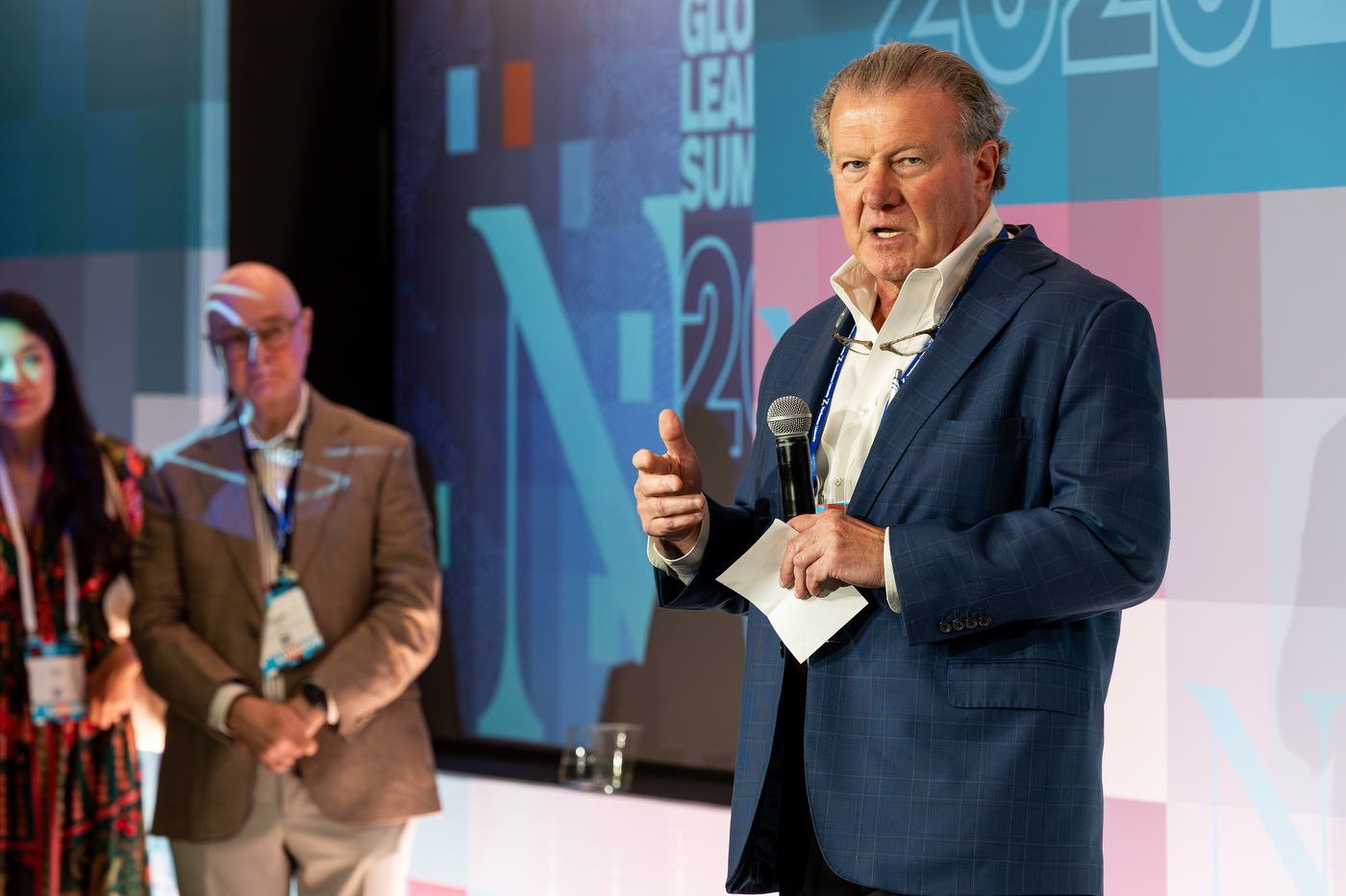
    Photo by Carmen Valino for Northeastern University

    “We, as a society, are going to face a constant balancing act between AI agency and human agency,” he tells the full-house at BAFTA. “From this perspective, the role of humans is going to be called into question, and I believe that human centrality has to be reasserted and redefined in this changing environment.”

    Universities must likewise reassert and redefine their mission. “Our mission is very clear. Our mission is not to preserve knowledge and disseminate it. Our mission is to put the human beings at the centre again, which means that our education has to focus on each student and on the community of students,” he says. “We are also responsible for creating new discoveries that are going to augment human beings and not relegate them to the side.”

    — Matthew Ponsford

  • Pinned

    Data literacy is key for digital commerce, Mastercard CEO says 

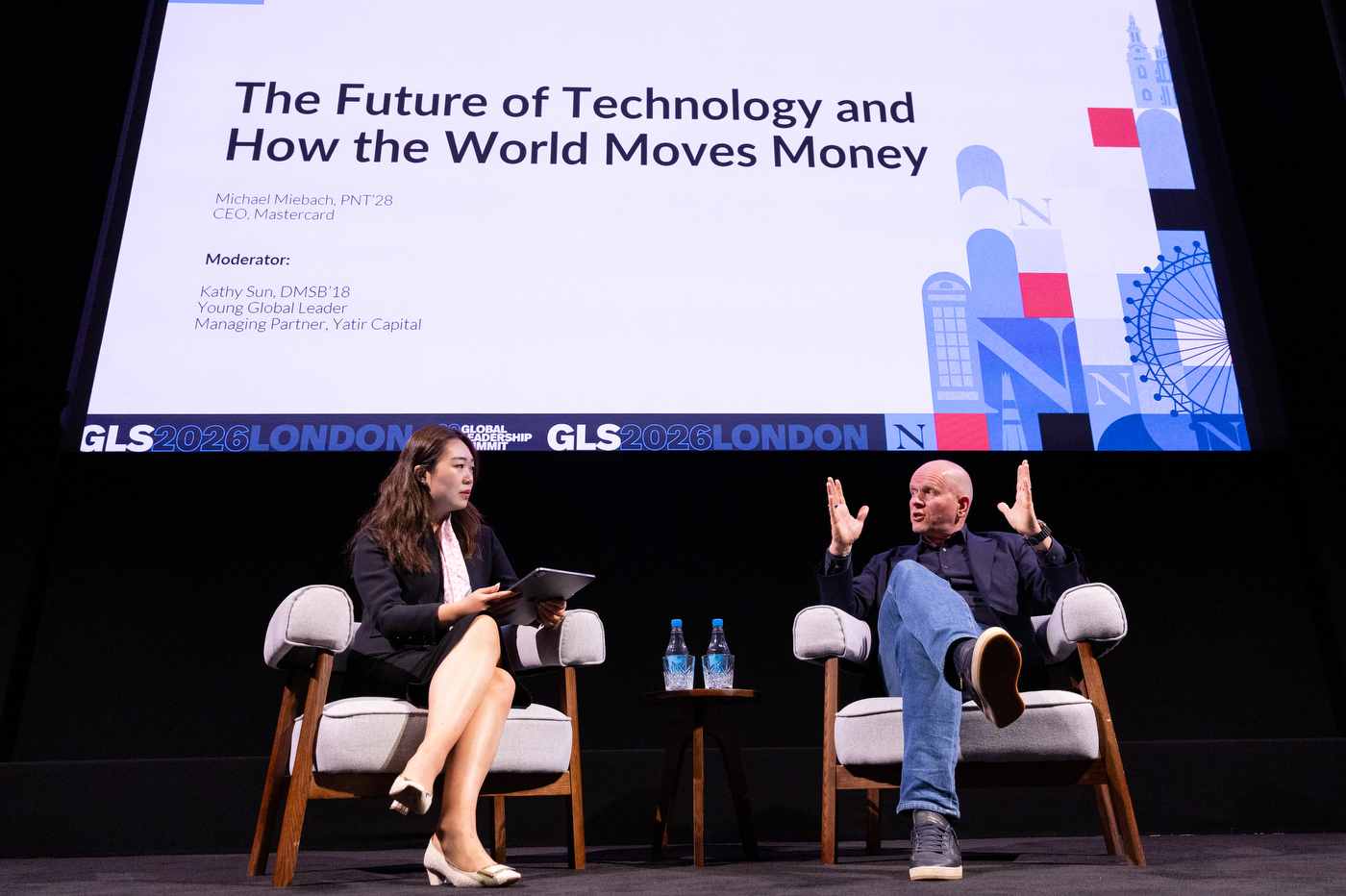
    Following the panel “Human Leadership in the Age of AI” led by Northeastern President Joseph E. Aoun, it’s time for “The Future of Technology and how the World Moves Money” with Young Global Leader Kathy Sun introducing Mastercard CEO Michael Miebach.

    2025 was a strong year for Mastercard, with net revenue of $32.8 billion, according to the company’s latest earnings report.

    “Twenty years ago, we were called a credit card company. Today, we are many things for different types of personas, the most global way to pay, given our license in China. We are also a platform that drives decisions for businesses. We are also an essential part of keeping the digital economy safe. When you see our brand, there is trust,” Miebach explains.

    “When you look at the future of digital commerce, agents will be used on our behalf. We will apply all this technology in the real world, around strategy, governance, and capability.”

    Photo by Carmen Valino for Northeastern University


    “When it comes to talent around AI, it is very important to have people with great data literacy and problem-framing skills; this is what we do with our employees. Coding is not really that useful anymore, but data literacy is,” Miebach says.

    For the Mastercard CEO, there is also a dual challenge between the approaches in Brussels and Washington, between a more regulatory and a more risk-taking approach, respectively.

    “It’s important to look at things in time. Ten years ago, people also felt that the world was complicated. It is important to distinguish between secular trends and cyclical trends. Secular trends do not change that much”.

    Geographically, there are different issues: in America, the issue is affordability, in Africa, it is access.

    When it comes to founding a company, Miebach explains that founders need to be driven by a plan, but also by what happens. 

    When it comes to AI, the CEO points out that the technology that moves money will keep changing, but what is not changing is the expectation: the technology must be safe, immediate, intuitive and simple. 

    — Angelo Boccato

  • Pinned

    Don’t erode trust with AI, warns Northeastern University London’s governor

    Brands that sell themselves on quality must think very carefully about how they use AI to promote products, warns Julietta Dexter, governor of Northeastern University London.

    Dexter is a branding expert with decades of experience working to develop luxury brands. When brands claim to represent “luxury and craftsmanship and artisanship,” customers are quick to call them out on social media for cutting costs on delivering content through generative AI, she explains.

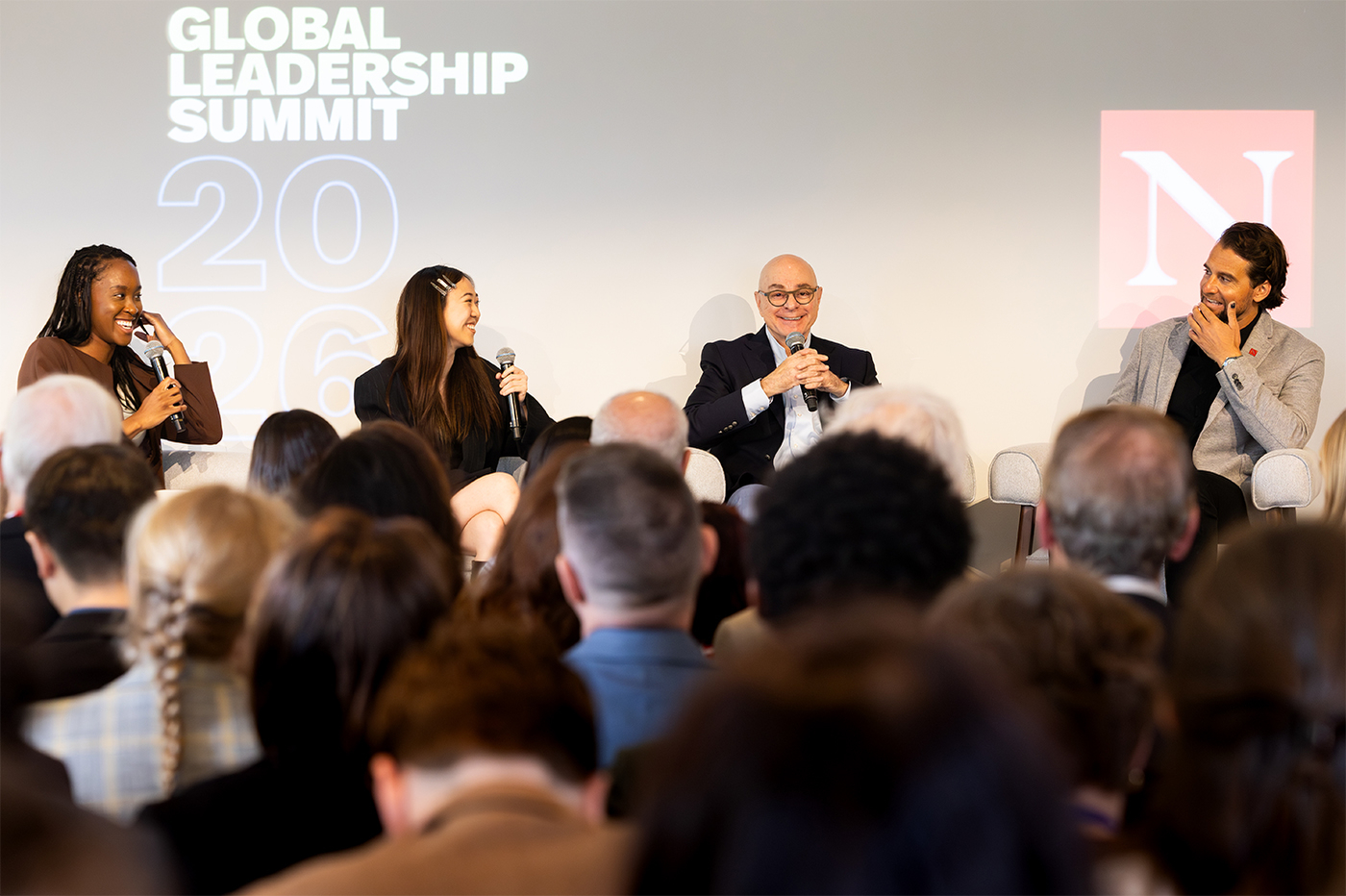
    A woman speaks to fellow panelists during a discussion at the Global Leadership Summit.
    Photo by Carmen Valino for Northeastern University

    “In my world, Gucci, Valentino, Coca-Cola have had absolute pastings on socials,” says Dexter, CEO of Brand Potential, a strategic brand development agency. 

    In a wide-ranging discussion at Devon House, the center of Northeastern’s London campus, Dexter was joined in conversation with Peter Cameron, who has led key brands like Wedgewood and All-Cald, and John V. Pulichino, chair and CEO, Group III International, which has achieved over $5 billion in sales of SWISSGEAR travel gear and watches branded by the maker of Swiss Army knives.

    All agreed that AI is here to stay but marketing campaigns shouldn’t undermine trust built up over decades by respected brands. 

    • — Matthew Ponsford
  • Grad praises GLS for ‘conversation on AI that is not scary’

    The GLS is rolling, and before we find out who will win the Global Venture Forum Award (worth £100,000 in funding) and sit on the Funding Throne, let’s hear from another brilliant alum, Mariana Travlou.

    Travlou holds a bachelor’s degree in neuroscience and psychology from Northeastern University.

    Back in 2024, she won a Women Who Empower Innovator Award from Northeastern University, and she is the founder of Nous Health, which is dedicated to empowering individuals through dedicated digital mental health support.

    The services offered by Nous Health include counseling, psychotherapy and life coaching.

    In Travlou’s view, an approach to lifelong education and connection is what makes Northeastern different, emerging from the crowd.

    Travlou says she attended the GLS because: “First of all, there are a lot of interesting people, and then there is a conversation on AI that is not scary.”

    The stories of Northeastern alumni are a truly global kaleidoscope of experiences … and now onward, a winner will be announced shortly, so stay tuned! 

    — Angelo Boccato

  • A truly global conversation on AI and its impacts

    Fresh from sharing the stage with President Joseph E. Aoun, Northeastern grad Kat Tse says she’s enjoyed the “thoughtful and thorough discussion” on AI and globalization throughout the summit. Tse put questions to Aoun about the role of AI in the arts and storytelling, and the two discussed the pursuits in which AI can’t match human ability but can “augment” our capabilities. 

    Toronto-born and Hong Kong-raised Tse graduated with a degree in communication studies from Boston in 2024, with a stop at Northeastern London during the spring of 2022. She says it’s always fun to catch up with other alums at events in Hong Kong and London: “It’s just incredible to see how global the institution is,” says Tse.

    Photo by Carmen Valino for Northeastern University

    Tse launched fashion wellness magazine Terms & Conditions during her time at Northeastern and the publication has continued to grow since graduation. The support of the alumni network has “not only made my career possible but made it possible for my business to expand,” she says. 

    In recognition of her work, she took home the Empowering Global Change Award from Northeastern University’s 2024 Women Who Empower Innovator Awards.

    • — Matthew Ponsford

Northeastern Global News, in your inbox.

Sign up for NGN’s daily newsletter for news, discovery and analysis from around the world.