Northeastern Global Leadership Summit stops the noise to offer leadership lessons in the age of AI
Amid polarizing debates on AI, humanity has a critical role in guiding societies with human values, attendees hear


Northeastern’s seventh annual Global Leadership Summit (GLS) launched with a mission to discover what role leaders can play in the age of AI. By the time the two-day program had wrapped up, attendees were left with a clear message: As we navigate the unprecedented pace of societal change driven by AI disruption, human leadership is more essential than ever.
The summit in London drew the largest attendance to date, including around 350 participants from 27 nations. For those in attendance, the summit promised to find a moment of reflection amid today’s chaotic world of a relentless news cycle and polarised debates.
“It’s a luxury to have several hours to just listen,” said Diane MacGillivray, senior vice president for University Advancement at Northeastern University.


From competition to conversations
The GLS opened on Wednesday at Northeastern University’s London campus with the Global Venture Forum Awards, a new competition that offered nine founders the opportunity to pitch their entrepreneurial ideas to a panel of judges. Five winners would take home a total of £120,000, around $160,430, a sum that would allow them to expand the reach and prospects of their businesses.
The judging panel included Richard D’Amore, Chaitanya ‘Chet’ Kanojia, Christopher A. Viehbacher, and John Pulichino, a quartet of Northeastern trustees with more than a century of collective experience as founders and CEOs. They were joined by Marco D’Ippolito, managing partner of asset managers Patira Investment, and Julietta Dexter, Northeastern London University governor and renowned branding expert.
The ‘Shark Tank’-style event was a highlight of the summit. The nine founders’ ideas ranged from virtual heart clinics to school farming projects. But a few stood out, both for their business acumen as well as for the value they brought to society.
Federico Ramirez, founder of ComparaFácil, an AI-powered tool for comparing financial products, emerged in first place, followed by Khushi Shah of Drizzl, a patent-pending smart irrigation system in second place. Alison Reilly, founder of Closai, an AI-powered app that can digitize users’ wardrobes, came in third. Also recognized were Lara Solomon, who scored the People’s Choice Award for her company Hoopsy, which produces plastic-free pregnancy tests; and Mohamed Kante, whose education platform for STEM learners in Africa, iNERDE Academy, earned him the Nonprofit Award.


The afternoon sessions offered attendees the chance to sit in on one of six Curated Conversations. Panels included Northeastern Professor Ravinder Dahiya’s talking about “Machines That Feel: The Future of Robots and Physical AI” and Darren Campili, global head of healthcare investment banking, at RBC Capital Markets, discussing how investment banking drives healthcare.
A second set of six panels finished out the rest of the day. These included how to maintain and redefine brand identity during moments of rapid disruption and a panel about quantum computing, led by Eric Van der Kleij, Co-Founder of venture investors EdenBase.


Considering AI’s role in society
The second day brought a series of high-profile global headliners. MacGillivray, hosted a curtain-raiser projected across the walls of the British Academy of Film and Television Arts in London’s Piccadilly neighborhood. As guests took their seats, they were suddenly surrounded by images of digital headlines representing the clashing views of AI as either a liberating superpower or a malevolent force.
Those competing ideas were on full display during a conversation with Northeastern President Joseph E. Aoun, who argued humanity’s belief systems are critical to guide societies into a future where AI can either augment us or replace us. He argued that leaders must reaffirm “human centrality” and understand the human qualities that AI cannot replicate, including community, creativity, ethical judgment, and a notion of justice.
“We, as a society, are going to face a constant balancing act between AI agency and human agency,” Aoun said. “From this perspective, the role of humans is going to be called into question, and I believe that human centrality has to be reasserted and redefined in this changing environment.”


That theme carried through the day by leaders who explained how AI is changing the roles that humans play in varied fields. Michael Meinbach, CEO of Mastercard, highlighted the crucial role of human talent but said that the skills people required had shifted. “When it comes to talent around AI, it is very important to have people with great data literacy and problem-framing skills; this is what we do with our employees. Coding is not really that useful anymore, but data literacy is,” Miebach said.
Viehbacher, CEO at Biogen, returned alongside Dame Emma Walmsley, former CEO of GSK, to host a wide-ranging conversation on leadership in the pharmaceutical industry. Viehbacher told the audience that AI is changing pharma R&D but not in the ways that many expected. “I do not believe AI is going to come out with new drugs, but it is definitely a tool to help us do R&D faster, and probably cheaper, and human insight remains crucial at any step,” he said. His own company is aiming to use AI to conduct placebo control studies using accurate digital twins rather than drug discovery, he shared.
Walmsley, a self-described outsider to pharmaceuticals when she first started at GSK, kicked off the debate by asking what the job of a CEO entails in this industry.


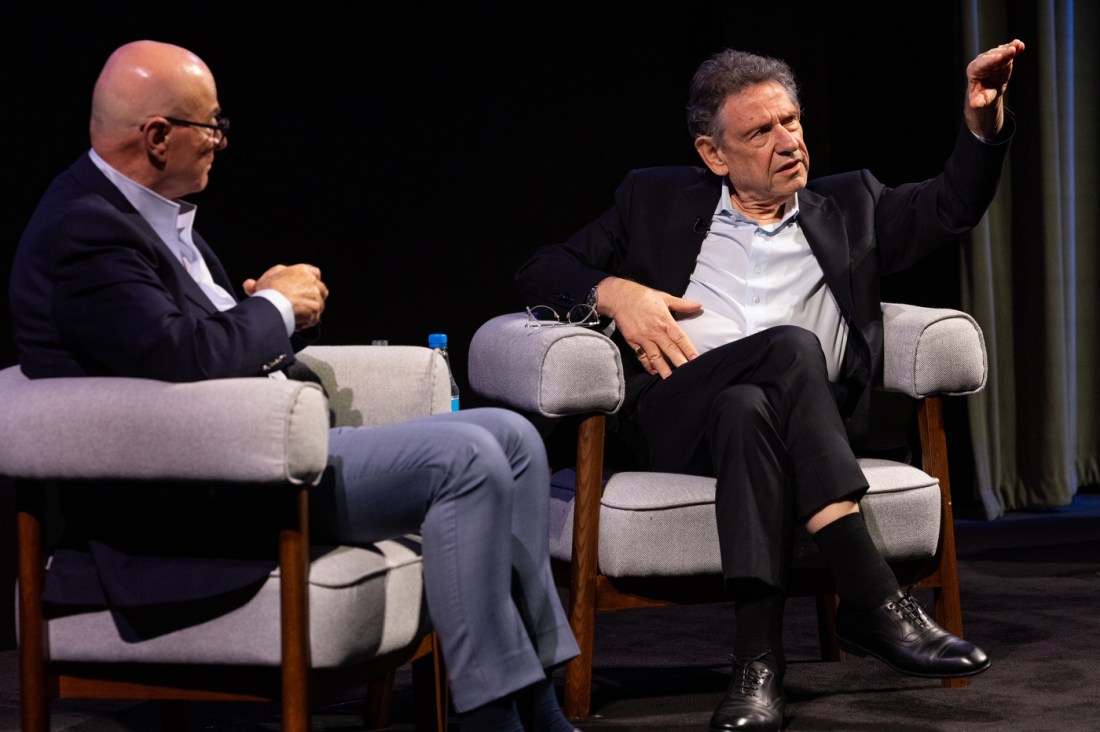
“It is not to pick the next molecule, there are many scientists for that, but it is doing strategy, and recruiting the best talent,” Walmsley said. AI may be able to replace parts of management “but people are motivated by other people, and this notion of being able to inspire others is a uniquely human ability,” she said. “Leadership, by definition, is being able to build fellowship.”
Hemant Taneja, CEO of venture capital firm General Catalyst, warned that today’s tech advances are outstripping society’s ability to absorb them and that we should be wary of the potential for widespread backlash against AI, as some become staggeringly wealthy and others lose jobs. He dubbed this “techlash” in his 2025 book “The Transformation Principles: How to Create Enduring Change.” AI is concentrating wealth in the hands of a few “people like me,” he said, as a tech investor who backed startups like Stripe, Snapchat, and Airbnb. “It’s a backlash for nerds,” jokes Taneja, who argued that opportunities stemming from AI use must be distributed or societies will turn to regulation.
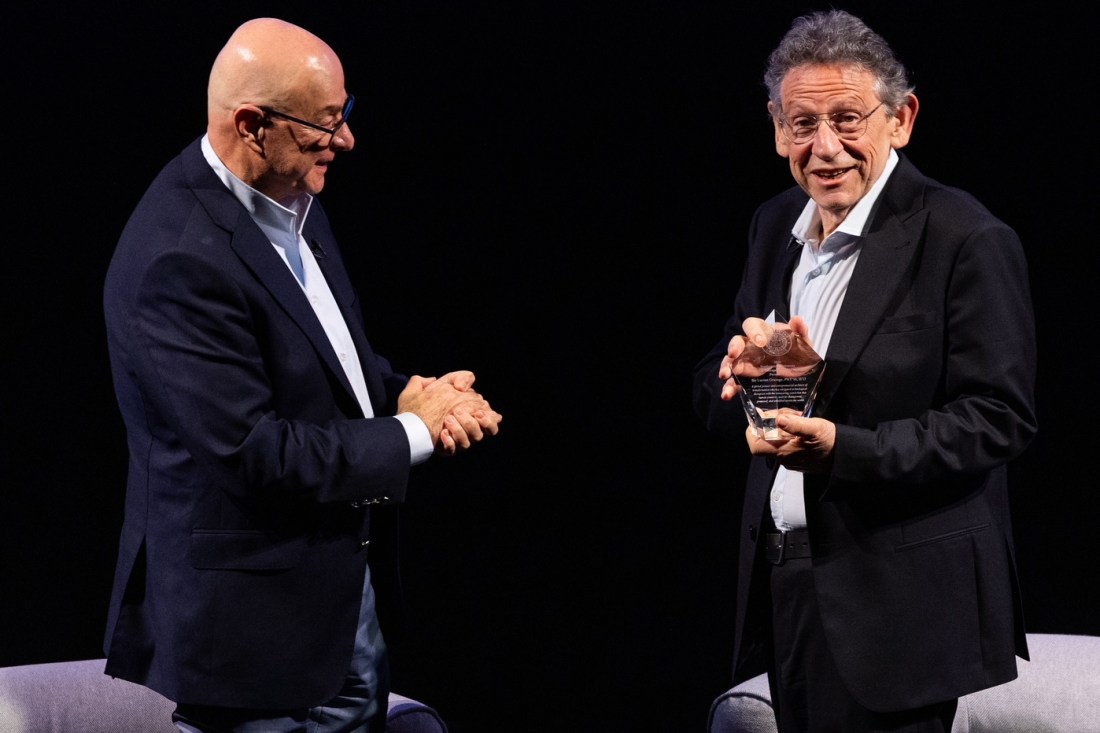
In a speech that closed out the summit, Sir Lucian Grainge, CEO of Universal Music Group, told audiences that music-lovers still want music that comes from human artists rather than AI-generated slop. But AI can enhance the experience of engaging with artists, he said, “The beauty of someone’s creativity can be harnessed and expanded as a result of this technology.”
When asked by Northeastern Global News about their takeaways from the two days at the summit, participants shared a range of feedback.
“Explosive,” said Niklas Homan, founder of AI investment platform Orbit. “Grateful,” said award-winner Kante.


