As migrants surge into Ceuta, do restrictive immigration policies work?
“In some sense, it was easier for [anti-immigration laws] to be effective prior to the modern era,” said Mindy Marks of Northeastern.

Brexit. Birthright citizenship. A population cap.
Major efforts to restrict or better control immigration have focused on the economy, the courthouse and the ballot box.
Still, people continue to cross borders.
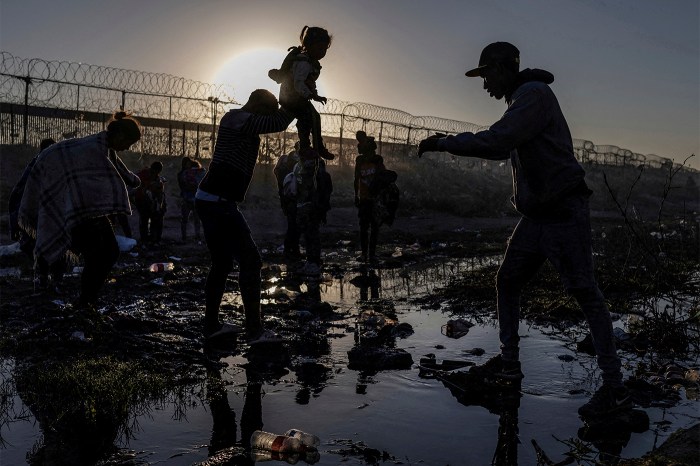
On July 31, tens of thousands of migrants had crossed from Morocco into Ceuta, a small Spanish territory in North Africa, in a surge that left nearly three dozen people dead and created a “political crisis” for Spain’s pro-immigration government, according to the New York Times and other international media outlets.
Ten years after Britons cited immigration as the number one reason they voted to leave the European Union, data from the European Parliament shows that immigration to the U.K. has increased rather than decreased.
The United States Supreme Court rejected a Trump Administration executive order that challenged the Citizenship Clause of the Fourteenth Amendment of the Constitution, which states that “all persons born or naturalized in the United States, and subject to the jurisdiction thereof, are citizens of the United States and of the State wherein they reside.”
In June, Swiss voters rejected a population cap of 10 million residents with a vote of 55% to 45%.
So it begs the question – Are restrictive immigration policies doomed to fail?
“This is the $1 million question, actually,” said Marianna Griffini, assistant professor of international relations and anthropology at Northeastern University in London.
“Deterrence policies usually do not work,” Griffini said.
She explained that restrictive policies rarely eliminate the typical “drivers” of immigration: economic advancement, safety from wars or persecution, or environmental catastrophes such as famine. That means people are still willing to risk the journey, and may choose more dangerous options for travel through smuggling, more dangerous routes and more.
“If you act in a very restrictive way by punishing and criminalizing immigration and cutting down on regular routes for immigration, then migrants typically look for alternative and extra legal ways to migrate,” Griffini said.
Mindy Marks, associate professor of economics at Northeastern, said the days when immigrants to America would typically arrive after a long boat voyage at, say, Ellis Island in New York, once the busiest immigrant processing and inspection station in the U.S. and now part of Statue of Liberty National Monument, are no more.
Today, there are many entry points. Technology can also easily, cheaply and share information on everything from safe routes of travel across borders to the paperwork required for asylum or refugee applications and even the location of law enforcement.
“In some sense, it was easier for [anti-immigration laws] to be effective prior to the modern era,” Marks said.
In 2024, approximately 304 million people resided in a country different from the one in which they were born, according to the latest data from the United Nations Department of Economic and Social Affairs. This number includes immigrants who have moved permanently and migrants who moved temporarily, regardless of their legal status. The number has more than doubled since 1990, and also includes 36.9 million refugees and 8.4 million asylum seekers, according to the U.N.
Nearly half of migrants and immigrants move less than 500 kilometers (310 miles), according to a 2025 report by the International Organization for Migration, an intergovernmental organization within the U.N.
Editor’s Picks


But recent geopolitical events have prompted migration and immigration to more developed countries in North America and Europe. Wars in the Middle East caused a refugee crisis in Europe with roughly 1 million people arriving to the continent in 2015.
The COVID pandemic prompted a surge in encounters with migrants at the U.S.-Mexico border between 2020 and 2024, according to findings by the Pew Research Center, although 2025 saw a remarkable drop in encounters.
Colin Brown, associate teaching professor of political science at Northeastern, said the increasing global migration has corresponded with several other trends that “feed into each other.”
Brown said more awareness of immigration (although he noted that public opinion is “notoriously inaccurate” in judging the extent of immigration) has coupled with a shift in who is immigrating. Particularly in North America and western Europe, a larger and larger portion of immigrants and migrants are refugees and asylum seekers – people fleeing conflict, violence and persecution – compared to historical patterns where people primarily moved for economic reasons, he said.
“People are a little bit more negative toward asylum seekers and refugees than they are towards economic migrants,” Brown said. Research shows that Americans, for example, blame asylum seekers and refugees for increased crime and strain on public services.
Griffini added that the 2008 global financial crisis, COVID-19 and ongoing wars has caused a “deep feeling of economic insecurity and instability” that has prompted migration to more economically developed countries … and also backlash.
“What is really shared by all these countries that are attempting to control immigration is a sentiment of economic dissatisfaction,” Griffini said.
Experts also said the rise of populism, a political movement that champions the common person over the elite or establishment, and its focus on immigration as a concern, has also had an impact.
“In many nations, there’s now right-wing populist leaders who find immigrants to be a convenient scapegoat for domestic issues,” Marks said, citing U.S. President Donald Trump as an example.
White House officials routinely discount criticism that Trump is bent on stoking societal division, arguing instead that border security protects U.S. sovereignty and American communities and is “restoring integrity to the immigration system and ensuring the law is applied consistently.”
To be sure, Griffini said that some immigration policies can be effective, for example, tying immigration to employment and controlling the number of work permits issued. Partnerships between countries that are sending immigrants and receiving immigrants are another option, Griffini said.
But those plans can be tricky. Griffini cited Italy’s Mattei Plan, a 5.5 billion euro economic development plan for 18 African countries. The plan doesn’t explicitly emphasize migration controls. But coupled with Italy’s agreement with Albania to process migrants in that country, the plan has been criticized for trying to keep migrants from the Italian border.
Add in factors from economic malaise to populism combined, Brown predicted immigration control that would continue to focus on the stick rather than the carrot … even though that may not always work.
“I don’t think we’ve hit the peak of anti-immigrant mobilizing or anti-immigrant legislation,” Brown said. “Some will succeed,” but many of the more restrictive immigration measures and migrant policies will not, he added.