China’s ursine statesmen arrive at an American zoo
Pandas are back


Are panda’s ursine politicians? Well, actually, they’re more like international statesmen.
And some Northeastern University experts believe that a pair of Chinese giant pandas that arrived in the U.S. on Sunday are a sign of soothing tensions between Beijing and Washington.
“Pandas are an unusually effective diplomatic symbol,” said Xiaoxiao Shen, an assistant research professor at Northeastern who focuses on Chinese international politics.
“They are associated with China but aren’t controversial.”
It’s called “soft diplomacy”, said Daniel Aldrich, a Northeastern University professor who teaches political science, describing a diplomatic tool used to show good will to other nations.
Typically it is done by giving food, medicine, other aid – or in this case, pandas – to help inspire people in foreign countries to feel more favorable to your nation, he said.
“China wants to see happy headlines about pandas and not the abuse of the Uyghurs,” a minority population in China, Aldrich said.
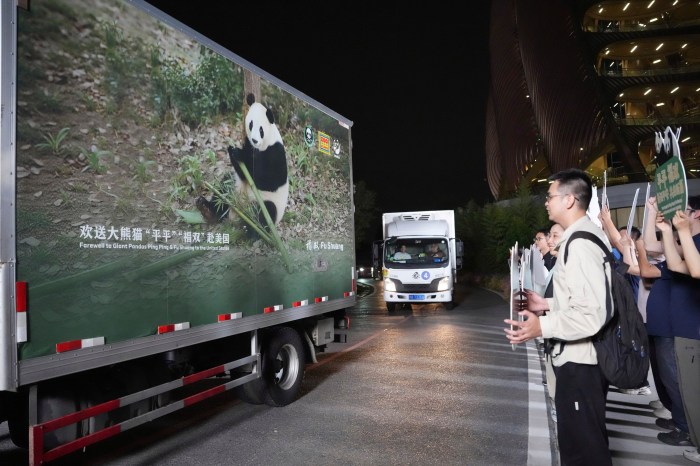
Shen explained that as political tensions rise and fall between the U.S. and China, pandas are given or taken away. There used to be 20 Chinese-owned pandas at American zoos. Since 2024, all but six have gone home, as relations between Beijing and Washington have ebbed and flowed.
“There is a clear political dimension,” Shen said.
The arrival of the pandas, Ping Ping and Fu Shuang, at Zoo Atlanta after their 8,000 mile journey from Chengdu, China, was announced by Chinese president Xi Jinping as he stood beside President Trump at a visit to the White House on Sept. 24.
Editor’s Picks


Xi declared that the bears were an “envoy of friendship.”
The practice of giving bears dates back to the Tang dynasty in the early about 1,500 years ago, at a time when daughters were often given in marriage to foreign kings and nomadic rulers in China to solidify treaties and border disputes, said Mark Henderson, a Northeastern political science professor who teaches at the Oakland campus.
The Bronx zoo received two pandas from China in 1941 and in 1972 the People’s Republic of China gifted then President Richard Nixon and his wife Pat with a pair of pandas, Hsing-Hsing and Ling-Ling, as a gesture of friendship.
Aside from deploying bears as a goodwill gesture, China has been using soft diplomacy to gain favor elsewhere in the world, including in Africa where it has launched vaccination programs and invested heavily in building roads, bridges, ports and other infrastructure, Aldrich said.
A July 2026 Pew Research Center survey of 36 nations found that China is seen more favorably than the U.S. across the globe with countries expressing more confidence in Xi than Trump. Even America’s closest neighbors Canada and Mexico – view China more positively than the U.S., the nonprofit thinktank found.
“There are two ways to influence people around the world,” Aldrich said. “The first is to bomb them. The second is to feed them, give them aid. As we’ve seen in Iran over these last seven months, bombs aren’t working.”
The U.S. had used soft diplomacy to great success in past years. In 1948, America committed $15 billion to the Marshall Plan to help rebuild Western Europe following World War II. The approach built trust and strong alliances as “America [was] is seen as the friendly nation,” Aldrich said.
But in recent years, the U.S. has all but dismantled the United States Agency for International Development or USAID, a state-run program that in 2023 spent about $40 billion in food, medical and emergency assistance across the globe according to the Congressional Research Service, according to Pew. That aid ended in 2025 when the government functionally dismantled the program.
In addition, the U.S. also cut ties with the World Health Organization, or WHO, in 2025, citing mismanagement and lack of transparency, according to a release from the U.S. Health and Human Services Department.
“People around the world, especially Africa, think that America has abandoned them,” Henderson said, as the lion’s share of USAID went to nations on that continent.
But the pandas coming-to-America moment is a sign of political thawing between the U.S. and China – at least for now, experts said.
“The pandas are given or taken away as China thinks favorably of you or not,” Henderson said.