Skip to content

8 numbers that tell the World Cup’s story over the first week

Elite goal scoring. Huge saves. Hydration breaks. The 2026 FIFA World Cup is off and running. Here’s a look at what the numbers say about the first week of action.

Croatia goalkeeper Dominik Livakovic dives to save a penalty from England's Harry Kane during their FIFA World Cup 2026 group stage match in Dallas.
Goalkeeper Dominik Livakovic of Croatia saves a penalty from Harry Kane of England during the FIFA World Cup 2026 football match between England and Croatia on June 17, 2026 in Dallas. Photo by JOEL MARKLUND/Bildbyran/Sipa USA via AP Images

This post is part of NGN Offside, a blog about the 2026 FIFA World Cup, powered by data science.

Across 16 cities and three countries, the world’s biggest sporting event is one week old. Here’s a look at some key numbers from the first round of group-stage matches that tell the World Cup story so far. 

3.12 goals

The average goals scored per game is 3.12, up from 2.56 goals per game in the group-stage of round 1 from 2022. Northeastern University data researcher Brennan Klein posited that the increase in average goals per game could be attributed to an expanded field from 32 to 48 teams, now with more lower-ranked teams.
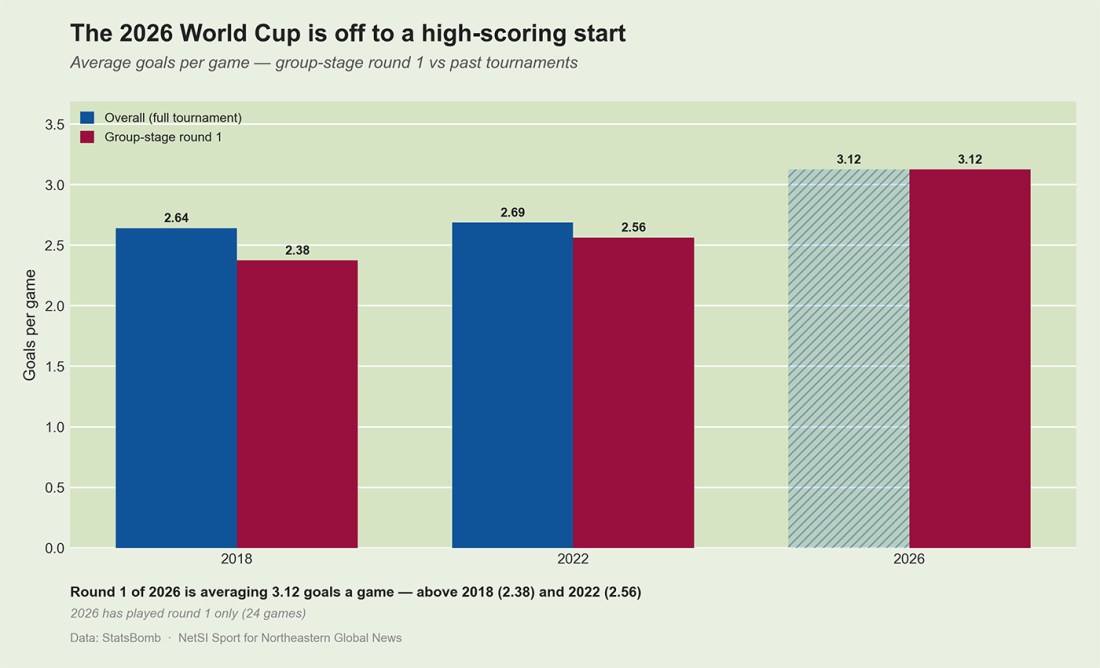
Grouped bar chart comparing average goals per game at the 2018, 2022, and 2026 FIFA World Cups. The 2026 group-stage round 1 average of 3.12 goals per game is the highest shown, up from 2.56 in 2022 and 2.38 in 2018. The 2026 full-tournament average is projected, not final.
See the graphic above for more on the average goals scored in the first round of the group-stage play in this year’s World Cup, compared to 2022 and 2018.

3 goals

Most goals scored by a single player in a game is three. Argentina’s star forward Lionel Messi scored a hat trick in the team’s opener against Algeria, tying Miroslav Klose’s record for most men’s World Cup goals at 16.

21 take-ons completed

The highest number of successful dribbles by one team is 21, and that was executed by the United States. Klein said the U.S. was much more willing to engage the defense than in years past, rather than settle for more conservative passes.

Horizontal bar chart ranking all 2026 FIFA World Cup teams by completed take-ons (dribbles) after round 1. The USA leads with 21 completed out of 31 attempted, followed by Morocco (19/32) and Jordan (14/21). Each bar shows completed dribbles in dark teal and incomplete in light teal. South Africa is last with 0 completed from 2 attempts.
See the graphic above for the number of take-ons attempted and completed by all of the teams in the first week.

24.4 fouls per game

Down from 27.7 fouls/game in 2022 and 29.3 in 2018, the average fouls per game is 24.4. Klein said the decrease in fouls could be related to the “increased scrutiny that players are under with the widespread introduction of video assistant referee (VAR),” as well as the referees in general “doing a pretty good job at letting the game flow and not whistling for smaller fouls that, in previous years, were likely to be called a foul.”

Three bar charts comparing per-match fouls, yellow cards, and red cards at the 2018, 2022, and 2026 FIFA World Cups. Fouls and yellow cards are both down in 2026 (24.4 and 2.17 per match), while red cards are up sharply at 0.125 per match compared to 0.062 in each of the prior two tournaments.
See the graphics above for more insight into the fouls and yellow and red cards thus far.

8.1 miles

Read more World Cup analysis on NGN Offside

The distance run by Noor Al-Rawabdeh of Jordan in the game against Austria was 8.1 miles, the highest of any player in the group stage. Al-Rawabdeh made history at the FIFA World Cup by providing the assist for Jordan’s first-ever goal in the tournament’s history in its debut match.
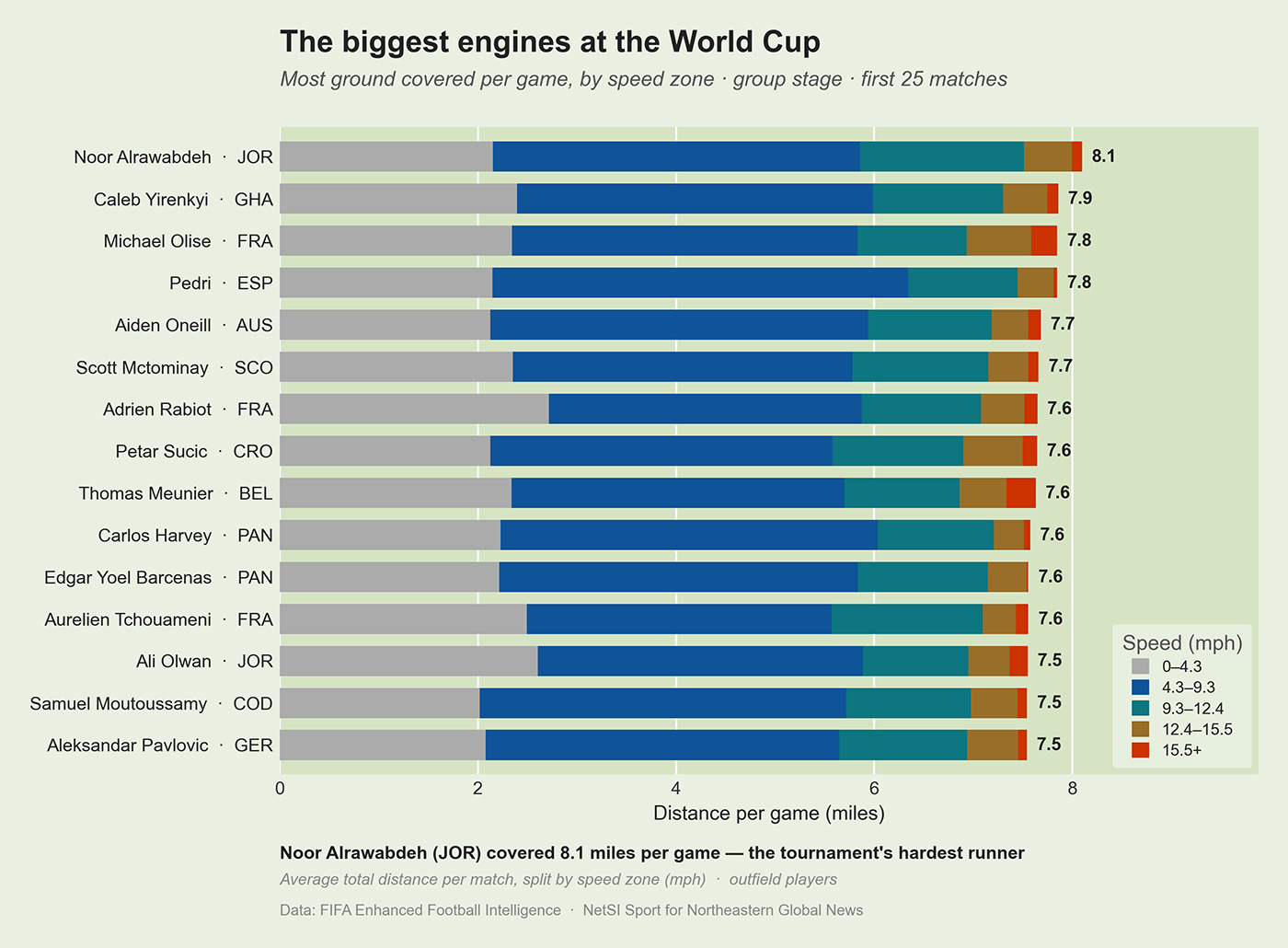
Stacked horizontal bar chart ranking the top 15 players by distance covered per game in the first 25 matches of the 2026 FIFA World Cup group stage, broken down by speed zone. Jordan's Noor Alrawabdeh leads at 8.1 miles per game, followed by Ghana's Caleb Yirenkyi (7.9) and France's Michael Olise and Spain's Pedri (both 7.8).
See the graphic that shows which players covered the most distance in their first games.

22.8 mph

Top speed by any player was 22.8 mph. Australia defender Jordan Bos led all players in top speed, while his teammate Mohamed Touré was fourth (22.2 mph).
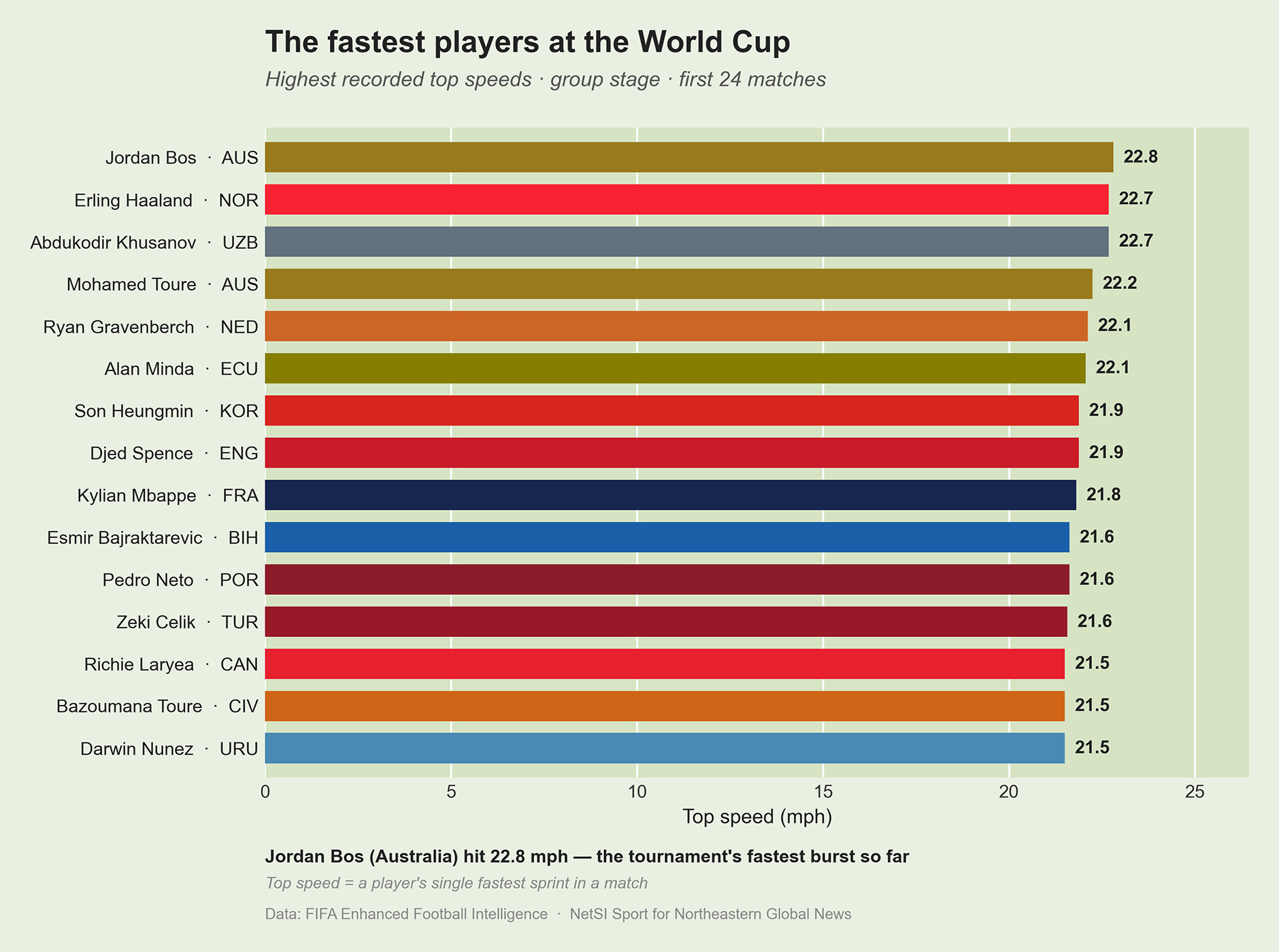
Horizontal bar chart ranking the 15 fastest players by top speed recorded in the first 24 matches of the 2026 FIFA World Cup group stage. Australia's Jordan Bos leads at 22.8 mph, ahead of Norway's Erling Haaland and Uzbekistan's Abdukodir Khusanov, both at 22.7 mph.
See above for the fastest recorded players at the World Cup through the first round of group-stage play.

0.82 xG

The highest xG of a single shot that was saved was 0.82. Croatia’s goalkeeper Dominik Livaković stopped a barrage of shots by England at the 55’ mark off a corner kick. 

157.7 minutes

Total time spent on the 48 hydration breaks that have taken place across all 24 played matches in the first round of the group stage was 157.7 minutes. Hydration breaks averaged about 3.3 minutes. Read more on NGN’s coverage on whether hydration breaks are leading to more shots. 

Northeastern Global News, in your inbox.

Sign up for NGN’s daily newsletter for news, discovery and analysis from around the world.