Skip to content

The numbers that show Spain’s dominance in the World Cup final

Spain set records in passing efficiency and defensive dominance, leaving Argentina pinned back, according to the data.

Spain's Marc Cucurella dribbles the ball toward an Argentine player during the World Cup final.
Spain held possession for 60% of the World Cup final, set records in passing, and unleashed an imposing defense in victory. AP Photo/Stephanie Scarbrough

Spain dominated Argentina in the 2026 World Cup final. The 1-0 score barely tells the story — the data does.

Spain set records for a World Cup final through the team’s 896 attempted passes and the 774 the squad managed to execute, achieving a 86.4% passing completion rate. The Spaniards only conceded two shots — also a new low — including zero shots in the first 90 minutes.

The cumulative xG, or expected goals, summed up the match pretty closely: Spain’s 1.56 xG to Argentina’s 0.13 xG, also a World Cup final record low, since the metric has been tracked.
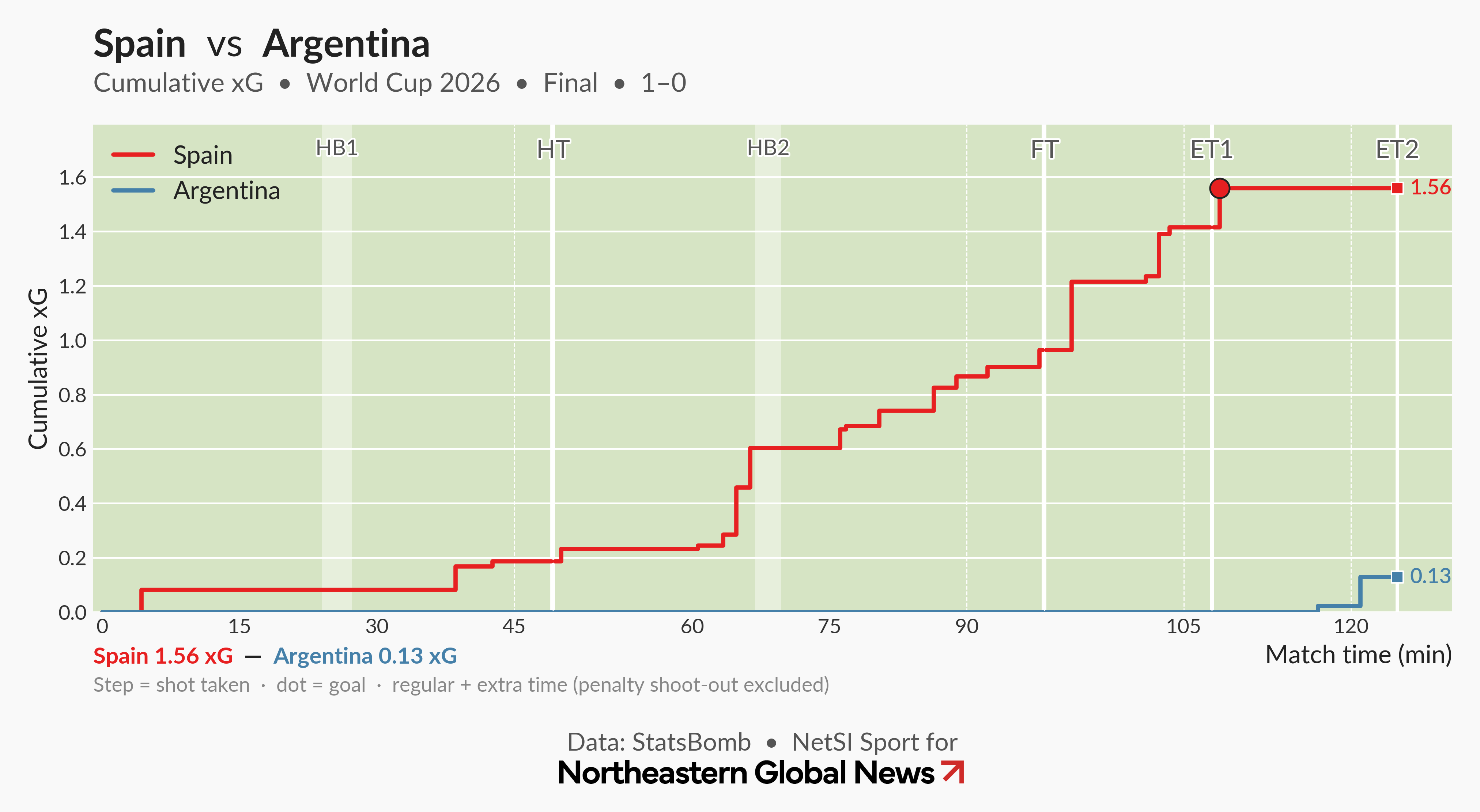
Line chart titled "Spain vs Argentina, Cumulative xG, World Cup 2026 Final, 1-0," showing Spain's expected goals climbing steadily to 1.56 while Argentina's remained flat near zero until reaching 0.13 late in extra time, illustrating Spain's dominant attacking pressure throughout the match.
The cumulative xG for both teams comes pretty close to the 1-0 margin: Spain’s 1.56 xG to Argentina’s 0.13 xG. Courtesy of NetSI Sport

Spain’s imposing defense suffocated Argentina’s attack. Argentina spent 50.5% of its possessions pinned back in its own end without crossing midfield — compared to a 30.4% average across its other seven matches in the tournament — by far the most defensive pressure Argentina faced in any match. The typical length of possession for Argentina — 11.4 seconds — was also its lowest of the tournament.

According to FIFA, Spain held possession for 60.2% of the World Cup final.

Soccer pitch diagram titled "Argentina vs Spain, Possession Escape Map, World Cup 2026 Final, 0-1," showing dense clusters of blue and gray lines tracking Argentina's possessions, with most concentrated in their own defensive half. Blue lines mark 49 of 97 Argentina possessions that never crossed midfield, illustrating Spain's suffocating press that regained the ball in roughly 11 seconds on average.
The graphic above shows Argentina’s possessions in the final. The blue lines indicate possessions that never crossed midfield, with failed attempted passes across halfway indicated by a blue “x” at the end of the line. The gray lines indicate possessions that occurred across midfield. Courtesy of NetSI Sport

Spain regained possession of the ball in the attacking third — the section of the pitch closest to its opponent’s goal — nearly nine times per game in the tournament, a rate second only to Germany. Another statistic from the final further exemplifies the impact of Spain’s pressure: Spain won the ball back 28 times in Argentina’s half of the field, leading to 10 shots.

The last time Spain won the World Cup, in 2010, it primarily relied on patient, lateral possession. The 2026 team featured a hybrid strategy — carrying the ball forward and threading vertical passes in addition to working it side to side. Its goal against Argentina captures that shift: almost entirely forward passes and carries. The graphic below traces the buildup.
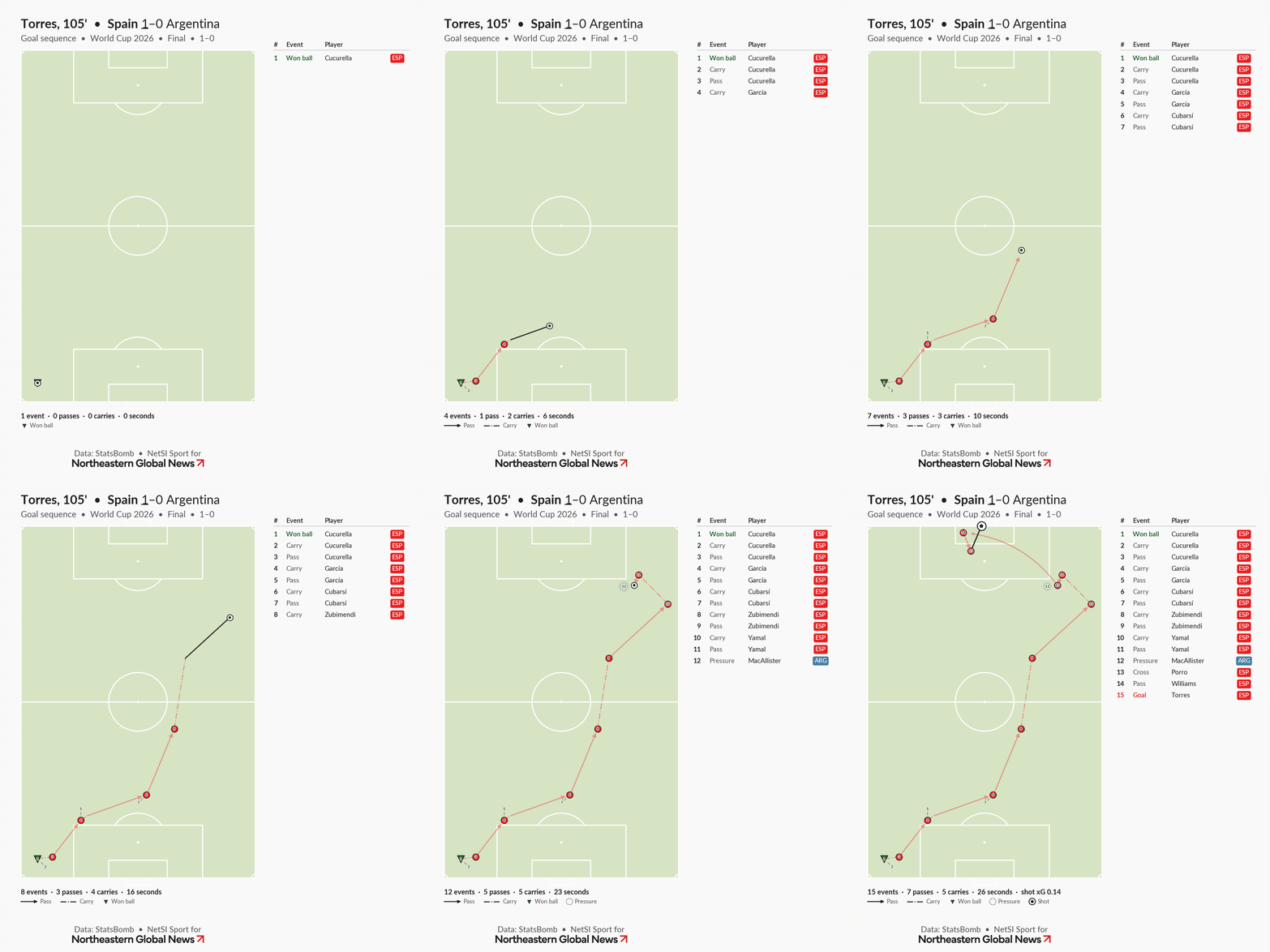
 Animated soccer pitch diagram titled "Torres, 105', Spain 1-0 Argentina, Goal Sequence, World Cup 2026 Final," tracing Spain's 12-event, 23-second buildup to the winning goal. The sequence shows Cucurella winning the ball and carrying forward, followed by passes through García, Cubarsí, Zubimendi, and Yamal, ending with Torres scoring under pressure from MacAllister.
The graphic above shows the progression of play that led to Spain’s goal against Argentina. Courtesy of NetSI Sport

Data analysis provided by Brennan Klein, director for Northeastern University’s NetSI Sport research group.

Northeastern Global News, in your inbox.

Sign up for NGN’s daily newsletter for news, discovery and analysis from around the world.

Greg St. Martin is a news reporter at Northeastern Global News. Email him at g.stmartin@northeastern.edu.