How will the new executive order on vaccines affect children? Experts weigh in
President Donald Trump has signed an executive order attempting to overhaul the childhood vaccine schedule. Experts warn the changes could drive down vaccination rates, fuel outbreaks and erode trust in vaccines.
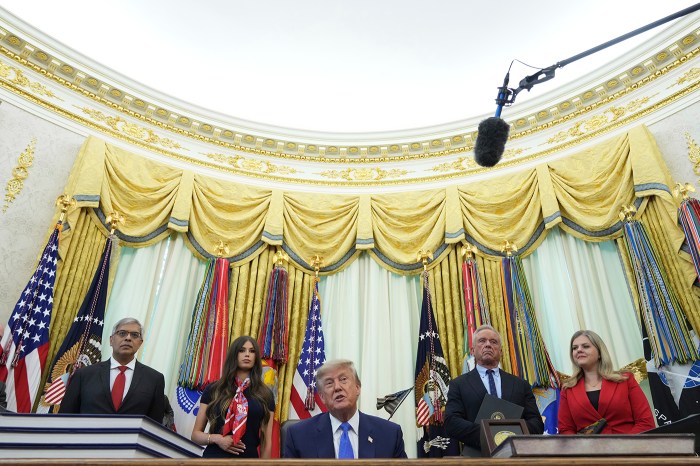

The White House says the executive order reducing the number of childhood vaccines will give parents more flexibility but experts say the order is not based on science.
President Trump’s executive order signed Monday seeks to cut the number of diseases children are routinely vaccinated for from 18 to 11. COVID-19, influenza and hepatitis B shots would no longer be universally recommended. The order also calls for the measles, mumps and rubella (MMR) vaccine to be split up into three shots given across separate visits.
In practical terms, this means fewer vaccine doses, more trips to the doctor — and a lot more individual sticks.
According to the administration, the changes will bring the U.S. in line with other developed countries that recommend fewer childhood vaccines. It could also give parents more choice, they say.
But there are some major holes in those arguments, along with practical concerns, experts say. Beyond potentially making toddlers dig in their heels at the prospect of yet another trip to the doctor — and another shot — critics say these recommendations could drive down vaccination rates and fuel outbreaks of preventable diseases.
The executive order also reignited a long-standing controversy with Trump suggesting that vaccines could be the culprit behind rising autism rates — a claim that runs counter to decades of studies.
Northeastern Global News talked to Bouvé College of Health Sciences professors Elizabeth Glowacki and Neil Maniar, Northeastern School of Law professor Wendy Parmet and other experts to try to make sense of the situation.
What does Trump’s executive say and how much power does it have?
“It’s a PR statement, not policy,” Parmet said. “He cannot legally require it,” she added, stressing the fact that the federal government can’t change childhood vaccine mandates enforced by the states.
Instead, the recommendations are done by the Centers for Disease Control and Prevention, with guidance from the Advisory Committee on Immunization Practices (ACIP), a federal panel of experts, she explained. Earlier efforts by the administration to change the childhood vaccine schedule and overhaul ACIP are currently tied up in court, and Parmet has helped write amicus briefs rebutting the administration’s assessment, which is behind both the executive order and the attempt to influence the ACIP.


“We did a pretty persuasive job in tearing it down,” she said, calling it “deeply flawed.”
The executive order, in turn, is the administration’s “attempt to do what they haven’t been able to do by the courts,” American Public Health Association CEO Dr. Georges C. Benjamin told Northeastern Global News, adding that “it’s not going to work.”
While the ACIP gives recommendations, the actual policy pertaining to vaccines is ultimately left to the states, Parmet explained, saying that many states have charted their own course in recent years.
Is there any science behind the order?
Andrew Racine, president of the American Academy of Pediatrics, a professional organization of children’s doctors, said the order is “not based on gold standard science,” and with measles cases at a 35-year high, it’s “not only disheartening but dangerous.”
Richard Besser, president and CEO of the Robert Wood Johnson Foundation, was equally blunt. The existing vaccine schedule was built on “decades of research and evaluation,” he told Northeastern Global News. New recommendations have “no medical or moral leg to stand on” and are “playing politics with children’s lives,” he said.
Editor’s Picks





But doesn’t recommending fewer vaccines work for countries like Denmark?
“It’s apples to oranges,” Parmet said, explaining that the epidemiological profiles of Denmark and the U.S. are completely different.
Robert H. Hopkins Jr., medical director of the nonprofit National Foundation for Infectious Diseases agreed, telling Northeastern Global News that borrowing another country’s vaccine schedule “will not necessarily provide the same protection for children in the United States.”
What are the biggest real-world consequences of this executive order?
According to Maniar, the order “isn’t solving a problem,” but creating one.
In fact, it’s creating quite a few.
For one thing, it could lead to distrust and confusion and give misinformation more room to spread, he warned.
Likewise, Parmet said that while the executive order is “mostly press release,” it “scares people, and adds to distrust.”
Then there’s the schedule itself, Maniar said, explaining that spreading out the shots across multiple visits raises the risk that kids might miss one along the way and remain vulnerable during critical susceptibility windows that the current vaccine schedule accounts for.
Moreover, simply getting all those shots could become a logistical headache.
How are parents supposed to juggle the extra appointments? And how will pediatricians make time for them? Parmet asked. After all, she explained, getting an MMR booster takes more legwork than going to “your corner drug store” for a flu shot.
Besides, extra doctor’s visits cost money — and so do hospital stays if falling back on vaccines ends up getting more people sick. In the end, someone has to foot the bill, she said — and costs add up quickly.
Finally, given that there’s currently no single-dose version of vaccines such as the MMR, the executive order also puts pressure on companies to work on creating one, the experts mentioned.
Could there be any benefits to the changes proposed by the order?
Glowacki said that while there’s no scientific reason to split up the vaccines, doing so might make them easier to stomach for those who are skeptical. “Maybe they’ll have a better time processing the idea of vaccines if they’re broken up into many steps,” she said.
However, as for the other part of the order — recommending fewer vaccines — it’s unlikely to build trust, Parmet said. “There’s just no evidence for that,” she added.
How does autism fit into the picture?
Quite simply: it doesn’t, Maniar said.
A “vast body of literature has debunked the association between childhood vaccinations and autism,” he said, and resurrecting it only creates confusion.
Alycia Halladay, chief science officer from the Autism Science Foundation said that “no environmental factor has been better-studied as a potential cause of autism than vaccines.” The research results have been consistent: there is no evidence that vaccination increases the likelihood of this neurodevelopmental condition, she said.
What should people make of this situation?
Glowacki said: “At the end of the day, people should talk to their children’s pediatricians” and listen to their recommendations.
Likewise, Maniar urged parents to turn to their providers to cut through the confusion. Ask questions, he said, follow the science, and stick with the vaccine schedule that’s been proven to be safe and effective.


