Networks are everywhere. These experts helped make them a science
During NetSci 2026, the flagship conference for network science, two of the field’s most influential figures, Albert-László Barabási and Réka Albert, break down how far it has come and why it’s more important than ever.

From the molecules that serve as the building blocks of life to the social media we use, almost every part of our lives is part of a network.
Hundreds of scientists who have dedicated their careers to studying these networks are gathering this week in Boston for NetSci, the flagship network science conference hosted by Northeastern University this year. The field, with its connections to pandemic forecasting and artificial intelligence, has quickly become one of the hottest topics in academia and beyond. But it wasn’t always that way.
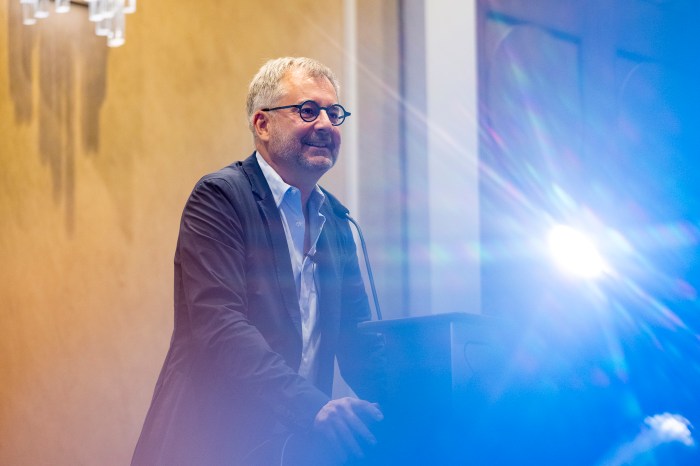
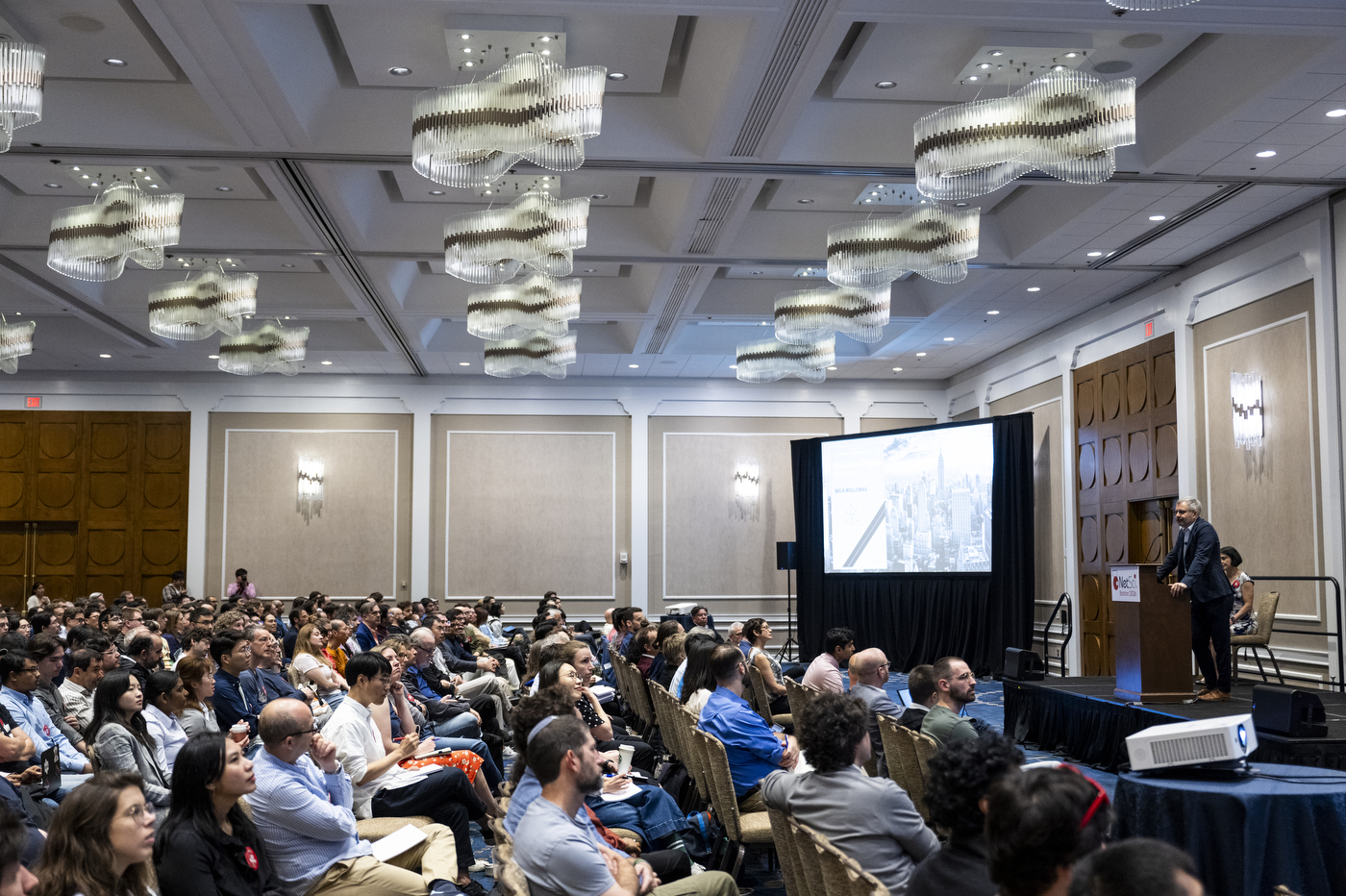
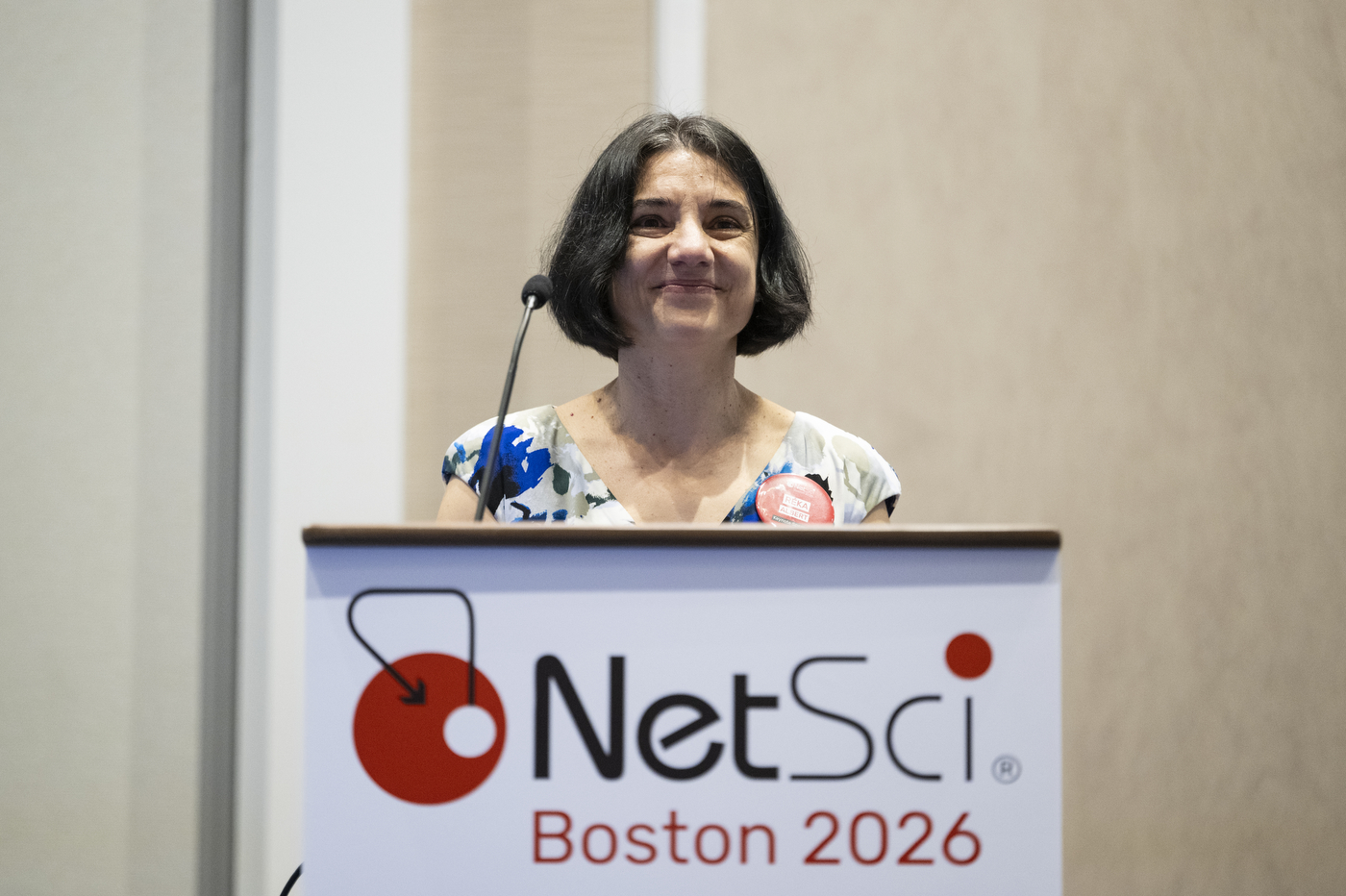
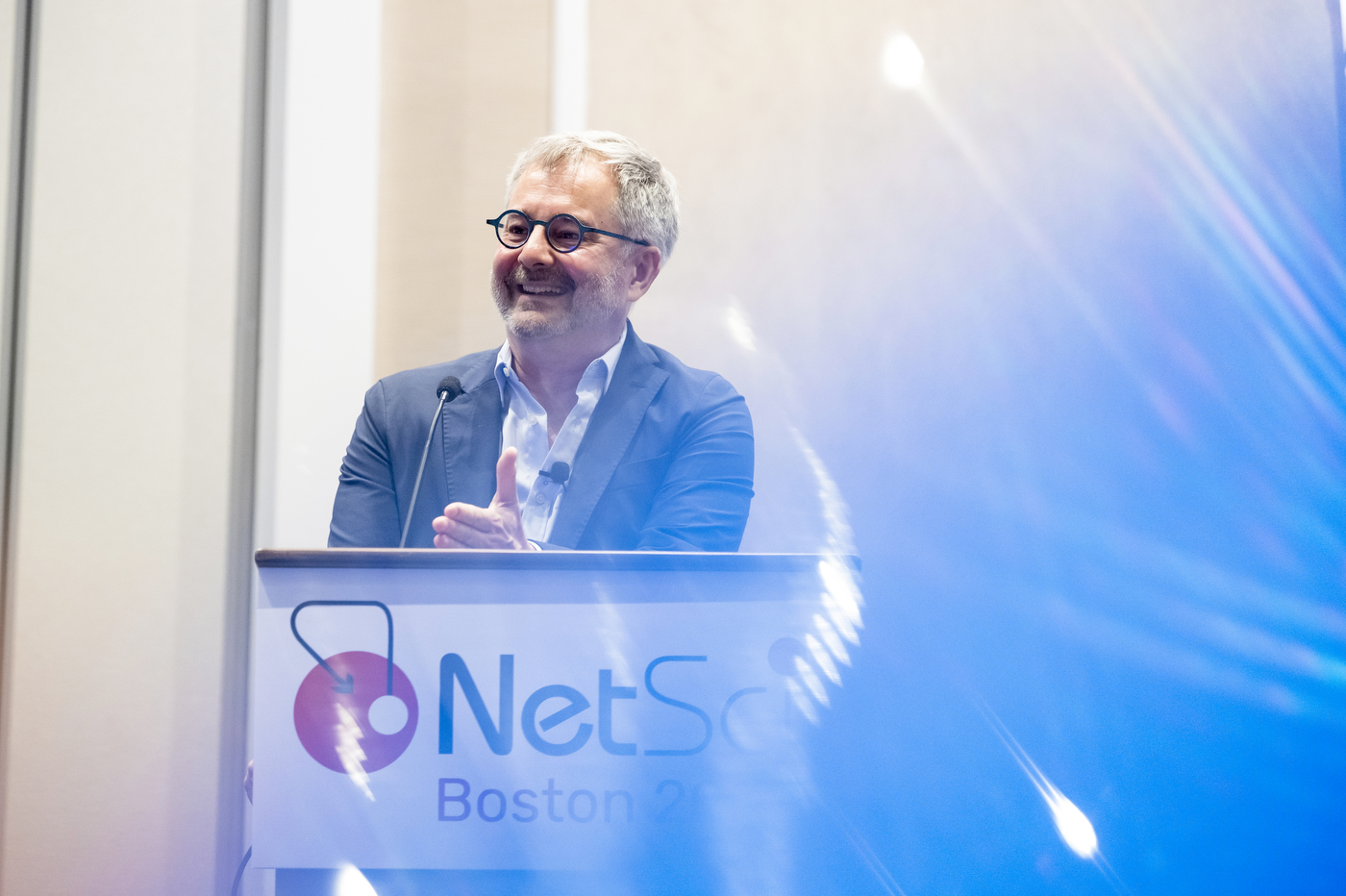
Albert-László Barabási and Réka Albert, two of network science’s founders, know that better than most. During a keynote speech at NetSci 2026, the two traced a path from the field’s origins, their seminal research that established the foundations of network science and the growing importance of the field in the world today.
“There are stories which are not just about results or important scientific contributions,” said Alessandro Vespignani, director of Northeastern’s Network Science Institute and the Sternberg family distinguished professor. “[Some] really opened the doors to an entire community to enter a world. This is what Réka and László have done.”
Network science generally involves the study of connections between different parts of a system, broadly categorized as hubs and nodes. They are deliberately abstract concepts that can apply to everything from biological concepts like proteins to road infrastructure.
Barabási, now a member of the Network Science Institute and the Robert Gray Dodge professor of network science and a distinguished university professor of physics at Northeastern University, created his first network diagram on Jan. 17, 1995, and never turned back. That diagram visualized invasion percolation, a mathematical model that describes how fluids slowly displace each other in rock, soil, foam and other porous materials.
“At that time, I was living in New York City, and I was walking around the city and I started to imagine how many networks there are around us,” Barabási said.
The more he started to look at the telephone lines and roads around him, the more he started to question why more scientists weren’t studying these systems of connection. He figured there had to be some universal principles that could help scientists better understand the world around them and the connections that governed it.
“This was what got my mind going,” he said.
Much to Barabási’s disappointment, he faced rejection after rejection from academic journals for his work in the early 1990s. No one disputed his ideas, but everyone asked the same question, “Why should we care?”
Despite the tepid response, he wasn’t ready to give up on network science as a field. He just needed real data, he figured.
In 1996, Barabási secured a position at the University of Notre Dame and set his mind on an ambitious task: mapping the World Wide Web, which was still in its infancy.
He struggled to get any collaborators to sign onto his project and had all but given up on studying networks when he reencountered Isaac Asimov’s “Foundation” series of science fiction novels. Central to Asimov’s series is a mathematician who develops a way to predict the future. Even then, Barabási saw the potential of using networks as a forecasting tool, he said.
“It also was the moment I realized this is a problem where I have been very, very successful alone, and I need somebody to help me,” he said.
Barabási met that somebody in Réka Albert, his doctoral student at the time.
Now a distinguished professor of physics and biology at Pennsylvania State University, Albert at that time saw network science as an abstract field that could nonetheless solve real-world problems.
“I was very excited to follow my adviser into this new scientific territory, and I was very excited at the prospect of finding universal principles,” Albert said during the NetSci keynote.
With Albert working to develop theories for how the components of networks –– hubs and interconnected nodes –– operated, Barabási returned to his passion project of mapping the World Wide Web.
Working with physicist Hawoong Jeong, the researchers developed a program that could follow a trail of hyperlinks from one web page to another. With their digital bloodhound, they could map the connections between every web page on the internet, which at the time was only about 800 million compared to the more than 2 billion that exist today.
Barabási expected it to be a purely random network. They discovered that any two websites chosen at random were, on average, only 19 hyperlinks away from each other.
Editor’s Picks


Their research, published in 1999, was revolutionary and completely changed how scientists understood networks. Networks, the team showed, were constantly growing systems of connection governed by certain universal principles that appear in everything from the spread of infectious diseases to the neural networks used in AI.
Barabási and Albert also introduced the concept of scale-free networks in which every node, or point of connection, could potentially link to any number of other nodes. These networks are constantly growing due to a phenomenon known as preferential treatment, where new nodes in the network — in this case websites — prefer to connect to preexisting superhubs. Today, these are sites like Google or Wikipedia that connect large swaths of the internet.
Wikipedia’s citations are not just essential for verifying information and giving credit. They are a roadmap to other corners of the internet.
Barabási still had to fight hard for these ideas to get accepted by an academic journal, but now, the Barabási-Albert model introduced in their 1999 research is a foundational algorithm used in network science and an array of fields, from physics to sociology.
Following their groundbreaking research, in 2001, Barabási and Albert published a summary of the entire field at the time, “Statistical Mechanics of Complex Networks.” It became a guide for the next generation of network scientists, Albert said.
When Albert graduated from Notre Dame in 2001, she essentially became the first network science Ph.D., she said. She was far from the last.
“For the first time, I can say I feel a sense of urgency for what we do, and this is something that not often happens in the scientific community,” Vespignani said during the event. “The impact that this community can have on the world is deeply important at the moment.”
With a research team that spans continents, Barabási and the other members of Northeastern’s Network Science Institute have now become leaders in the field. Their disease tracking and forecasting project Epistorm became instrumental in responding to the COVID-19 pandemic.
“Why do we need networks?” Barabási said, echoing the question he’s received throughout his career. “Because the world works as a network.”