This Northeastern student and percussionist wants to make the marimba more accessible. Here’s how
From oak to bamboo plywood to plastic used in 3D printing, a Northeastern student studied the properties of 17 materials to see if they could come close to the Honduras rosewood preferred in marimbas.


When Amartya Bhattacharya was in high school in Minnesota, he found himself in an unusual situation.
While his fellow classmates who played many of the band instruments were able to practice at home, he, as a marimba player, was competing for practice time in the band room. He and the other percussionists only had the one five-octave Yamaha professional marimba at school to practice on.
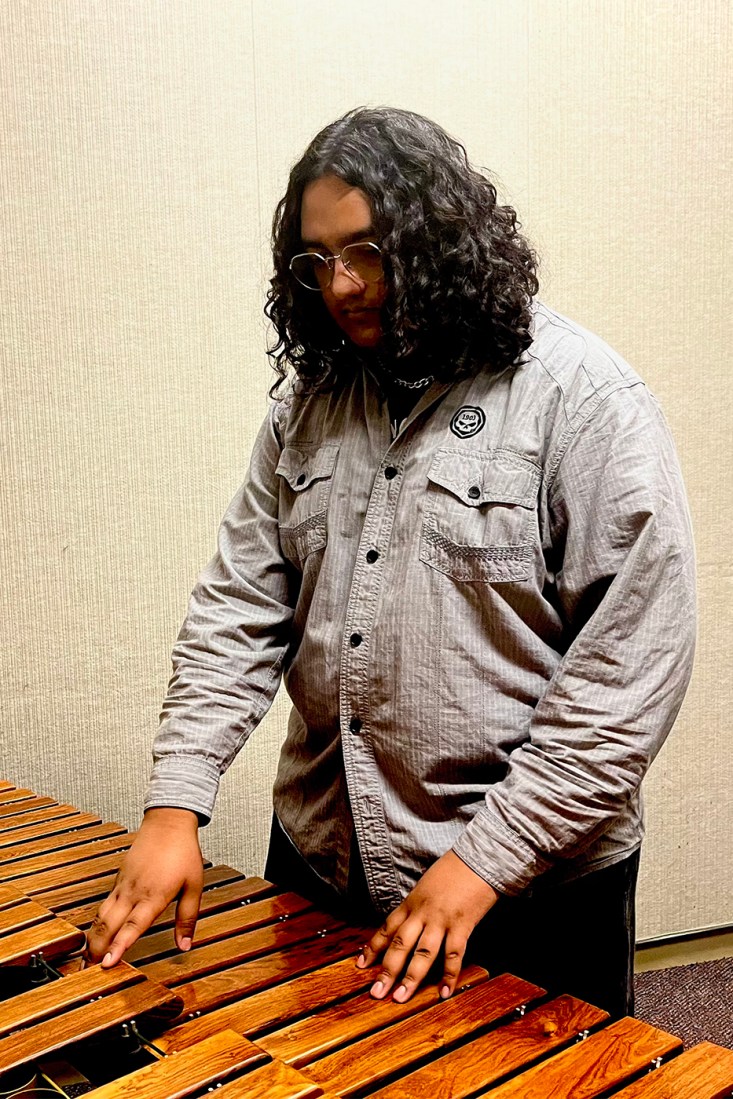
This was especially apparent during the Covid-19 pandemic, when Bhattacharya couldn’t enter the band room and had to rely on similar but altogether different instruments, like the glockenspiel, to practice.
It made Bhattacharya, now a computer science and computer engineering student at Northeastern University, wonder about ways to more easily access a marimba.
“I realized that a lot of our peers in wind instruments and such, like clarinet, trumpet, flute, et cetera, could just bring their instrument home and practice,” he told Northeastern Global News. “And as percussionists, almost none of us have marimbas at home and so it limits our ability to grow unless we stay at school (to practice).”
Beyond its size, the percussion instrument, played with a yarn-wrapped mallet, owes its rounded, earthy sound to the distinctive Honduras rosewood that’s typically used to make its xylophone-like sound bars. It is a slow-growing wood found in Belize, Guatemala and Mexico and can cost up to $53 per board foot. But because the rosewood is also at risk of deforestation and trafficking, the amount of wood needed to put together the instrument means one marimba can cost tens of thousands of dollars.
“Having access to a less expensive instrument, I think that’s something a lot of students and a lot of percussionists would share in that desire,” said Andrew Morrison, coordinating editor of musical acoustics for the Journal of the Acoustical Society of America, which publishes research on the wide-ranging subject of sound.
Bhattacharya started working on this problem while in high school. A class required him to partner with a mentor and conduct a research project and instead of exploring a topic related to computer science, he sought this issue that directly affected him.
He studied the properties of 17 hardwoods, softwoods, plywoods and plastics and found two – hickory and cherry – that have promise to be further explored as potential practice instrument substitutes to hopefully help a wider range of percussionists work on techniques like resonance, rolling and bar response. Hickory and cherry cost $8 and $6.20 per board foot, respectively.
Editor’s Picks




The rising sophomore presented his findings at a recent meeting of the Acoustical Society of America and submitted for publication to the society’s Proceedings of Meetings on Acoustics.
After getting input from mentor Jim Woodhouse, emeritus staff in the engineering department of the University of Cambridge who has written a book about the mechanics of musical instruments, Bhattacharya experimented by measuring the density and vibration of a range of materials for their durability and the quality of the sound. The materials included oak, pine, poplar, walnut, bamboo plywood and plastic used in 3D printing. He then compared the measurements from these materials to those of the rosewood and paduak, another type of wood used for marimbas.
The results were all over the place, according to Bhattacharya. “There would always be materials that are great in one area, and they’re just horrible in another area,” he said.
The plastics used for 3D printing, for example, had great density. But the sound was off.
“They were just completely dead. It sounded like I was hitting a table or something,” he said.
While no material he tested matched the rosewood or paduak, hickory and cherry came closest. Hickory had sufficient density and its stiffness measurement was close to that of the rosewood. Cherry is less dense than hickory, but it could be useful for lighter-duty practice bars, he said.
That nothing quite compares to rosewood isn’t a surprise, according to Doug Bielmeier, a teaching professor in Northeastern University’s Music Department who was not involved in the study.
“We often assume that if two materials have similar physical properties, they’ll sound identical, but subtle differences in density, stiffness, damping and resonance can fundamentally change an instrument’s character,” Bielmeier said.
The difficulty in mimicking sounds was evident in the Yamaha NS-10 studio monitor, he said, which was discontinued in 2001 due to the halted manufacture of a specialized pulp in the loudspeaker’s white woofer.
“Although newer materials could replicate many of its measured characteristics, engineers and producers still debate whether the replacements truly capture the original sound and response,” he said.
Morrison also wasn’t surprised by Bhattacharya’s conclusion, saying it underscored how difficult it is to find material substitutes.
“There’s definitely a real need in the world for alternatives that are either more sustainable, or lower cost, or both. Those are all good things to chase after,” he said.

As for Bhattacharya, he next wants to create actual tonal plates out of hickory. These aren’t just rectangular wooden bars, but involve tuning by sanding the underside to create the desired overtone. It’s a skill in and of itself, which Bhattacharya said could take weeks or months to do.
But it’s his love for the instrument that makes the work worthwhile. “It’s such an expressive instrument for me,” he said. In addition to the marimba, Bhattacharya also plays the dhol, a double-sided drum, with Aaroh, a Northeastern club that performs various styles of Indian music. “The marimba itself has a very warm, rounded sound, especially in its deep register. It has a very beautiful ring that is very unique to it.”


