Northeastern grad’s MFA exhibit asks: ‘Can You Hear the City?’
Northeastern graduate and artist Kelly Chen worked with Boston youth on an exhibit in the Museum of Fine Arts, exploring city life through mosaic and sound.


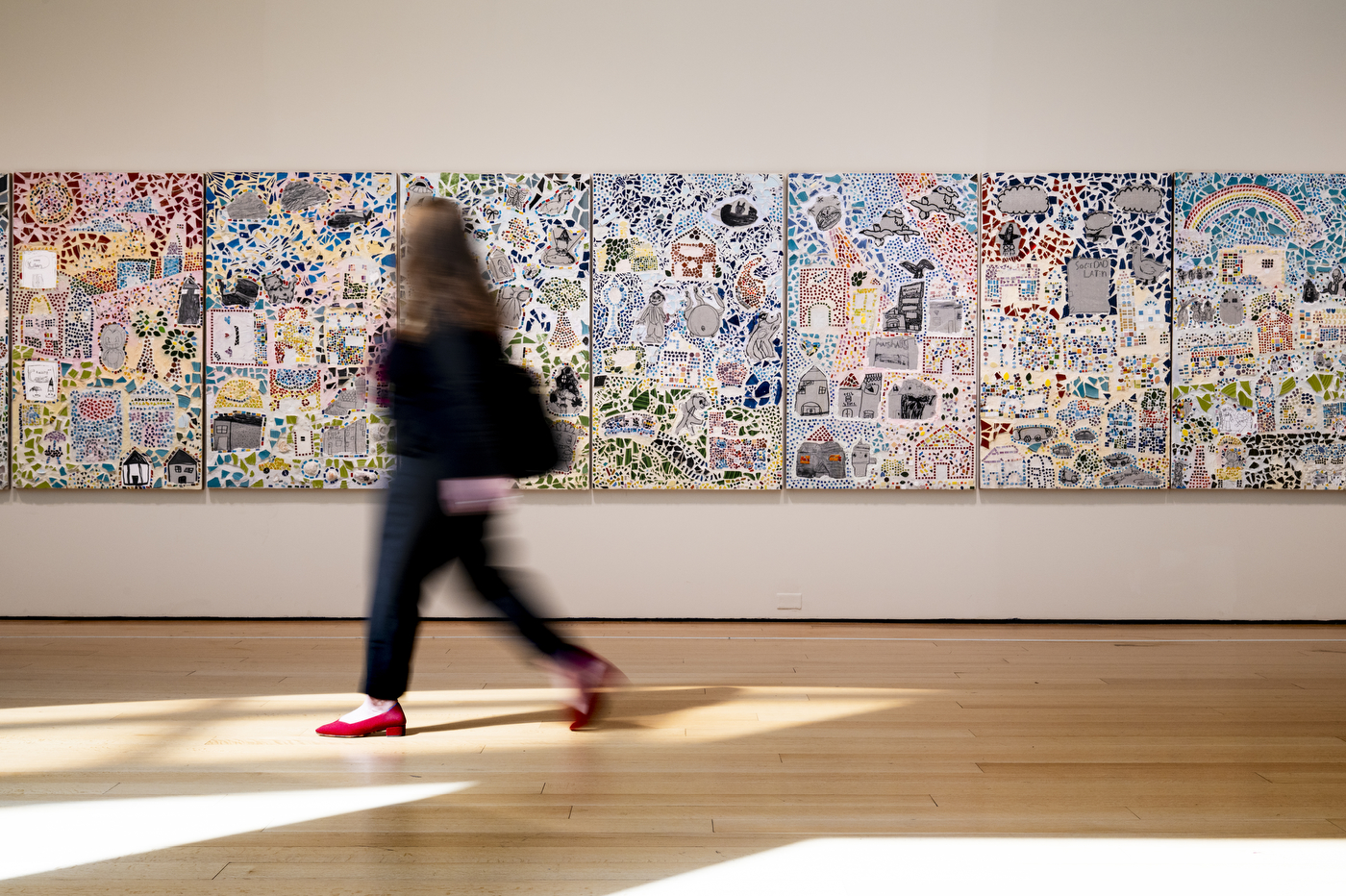
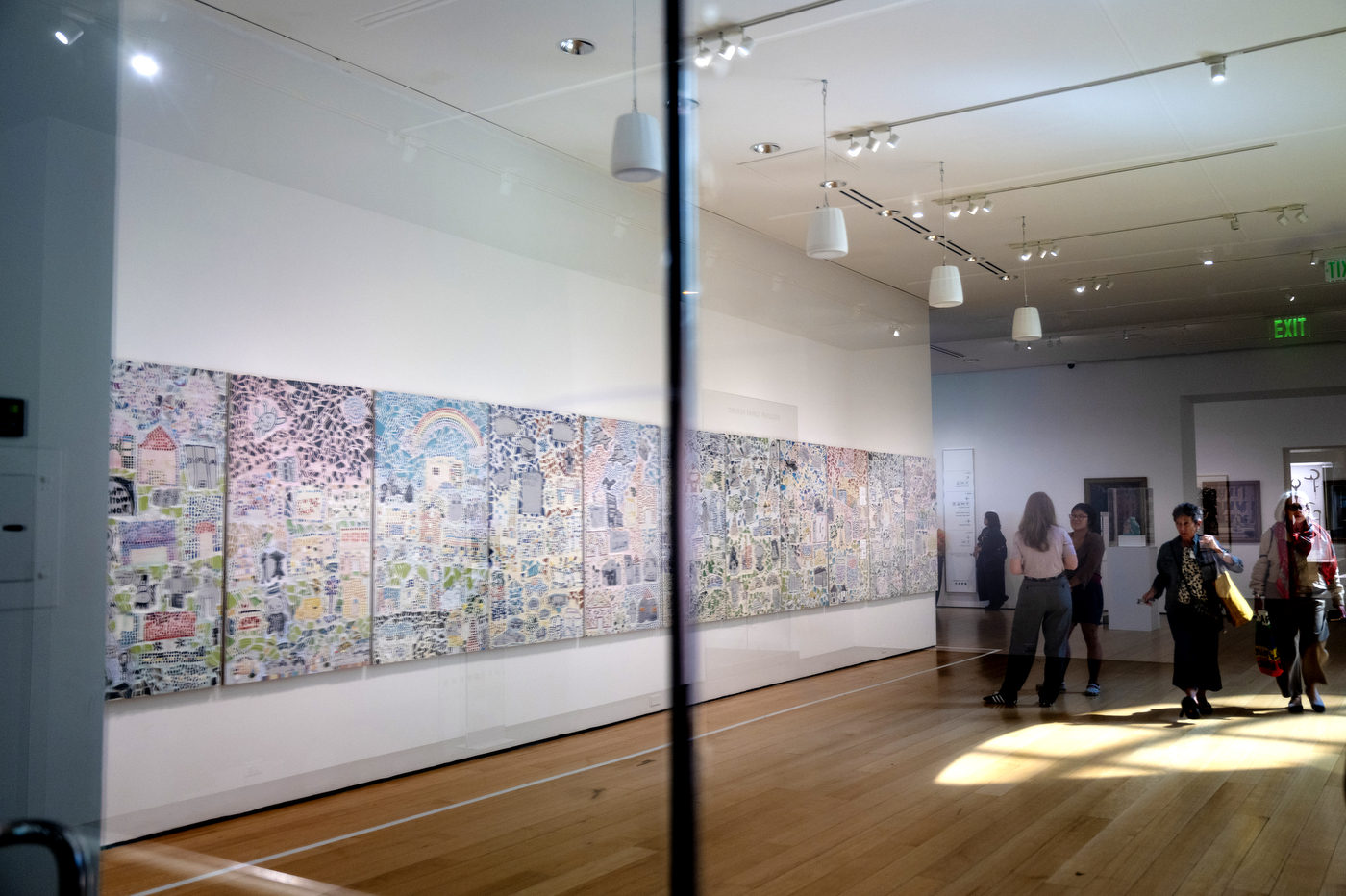
Scenes of city life imagined by Boston’s youth unfold across a dozen large colorful mosaic panels on display at the Museum of Fine Arts. In one tableau, an alien spaceship abducts a Marshall’s chain discount store. Another shows a wintery scene with snowmen, tiled snowflakes, an AMC movie theater and a hand-written sign that reads “The World Needs You.”
Twelve-year-old Alicia’s contribution was a painting of the Boys & Girls Club of Dorchester, where she’s been a member for the past few years.
Her reason for depicting the youth organization was simple.
“It feels like home,” she said. “My friends that I have (here) are meaningful.”
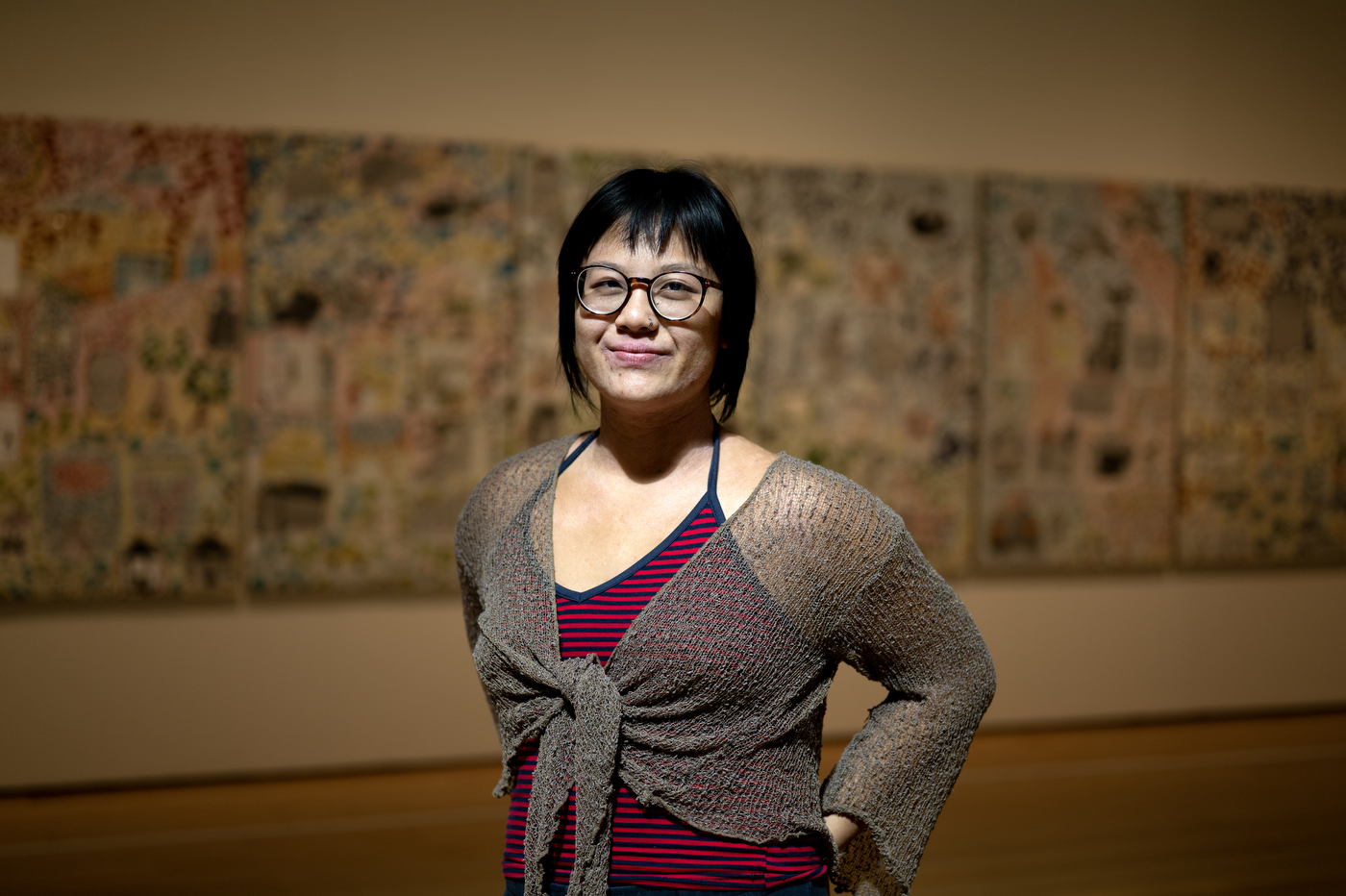
Through the Community Arts Initiative, which introduces young people to the museum’s collections and how art is made, Northeastern University graduate and artist Kelly Chen collaborated with more than 150 members of a dozen local youth organizations over a roughly eight-month period to create the exhibition: “Can You Hear the City?”
Each panel displayed in the Linde Family Wing for Contemporary Art represents the creative contributions from members of a specific club. As part of the art-making process, Chen gave the youth recording devices to capture the sounds of their neighborhood during deep listening walks.
Those sounds, compiled into audio collages, are piped in over three speakers placed above the mosaics. There are children laughing and squealing and interviewing one another, the honking of passerby cars, and a recording device taking a bumpy trip down a slide.
Eleven-year-old Joceyln said since participating in the program, she notices more colors and details around her neighborhood.
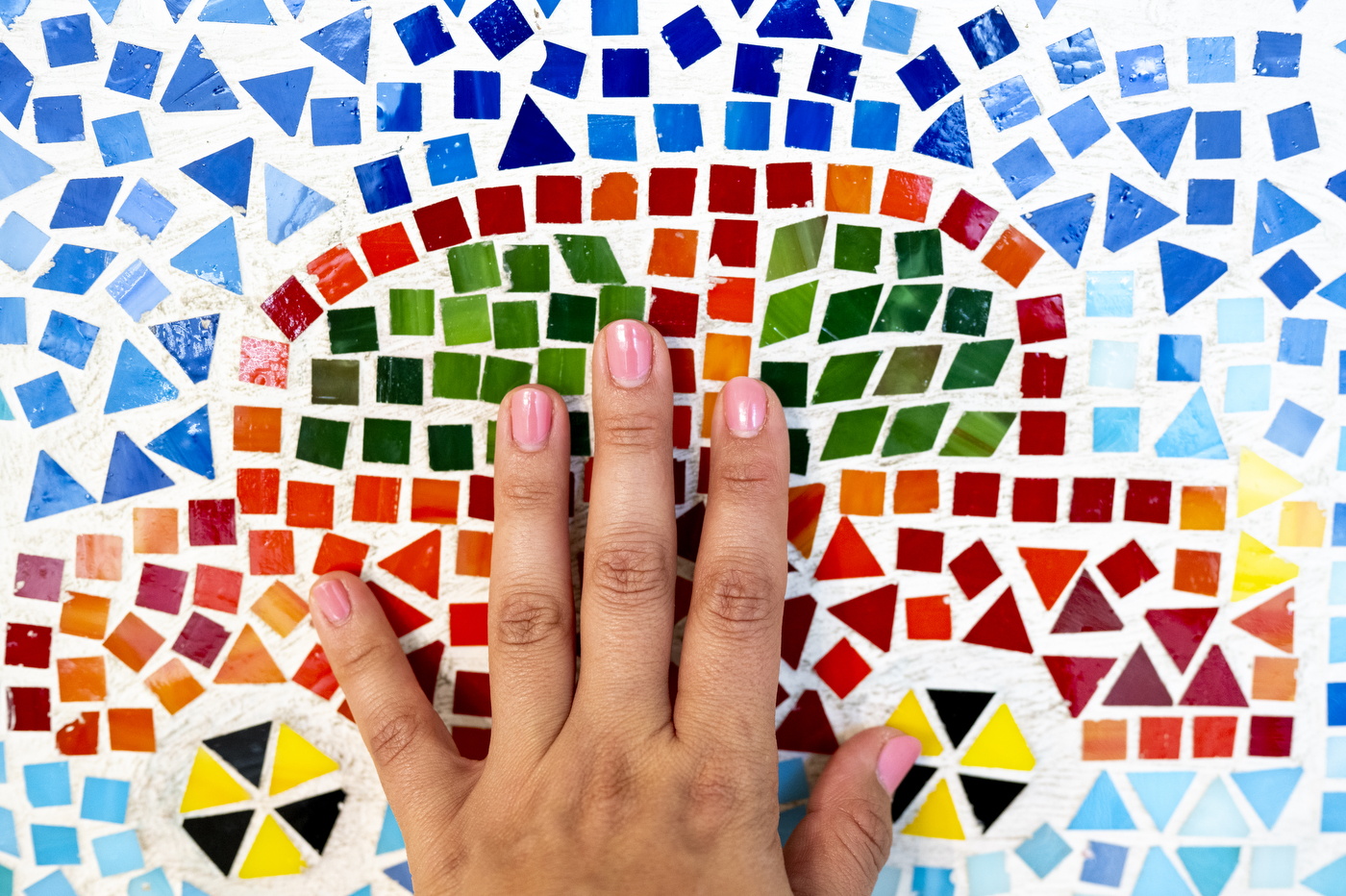
“I learned that you could use pieces of broken things and create new stuff with it,” she said. “It helped me remember that people love to do art because they want to show compassion and show the world what they feel, what they like, different stuff they want to do.”
Chen hopes that people who view the exhibition and hear its sounds “leave thinking about what they do or don’t pay attention to and how that affects their spatial reality.
“It’s very easy to do in a city, to go tunnel vision and not pay attention to the things around you,” said Chen, who graduated in 2023.
The collage is on view through Oct. 25, after which the mosaics will live at the respective youth organizations.
Sound is a large part of Chen’s artistic process. While at Northeastern, where she studied media studies and data science, Chen was big into the city’s experimental music scene and often uses field recordings and sound collages in her work to document space and time. Two audiovisual solo works by Chen that explore preserving memories in digital spaces also accompany the exhibit.
“It’s a different access point to experiencing something. It’s not just seeing it, it’s hearing it and feeling it,” she said, adding that this Community Arts Initiative piece “is such a snippet of that moment in their life, the sound and spatial rendering of that very specific moment in their fall semester of last year, which is cool. It’s almost like a little time capsule.”
In a roundabout sense, Chen also drew from the critical theoretical text she was exposed to from her classes with communication studies teaching professor Kristopher Cannon, which asked questions about representation, power and knowledge.
Editor’s Picks


“That’s part of our goal. To make (our students) more critically engaged with the world and their work. That’s something that Kelly always had in spades, and I think that it’s well-deserved,” Cannon said. “She’s an incredibly hard worker and very motivated to make things happen for herself, so I’m not surprised that this happened either.”
For this exhibition, Chen said she thought about Boston as a constantly changing city. But who has the power to influence Boston’s story?
“It’s rare that youth are given that agency to think about their civic space and how it’s represented and who they are in it, and art is a really great way to do it,” she said.
Chen started out the process by asking the teens and preteens what makes up their Boston neighborhoods, who lives there and what makes them run? Perhaps there’s City Hall, a train station or other municipal fixtures.
She was soon met with some resistance to this narrow idea. To them, Boston was just school and home.
“They want to draw Hello Kitty. she said, referring to the iconic Japanese cat character. “They don’t want to draw a library.”
That made Chen reconsider the way in which these youth viewed their world, and decided to expand the concept to what the exhibition viewers will see.
“It’s important that their world is both their digital space and their physical space, both places that are changing rapidly,” she said. “Once I made (the concept) a lot looser, it became a lot easier and better and more engaging.”
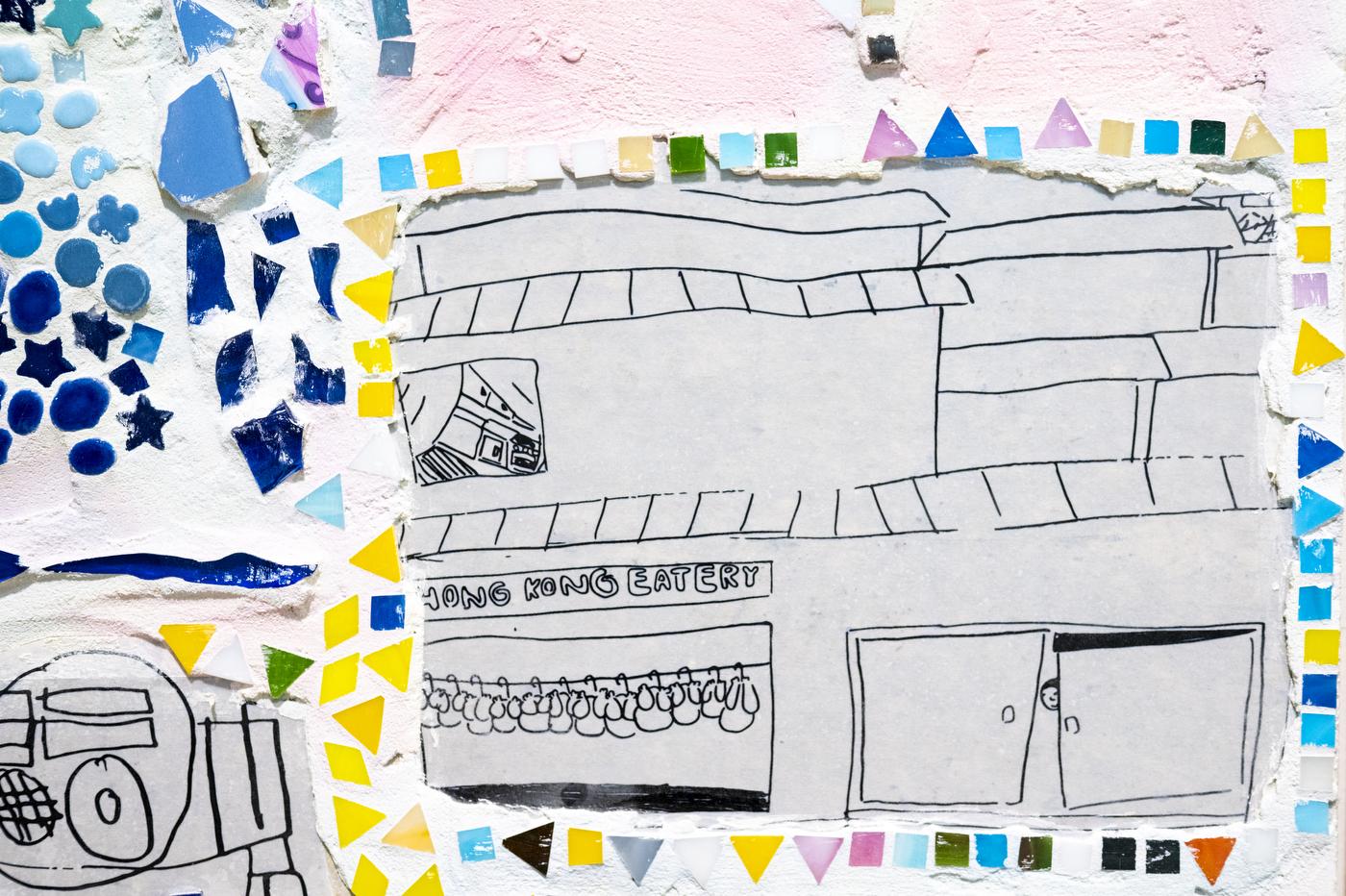
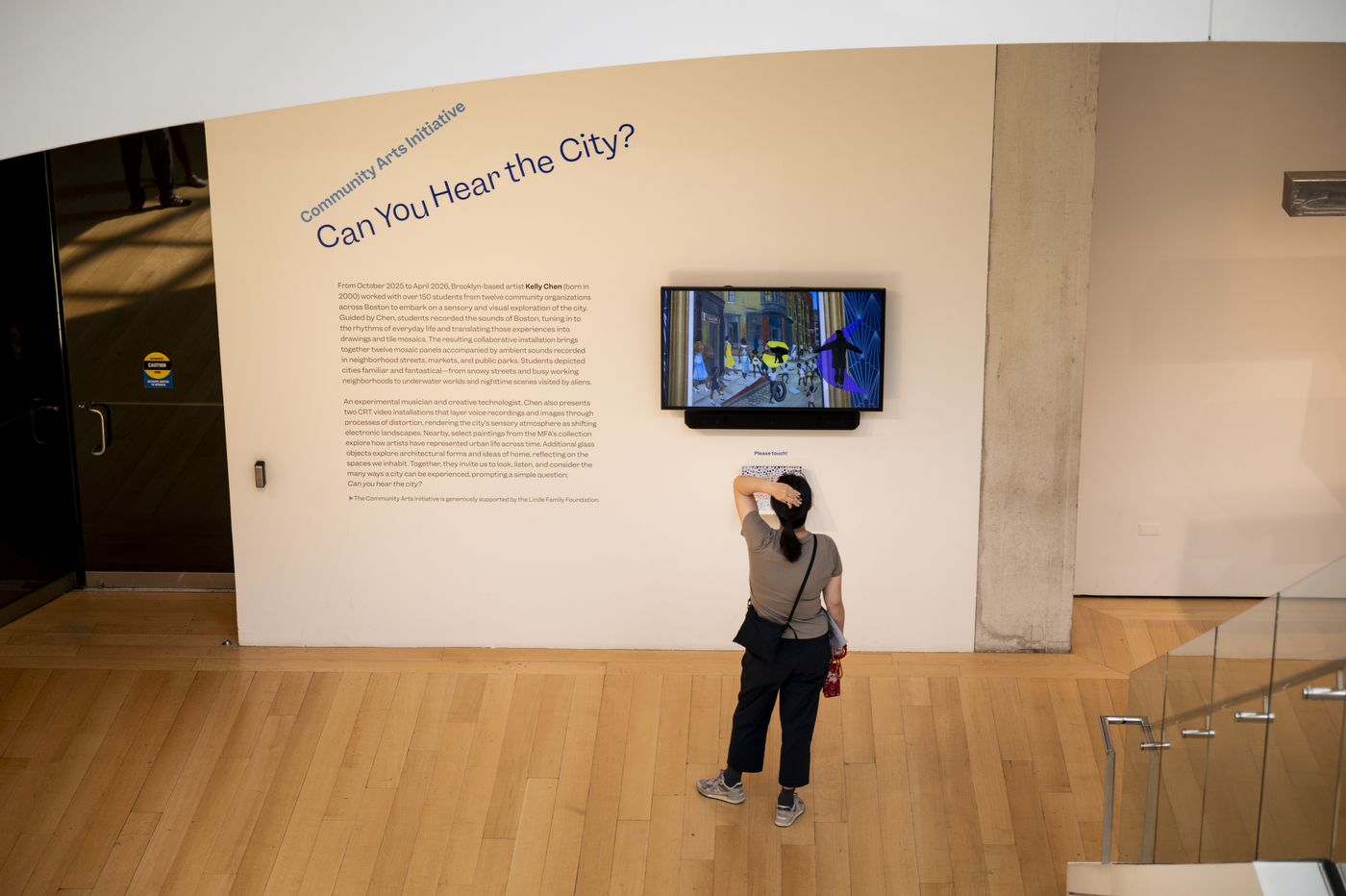
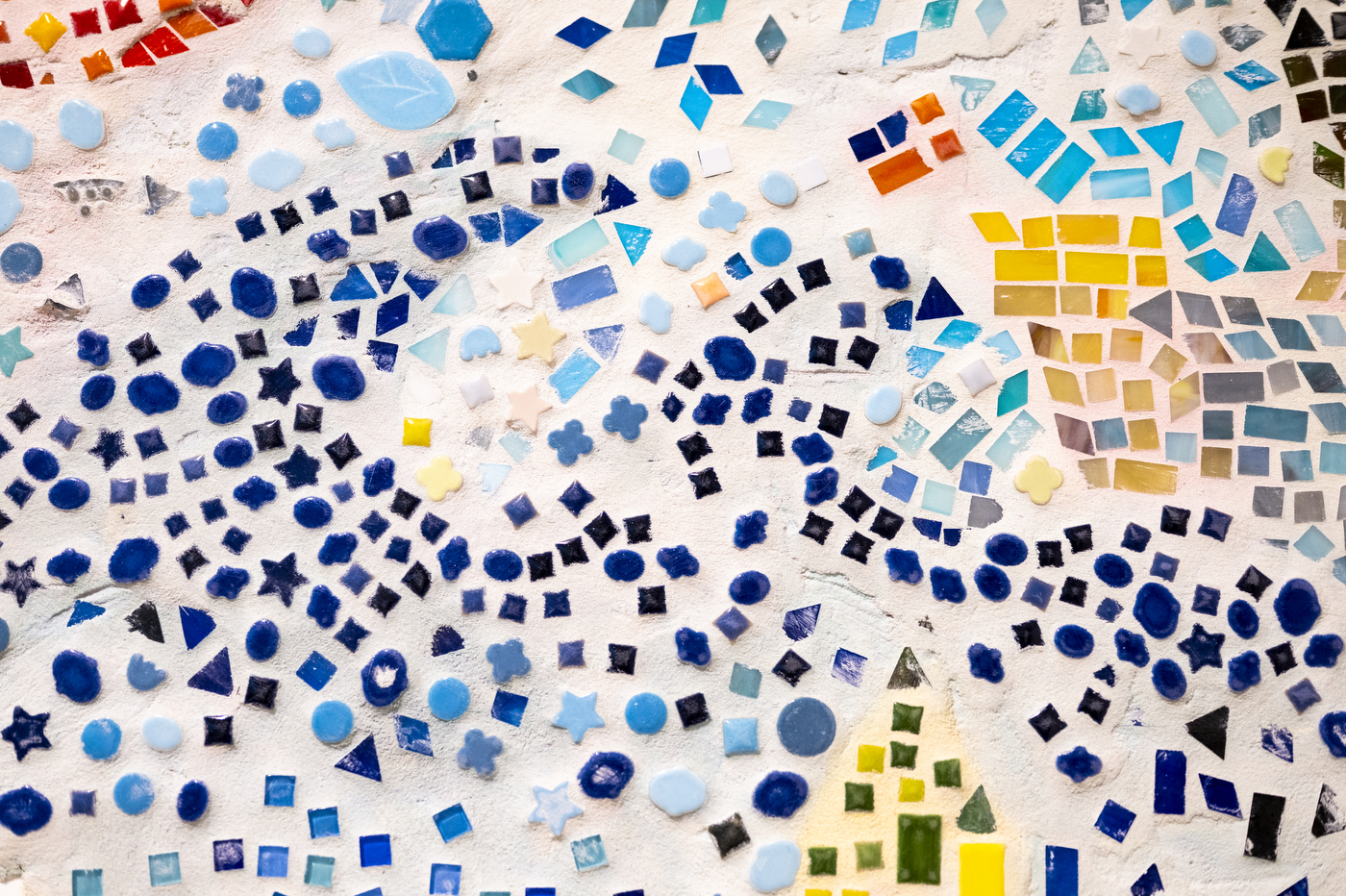
After capturing their neighborhood sounds, the club members toured the museum’s collections to learn about how cities are represented in other pieces of art, like in Edward Hopper’s nighttime still life of a street corner called “Drug Store” and “Tire Jumping in Front of My Window” by Boston artist Allan Rohan Crite, which captured a playful street scene in Boston’s South End. The youth then drew and mosaiced the objects, people and places that would be found in their cities, which Chen arranged in the larger cityscape.
“I want people to walk away thinking about who gets to be represented in a museum, what you’re allowed to do in a museum and what kind of content is accepted,” she said.
Katy Sullivan, art director for the Boys and Girls Club of Dorchester, said this kind of exposure to working artists and the museum allows its members to “have a chance to see art as something more than just something they do after school, something more than just a fun hobby.”
“Being able to work with so many kids at that capacity gives them all a glimpse into the art world here in Boston that they may not have otherwise had the opportunity to be a part of,” Sullivan added. “Sometimes it feels like an inaccessible space.”
Working with the youth in this way mirrored Chen’s own journey as a student at Northeastern University, with her professors and advisors helping her navigate an untraditional path where she was divided by two interests in the College of Arts, Media and Design and Khoury College of Computer Sciences.
“The flexibility and the amount of expertise and advisory, without trying to get me to do a certain thing, was really important,” she said. “Giving me a little bit of guidance of what to look into, who I should go assist or art to engage with in the greater Boston area was more helpful than being like, ‘Go get this internship at this specific place.’ I really appreciated the space that being at Northeastern gave me.”


