The story behind the 16-foot bronze hare sculpture installed on the Boston campus
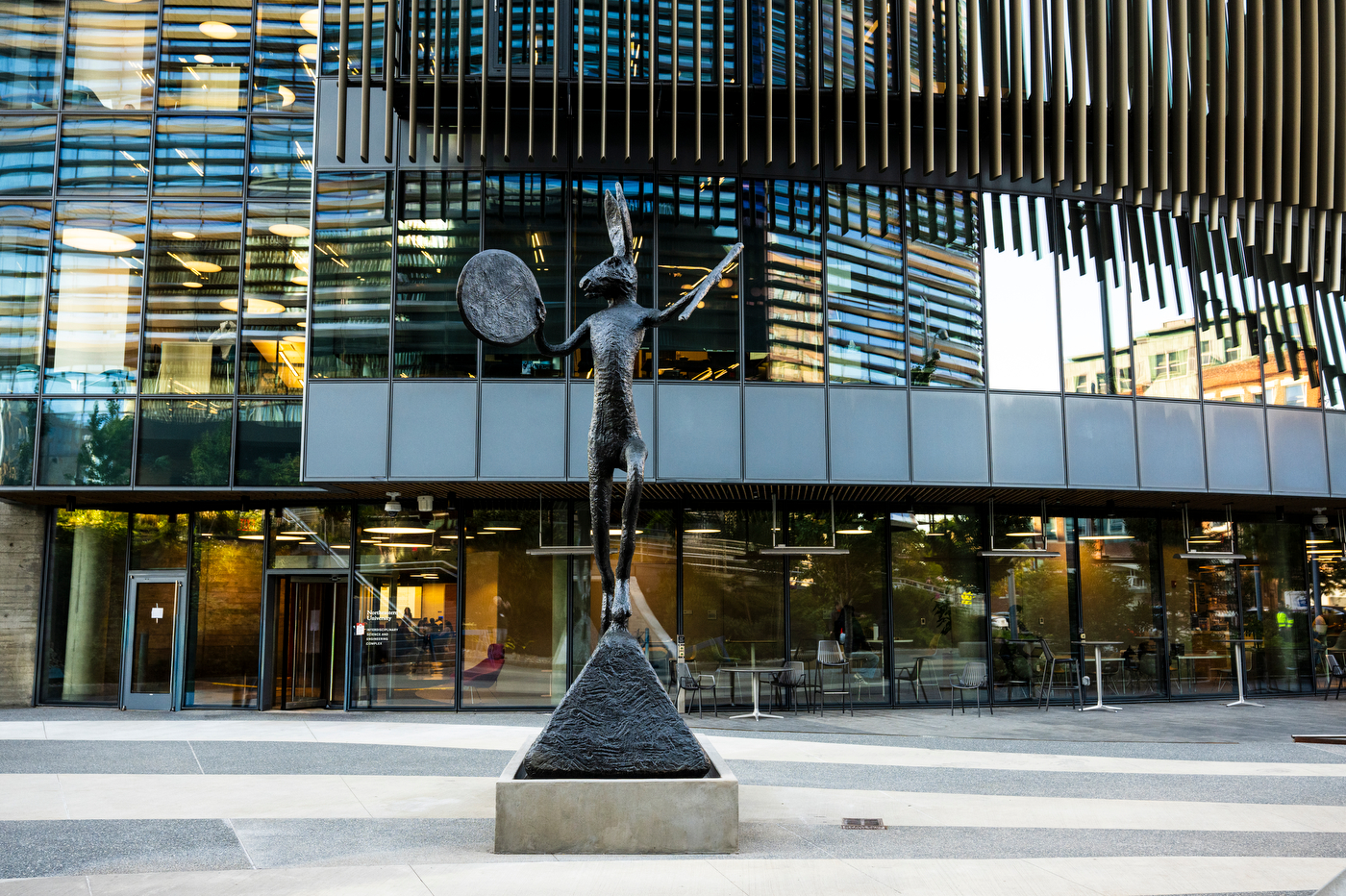
A whimsical, 16-foot bronze sculpture of a hare playing a drum was installed on Northeastern’s Boston campus, adding to the university’s display of public art.


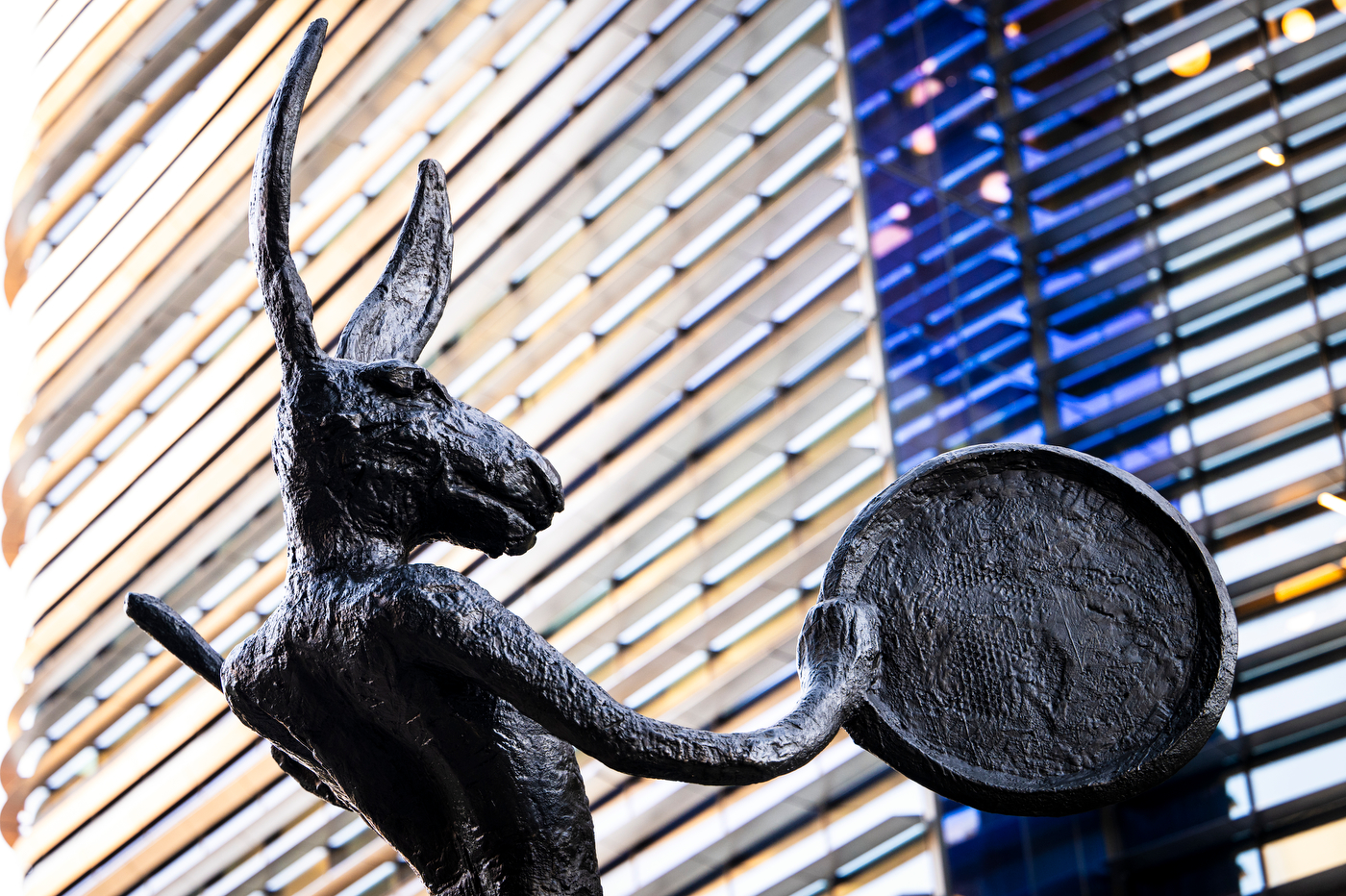
The hare stands upright on its long, squiggly hind legs, one stepping in front of the other toward a triumphant climb. Its back is arched; head is turned right with long ears pointed and aloft.
The animal’s right paw clutches a round hand drum. Its left raises a drumstick, as if poised to strike a beat.
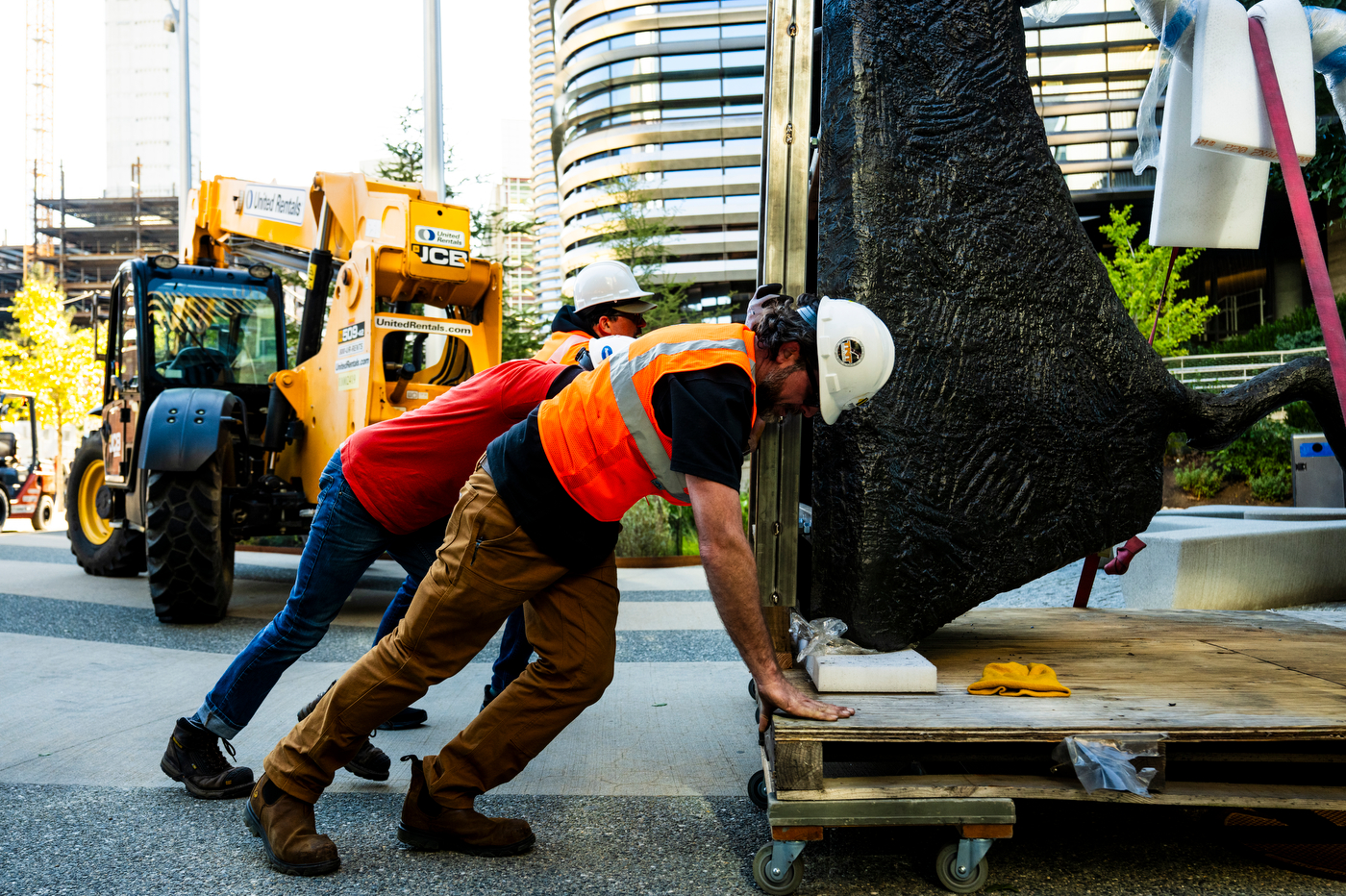
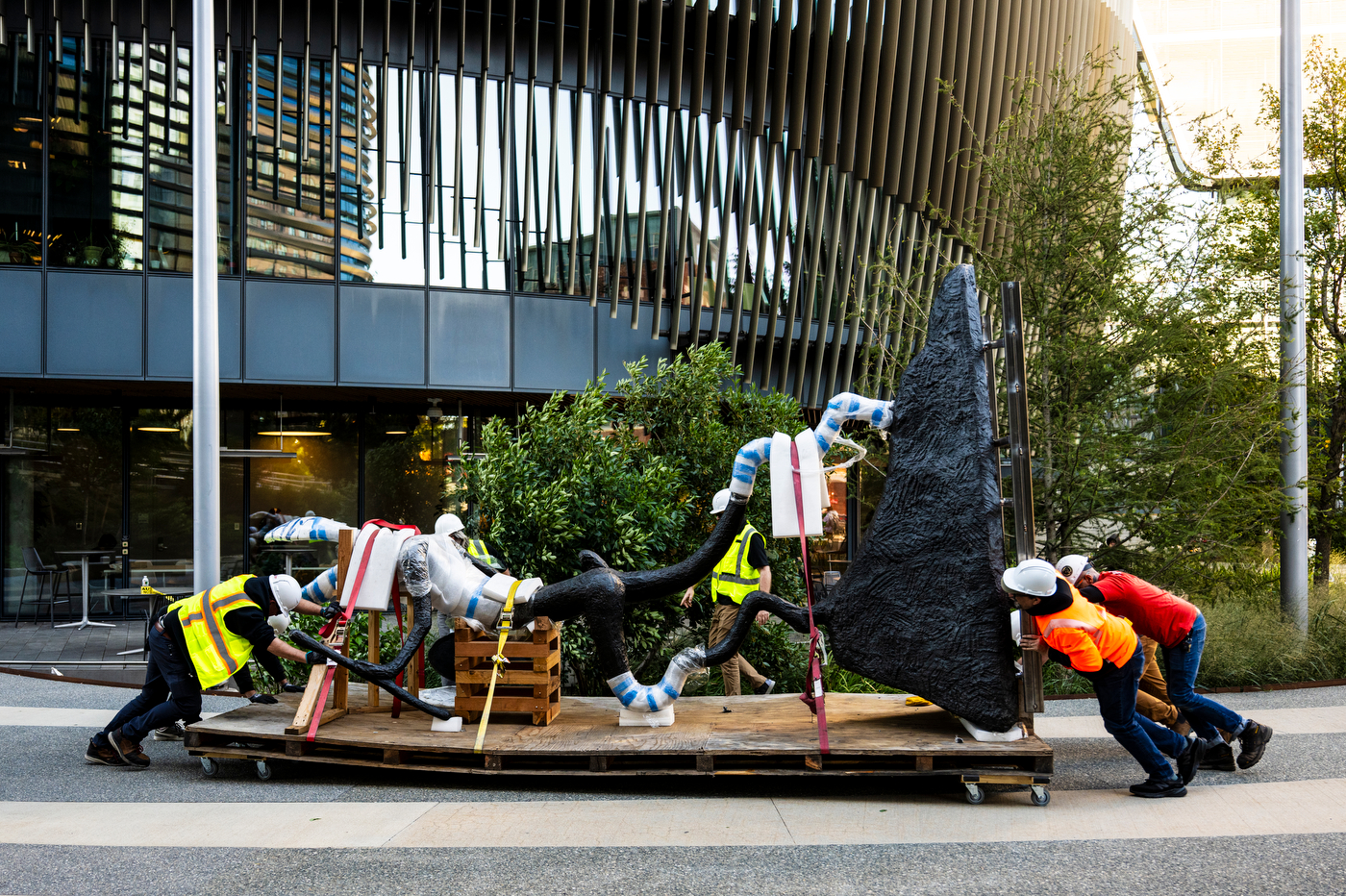
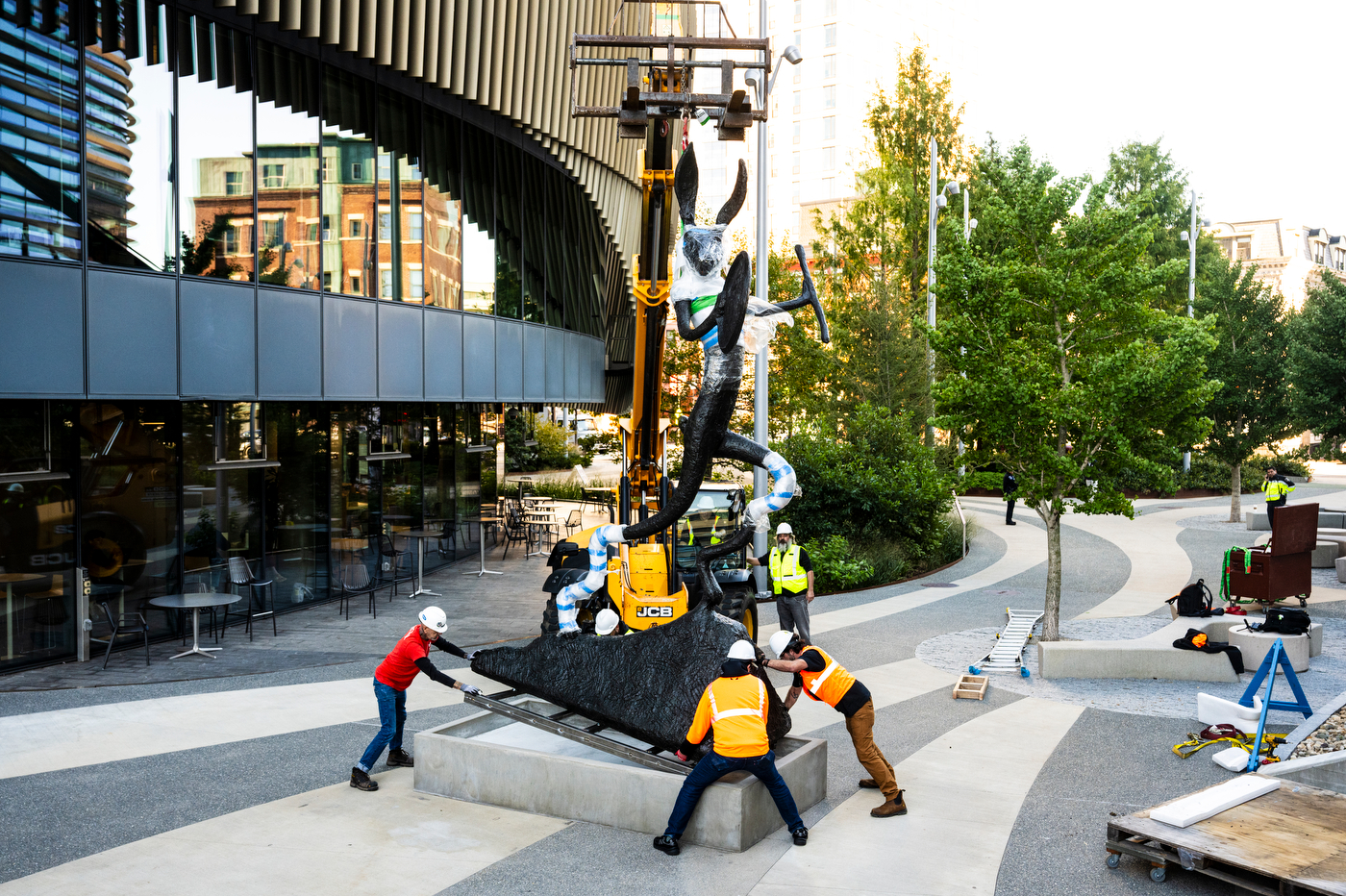
The 16-foot, 2,600-pound bronze sculpture by Welsh-born artist Barry Flanagan called “Large Left-Handed Drummer” was installed Tuesday afternoon – the latest public art piece on Northeastern University’s Boston campus – as a short-term loan from the London-based Waddington Custot contemporary art gallery.
It can be found atop a concrete plinth between EXP and the Interdisciplinary Science and Engineering Complex in a curious juxtaposition between the hare’s whimsy and the innovative research happening in each building.
The 2006 sculpture speaks to leadership and community, said entrepreneur and avid art collector David Roux. He and his wife Barbara partnered with the university in 2020 to launch the Roux Institute in Portland, Maine.
“No one plays the drum by themselves,” Roux said. An observer of the sculpture could imagine a group of people – or animals – behind the hare, he added. Maybe they’re marching to a party or wedding, or perhaps some are dancing or playing instruments.


“You can just see the expression that we’re doing something special together,” he said. “I think that’s what I was really taken by.”
Flanagan, who died in 2009, created a sculpture series based on hares in various human-like poses, beginning with the 1980 piece “Leaping Hare.” At a time when other artists had a growing focus on abstract expressionism, Flanagan doubled down on “this figurative, representational style,” Roux said.
Editor’s Picks


“I’m a sucker for the rebel in him and admire the stick-to-it-ness and his dedication to his craft and his personal vision,” he added, noting that the piece is special because he too is left-handed.
The Rouxs have a collection of sculptures displayed outdoors across their sprawling St. Bride’s Farm in Virginia. They own another Flanagan piece called “Acrobats 30’,” in which one hare performs a handstand on the outstretched hands of another.
Having developed relationships with museums, galleries and estates of prominent sculptors over the years, the couple’s curator alerted them of the potential for “Large Left-Handed Drummer” temporarily to live on one of Northeastern’s campuses. Roux worked with President Joseph E. Aoun to make it happen.
“Our campus is a canvas, enriched by artists from every corner of the world,” said Aoun. “Public art doesn’t just decorate a space; it sparks dialogue, challenges perspectives, and connects us to one another. We’re delighted to add this statue to that story.”
As the sculpture arrived wrapped up in protective covering on the back of a flatbed truck, Shayna Ahteck and Jay Rodolitz watched from the patio at EXP. The computer science Ph.D. students were catching up over coffee and they were captivated, Ahteck said.
“A lot of the sculpture art around campus has been very abstract and suggestive of form,” Ahteck said. “I’ve really liked the presence of interesting art on the Northeastern campus. I’m excited to see what’s going to greet us.”
Northeastern’s art scene offers a range of curiosities around every corner, no matter the campus. In Boston, the “drummer” joins similarly figurative sculptures like “A Man and a Cat Named Yitz” outside of Shillman Hall, as well as an untitled spray paint piece by a Parisian street artist and the “100 Years of Solitude” mural on the Columbus Parking Garage overpass that kicked off Aoun’s Public Art Initiative. Ming dynasty statues of Chinese lion-dogs guard Oakland’s Mills College Art Museum, a place for exploration and experimentation with contemporary art. The works of students and professionals are on display inside and out of galleries on the New York City campus.
“You don’t get to see a sculpture installed every day,” Rodolitz said.
“A new figure as a gateway to the center of campus,” added Ahteck.
Flanagan’s inspiration for the drummer came in part from a medieval drawing of a hare with a drum, and also from a separate sighting of a coursing hare, Flanagan’s estate told Northeastern Global News.
According to a quote provided by his estate, Flanagan once said that “the image of that drawing stuck in my mind’s eye. I had seen this hare … let’s say the hare courses, rather like a dog that’s supposed to be chasing after something. And this hare coursing parallel to a car I was driving with plenty of time for it to wend itself to my hunter’s eye…”
The sculpture has been exhibited in many places over the years, including New York’s Union Square Park, the Royal Academy of Arts in London, and the Petit Palais museum in Paris.
Roux noted that there’s a depth to the piece beyond whimsy or anthropomorphizing animals. In mythology and folklore, hares often are used to represent fertility or immortality.
“I think that you really have to see it, and really [Flanagan’s] whole body of work through this lens of symbolism, where for him, the animals were really saying something and connecting us to a broader existence and one which is oftentimes lost as we live and work in these big cities, where you’re not in an agrarian city,” he said. “It’s a very important reconnection with that.”


