These Northeastern professors are “sculpting” radio waves
Northeastern’s Institute for Wireless Intelligent Network Systems is working with the U.S. Army Research Office to build large antennas to bend radio waves.


Wouldn’t it be nice if your car could warn you about a vehicle racing along the road on a blind curve?
Despite advancements made in vehicle safety technology in the past 10 years, a standard car’s radar — the system that helps tell you when objects or people are close to your car — still can’t do that. Sensor systems found in most cars today still need a direct line of sight to detect objects in front, on the side, or behind them, according to Northeastern wireless security experts.
But Josep Jornet and Tommaso Melodia, leaders of Northeastern’s University’s Institute for Intelligent Networked Systems,which studies wireless communication systems, could help make that future a reality as members of a new $15 million research center funded by the U.S. Army Research Office.
The pair will spend the next five years helping to develop a new class of extremely large scale antenna arrays, or ELSAAs, that will be capable of bending and sculpting radio waves at will, according to a release published by the Institute for Intelligent Network Systems.
This is important because a lot of information shared wirelessly travels through radio waves but many radio and radar technologies in use today rely on systems that can only direct those waves in a straight uniformed fashion, Jornet explained.
This innovation could serve as a foundational technology in improving the detection of objects in challenging environments, the researchers said.
“Think of a wireless signal like a flashlight beam: anything in the way blocks it, “Jornet said. “We’re teaching signals to bend around corners and repair themselves after hitting an obstacle, so the connection holds when it matters most.”

The U.S. Army is particularly interested in this technology to help it improve its military and threat detection systems, the pair said. For example, it could help better spot drones and other aerial threats that might be located behind structures, they said.
The U.S. Army Research Office did not immediately respond to a request for comment from Northeastern Global News on the potential of the new technology.
But, the hope eventually, is for this technology to trickle down into products and services used by the general public, such as car safety features.
Jornet and Melodia will be tackling the project on two different fronts.
Editor’s Picks


Jornet is charged with developing the mathematics behind the technology. This work intersects directly with his research on terahertz frequency bands, a next generation wireless technology capable of operating at wireless frequencies that are significantly higher than a standard fifth generation, or 5G, connection.
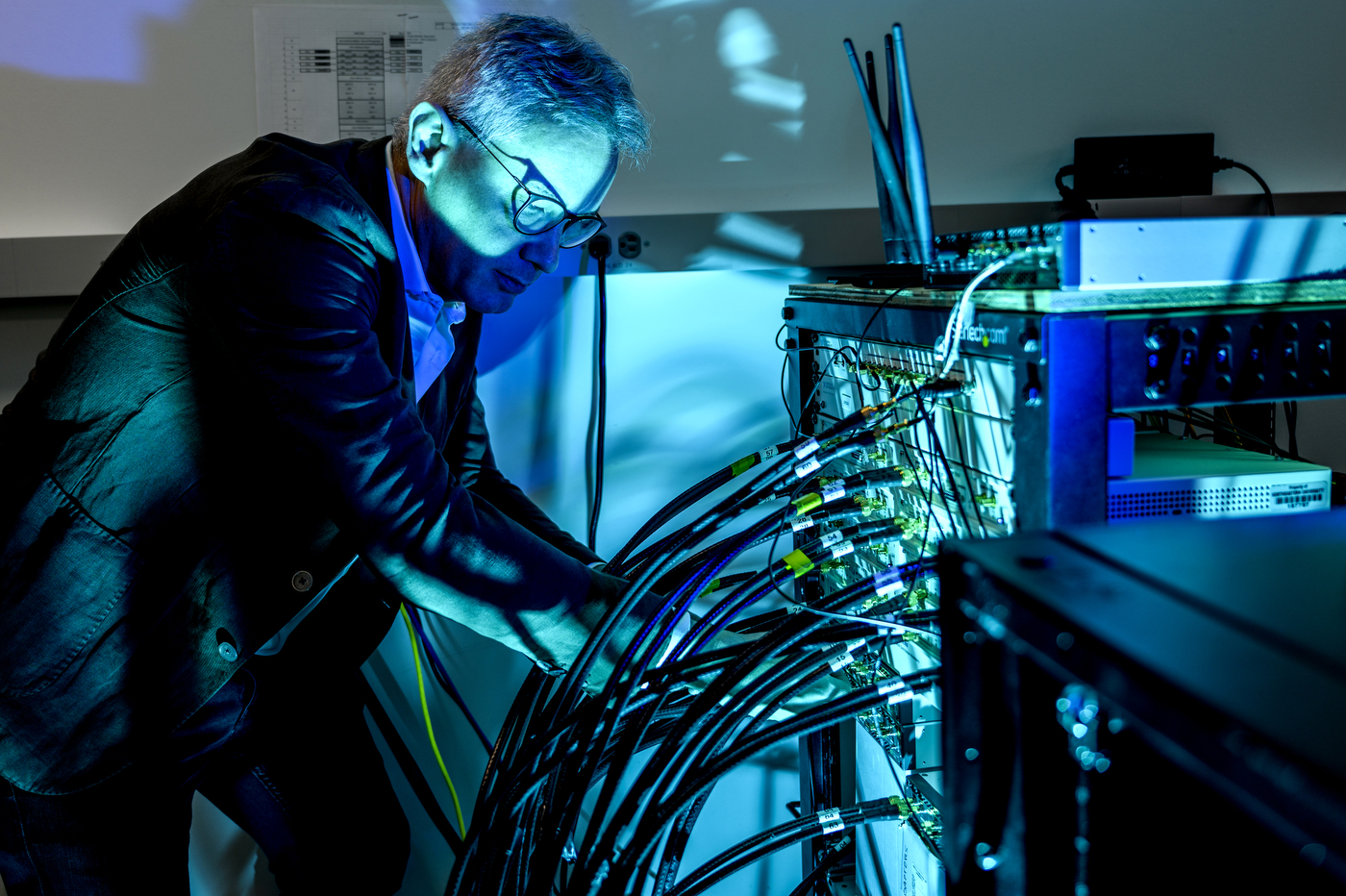
Melodia, by contrast, using Northeastern University’s in-house technology will validate the findings. Specifically, he will test the technology on the institute’s private 5G network, its wireless testing network bed called Arena, the university’s anechoic chamber, a room that stops sounds and echos of electromagnetic waves, and on the institute’s outdoor drone facility located on Northeastern’s Burlington campus.
“We are proving this on real hardware, meaning we have this real cellular structure and we are developing capabilities there,” said Melodia, a professor of electrical and computer engineering and the director of the Institute for Intelligent Systems.
Northeastern has partnered on the project with several other universities and labs, including Rice University, Brown University, Duke University, the University of Texas at Austin, the University of California, Los Angeles, and Los Alamos National Laboratory.
They are also working with major industry partners, including Booz Allen, Intel, Keysight, Lockheed Martin, MITRE, Northrop Grumman, Qualcomm, and Raytheon – all major technology companies working in national security and defense.
Melodia said he’s hopeful this technology will one day help improve the lives of the general public.
“A significant amount of technology that was developed for military purposes falls down to commercial products — everything from the internet to cellphones,” he said.


