Spain versus Belgium: What the data says about the matchup
Spain’s ability to break defensive lines will be key in its matchup against Belgium.


Spain is the only team left in World Cup play to have not conceded any goals, and Belgium is riding high after a dominant victory over the United States.
The high-stakes quarterfinal match takes place at 3 p.m EDT Friday at Los Angeles Stadium.
The data points to some notable trends that shed some light on how the game may turn out, explained Brennan Klein, director of Northeastern’s NetSI Sport research group. The data was collected by the sports analytics company Hudl StatsBomb.
How Spain could win
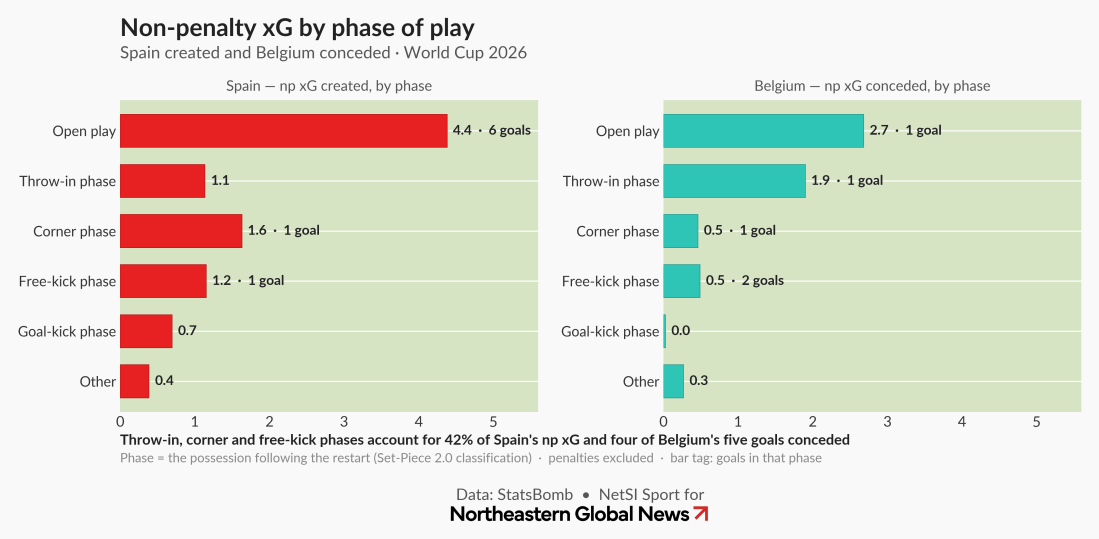
In all of its World Cup matches so far, Spain has found a lot of its success in scoring goals during open play, which is when the ball is in motion during a match as opposed to a free kick or throw-in.Of the nine goals the team has recorded so far, six have come from scoring opportunities during these situations, the data shows.
This is a testament both to the team’s strong attacking formation and its ability to break defensive lines, Klein said. That’s not surprising, in part because the team’s strong dribbling prowess, he said. One standout is Lamine Yamal, largely considered one of the best dribblers in the world, who at this World Cup averages eight dribble attempts per match and successfully completes on average 3.8 of them.
For context, the U.S. was leading the tournament in successful dribbles with nine per match before it was eliminated, Klein said.
“Yamal has basically 40 percent of those on his own per match,” he said.
Additionally, the team has an exceptionally strong defense. Over five games, Spain has only faced 30 shots and a cumulative of 1.3 of expected goals, or xG, faced, which Klein highlights is “extremely low.”
Because of the team’s versatility, particularly its ability to break opponent’s lines of defense, Klein forecasts that Spain will not find it challenging to infiltrate Belgium’s defenses, which he described as inconsistent since the formation of its starting 11 players changes from match to match.
The data also shows the Belgian team has conceded 2.7 of xG from open play, the highest of any other phase of play in a match that leads to a scoring opportunity, including throw-ins, corner kicks, and free kicks. While only one goal has been scored against the team from open play so far in this tournament, Klein attributes it mostly to luck and “superb” goalkeeping.
How Belgium could win
However, Belgium certainly can also take advantage of vulnerabilities in Spain’s strategy. Spain tends to hold its defensive line high up on the pitch, leaving a lot of open space on the lower end for its opponents to take advantage of, Klein said. To capitalize on this, the Belgians will likely turn to Charles De Ketelaere, Dodi Luekbakio and Leandro Trossard, who rank highly in key passes, deep completions, progressive carries and shot-creating actions, Klein said.
Read more World Cup analysis on NGN Offside →
If the match goes into penalty kicks, the Belgians also have an advantage with their goalkeeper, Klein said.
Belgium’s goalie Thibaut Courtois has proven to be excellent in stopping penalty kicks in high-stakes settings. Throughout his career, he has saved 13 penalty kicks out of 66, including one during the 2022 World Cup, for a success rate of 20%. By contrast, Spain goalie Unai Simon has made eight saves out of 37, for a success rate of 21%.
While they are roughly equal in success rate, with Simon having the slight edge, Klein noted that the fact that Courtois has faced so many more penalty kicks in his career puts him at an advantage.


