Physicist explains how to ‘bend it like Beckham’
Professor Arun Bansil said the “absolute key” to bending is the Magnus force or effect.
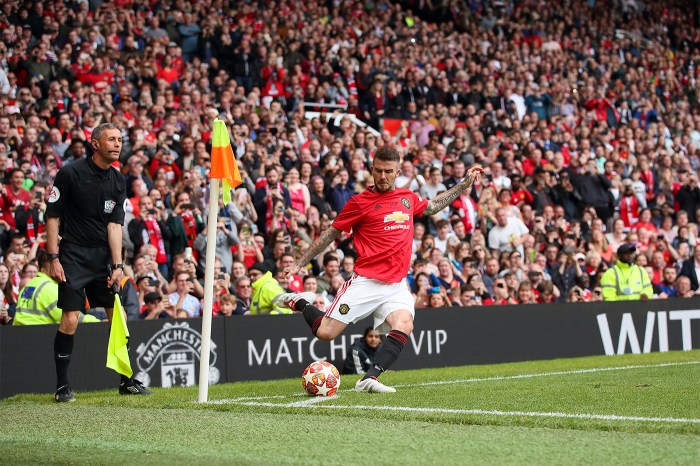

It contributed to soccer legend David Beckham’s record number of goals on direct free kicks, and entered popular culture by inspiring a movie which, in turn, inspired a West End musical.
So, how do you bend it like Beckham? At least from a physics point of view?
Northeastern University physicist Arun Bansil said many forces are at play in “bending” a soccer ball — including gravity, which draws masses with energy toward each other, and drag, which slows down the forward motion of the ball.
Bansil said the “absolute key” to bending, however, is the Magnus force, or effect, which is the generation of a sidewise force triggered by a ball spinning through the air.
“As the ball rotates, one side moves with the oncoming airflow while the other moves against it,” said Bansil, university distinguished professor of physics at Northeastern. “This accelerates the air on one side and decelerates it on the other.”

Thanks to Swiss mathematician Daniel Bernoulli, we know that the pressure in the faster-moving air is lower than the pressure on the slower-moving air, Bansil explained, and this pressure difference pushes the ball sideways, or perpendicular to the direction of motion, toward the lower-pressure, faster-moving air.
Read more World Cup analysis on NGN Offside →


But creating the Magnus effect is all dependent on spin, what Bansil calls “the magic of bending.”
A ball spinning left-to-right will bend left, while a ball spinning right-to-left will bend to the right. A ball spinning from top-to-bottom produces topspin that bends the ball downward.
The degree of that bend includes not just the amount of spin on the ball but the ball’s speed, Bansil said.
“Slower, heavily spinning balls tend to curve more dramatically than fast, lightly spinning ones,” Bansil explained, due to the former generating more Magnus force. Greater speed also generates more Magnum force, but because the ball spends less time in the air, the effect is “more subtle,” Bansil added.
“Skilled players combine foot placement, contact, and follow-through to control the direction and the degree of bend with impressive precision,” Bansil said.
In fact, skilled players aim not at the target, but a point offset from it, to account for the curve, Bansil said.
“The amount of offset depends on the speed of the shot, the amount of spin, and the distance to the target,” as well as wind conditions that can push the ball from side-to-side or forward or back.
However, perfecting that aim takes more than physics.
“Aiming a curving ball is both an art and a science,” Bansil said.
As is protecting the goal against a bending ball.
“Elite goalkeepers cannot simply react to the bend of a ball,” said Ashley Phillips, Northeastern’s women’s soccer coach and a former college goalie. “They must begin reading its flight before it is ever struck.”
Thus goalies must recognize the kicker’s angle of approach, hip position, plant foot, pace of leg swing, and point of contact on the ball, to begin to predict a shot’s pace, spin, and potential bend, Phillips said.
“That early information allows them to move sooner, while their reactions enable them to make the final adjustments as the ball travels,” Phillips continued. “Great goalkeeping is the seamless combination of anticipation and reaction.”


