Spain versus Argentina preview: Team brilliance versus individual star power
Here’s what the data says about the World Cup final between Spain and Argentina on Sunday.


Defending World Cup champion Argentina will meet second-ranked Spain in the final match at New York New Jersey Stadium on Sunday.
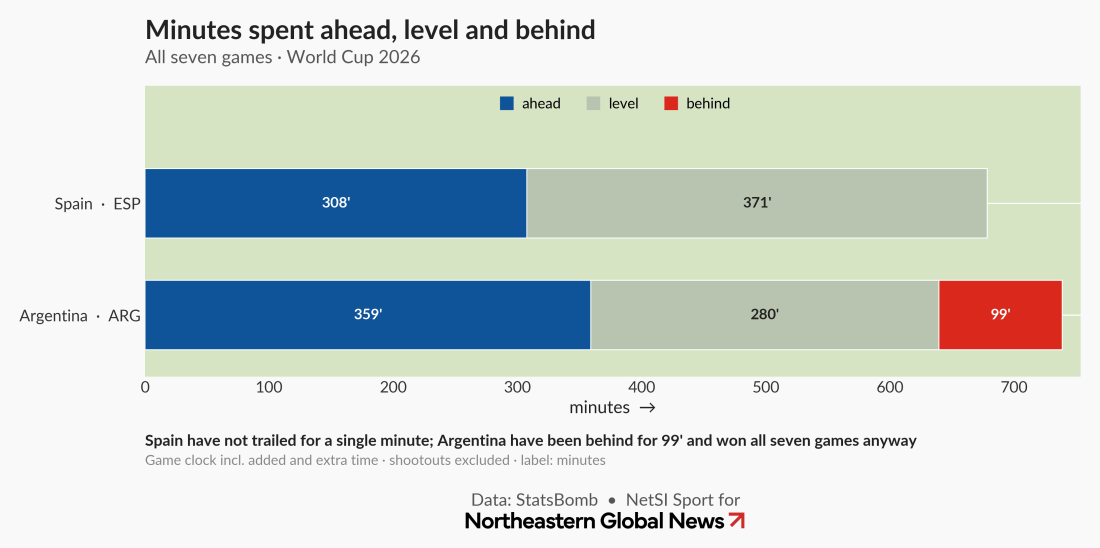
By the metrics, Spain is the higher-performing team, explained Brennan Klein, director of Northeastern University’s NetSI Sport research group. It’s yet to trail in any match, has only conceded one goal and handily beat France – a top-four ranked team – in a semifinal matchup.
“In terms of team play and tactical prowess, I see no reason that Spain shouldn’t win this game,” he said.
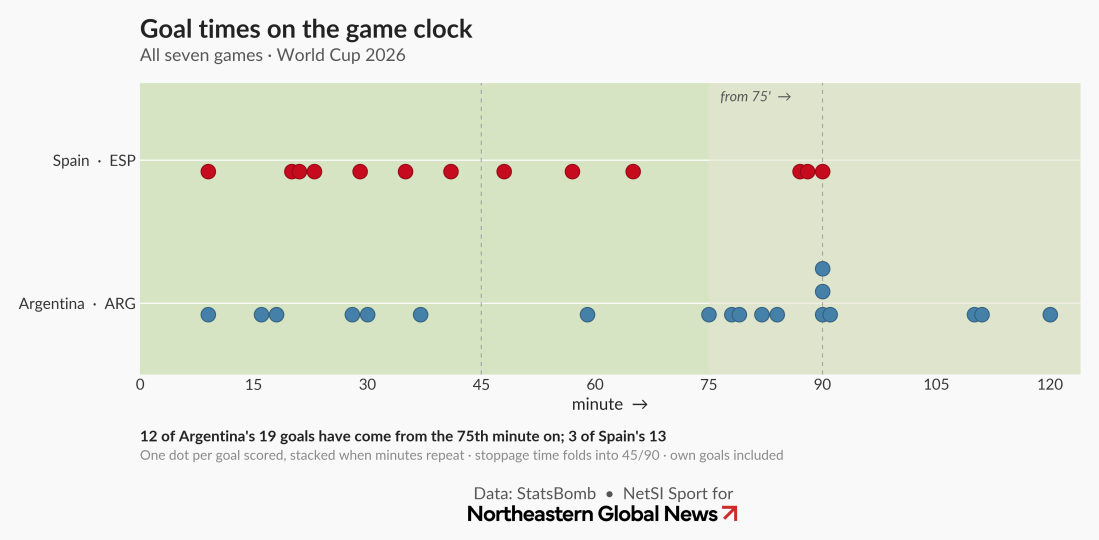
But Argentina, largely driven by its star player and captain Lionel Messi, has had a miraculous run in its own right, coming back from the brink of defeat in multiple matches. Twelve of the team’s 19 goals in the tournament so far have come after the 75th minute, according to data collected by Northeastern’s NetSI Sport.
“There’s just some kind of mystical inevitability about Argentina in the last 10 minutes,” Klein said.
So who will actually win is anyone’s guess, Klein said, but data reviewed by the research group does provide insights into the driving force behind each team’s success going into the final.
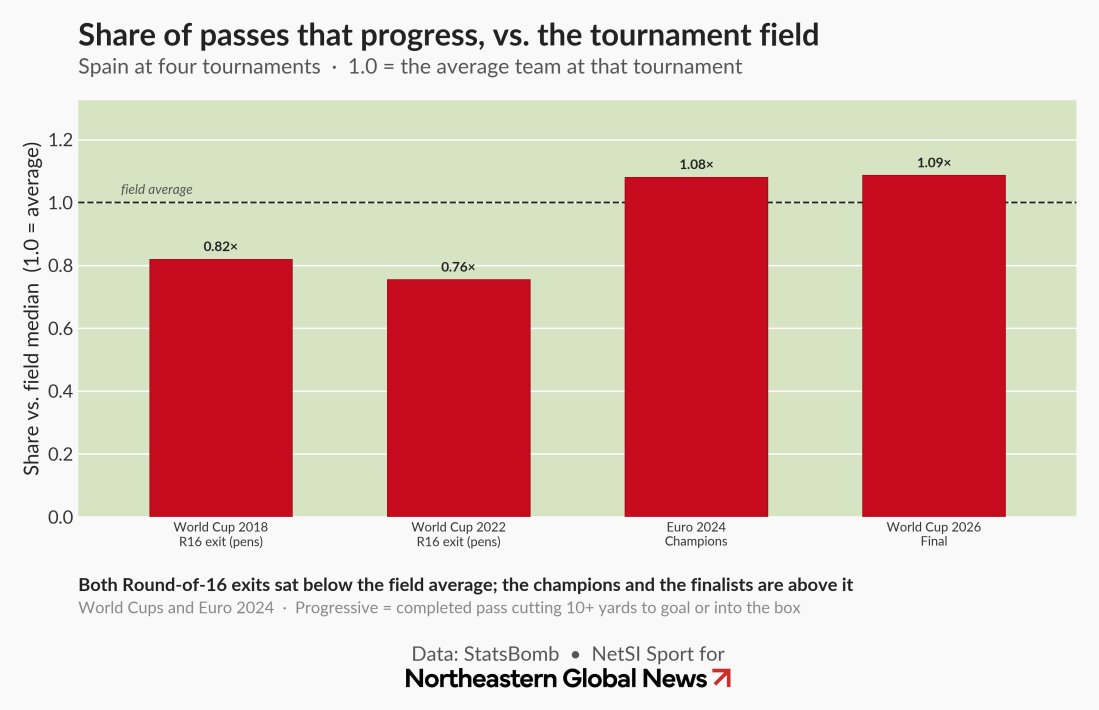
Key for the Spanish team has been the evolution of its signature tiki-taka style of play, which emphasizes dominating possession of the ball through short and quick passes in the midfield. In recent years, the team has adopted a more “attacki-taka” style, Klein explained, characterized by an increase in progressive passes — long vertical passes that get the ball up the pitch quickly – and goal-scoring opportunities.
That style of play was on full display at this year’s World Cup. The team leads in progressive passes among teams that have played at least five games, with an average of 70 progressive passes per game.
Argentina, by contrast, has far more of its success by relying heavily on Messi, who, perhaps surprisingly at 39 years old, is performing better in this tournament than he did in 2022, according to the data.
His expected goal rate, or xG, doubled from .26 per 90 minutes in 2022 to .52 per 90 minutes in 2026. Similarly, his attempted shots and final third receptions are higher in this tournament.
One notable statistic is that among the tournament’s attackers, Messi by far walks the most, according to data. Sixty-four percent of the distance he has traveled at the tournament has been at a walking pace. His next closest competitors, including France’s Kylian Mbappe and Norway’s Erling Haaland, walked close to 45%.
Editor’s Picks


Klein notes that it isn’t likely an indication of fatigue, but rather part of a strategy for the star player to conserve his energy in critical moments when he is needed most. And while he may walk the most, he also leads attackers in on-ball value at .71 per 90 minutes, a measure used to measure the impact of a player’s possession of the ball.
“Messi knows how to run. He is still a professional athlete,” Klein said. “This allows him in the 75th minute to destroy people on the dribble.”
During Argentina’s game against England, Messi performed nine successful dribbles – the most of any player in this tournament — and made a critical cross in the 92nd minute that led to a goal, Klein highlighted as an example.
Ashley Phillips, head coach for Northeastern’s women’s soccer team, said Spain will likely have the upper hand in the match with its strong dominance of the ball. On performance and tactical prowess alone, it is the better team.
But she wouldn’t rule out Messi’s individual brilliance in helping the Argentinians to victory.
“I would not be upset if Messi has some dark horse magic and wins this World Cup for Argentina, carrying them on his back,” she said.


