A look at the World Cup’s top players, according to the data
World Cup 2026 is heading toward its conclusion. Here’s a data driven look back on some of the tournament’s top players.


As the biggest World Cup on record moves toward the final game on Sunday, several players have seized the spotlight on soccer’s biggest stage.
Here’s a look at some of the tournament’s top players by the metrics, according to data analyzed by Northeastern NetSI Sport research group.
Most goals + assists
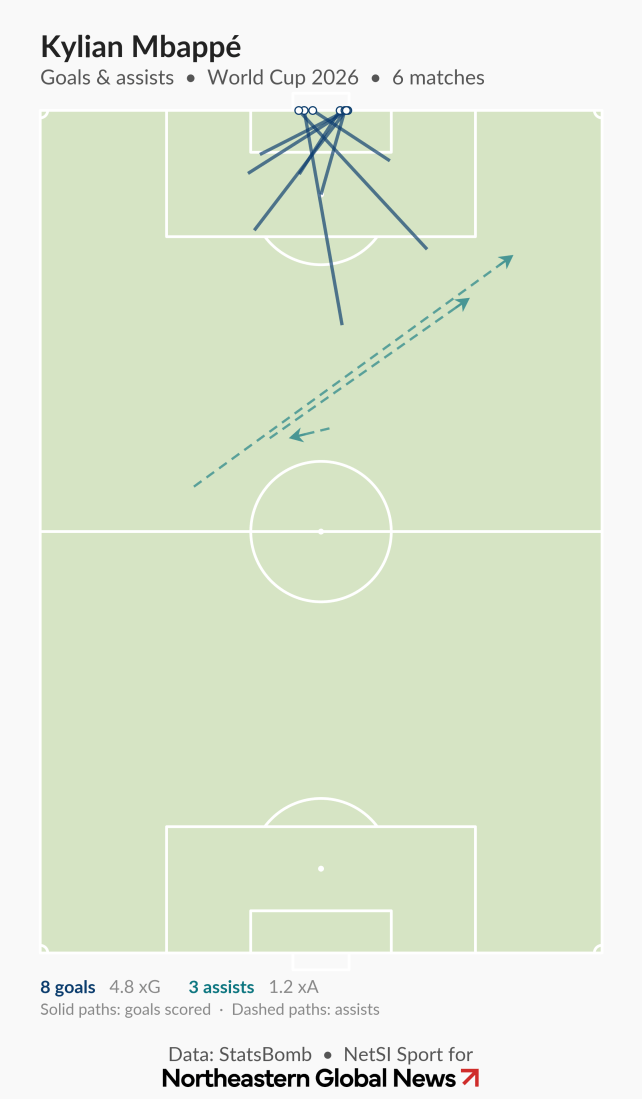
France’s Kylian Mbappe currently holds the top spot for total goals and assists, having scored a total of eight goals and three assists. The French captain’s closest competitor is Argentina’s Lionel Messi, who has scored eight goals and made two assists through six games going into the semifinal match with England.
Most dribbles
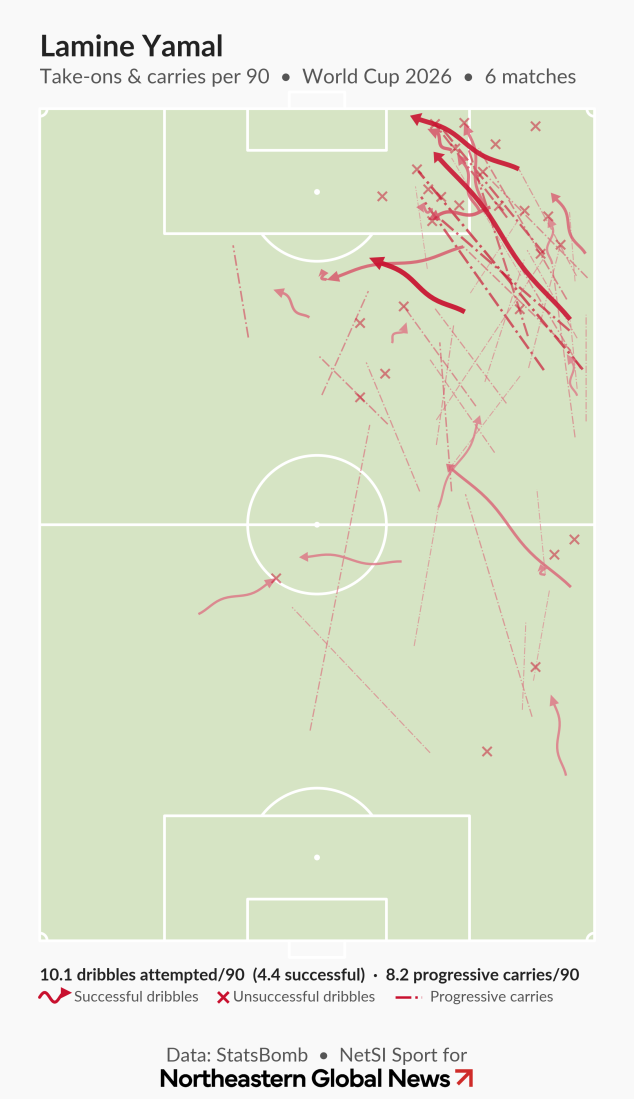
Spain’s Lamine Yamal leads the tournament in dribbles, averaging around 4.4 successful dribbles per 90 minutes before the country’s semifinal match against France. His closest competition is Curacao’s Tahith Chong, who averaged around 3.2 dribbles per 90 minutes through his team’s run in the group stage.
Most defensive actions
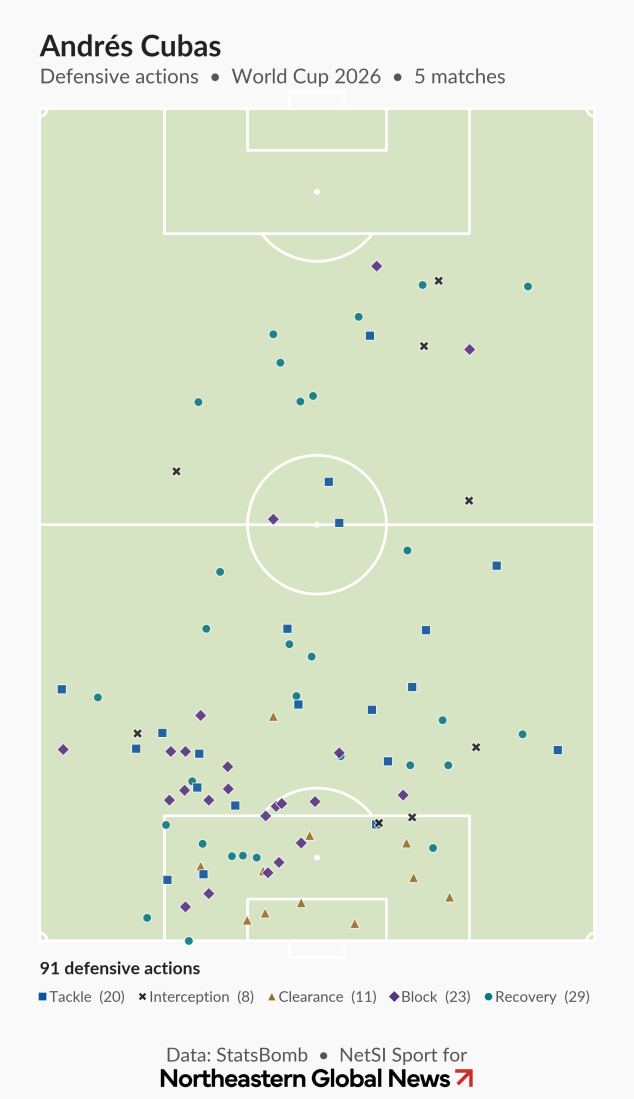
Paraguay’s Andrés Cubas performed the most total defensive actions, completing a total of 237 over the country’s five games. That included 91 direct actions such as tackles, interceptions, blocks and ball recoveries, and 146 pressures, an action that involves chasing or marking players with the ball in an attempt to win it back. His closest competitor is England’s Elliot Anderson, who has completed a total of 182 defensive actions over six games.
Most attempted passes
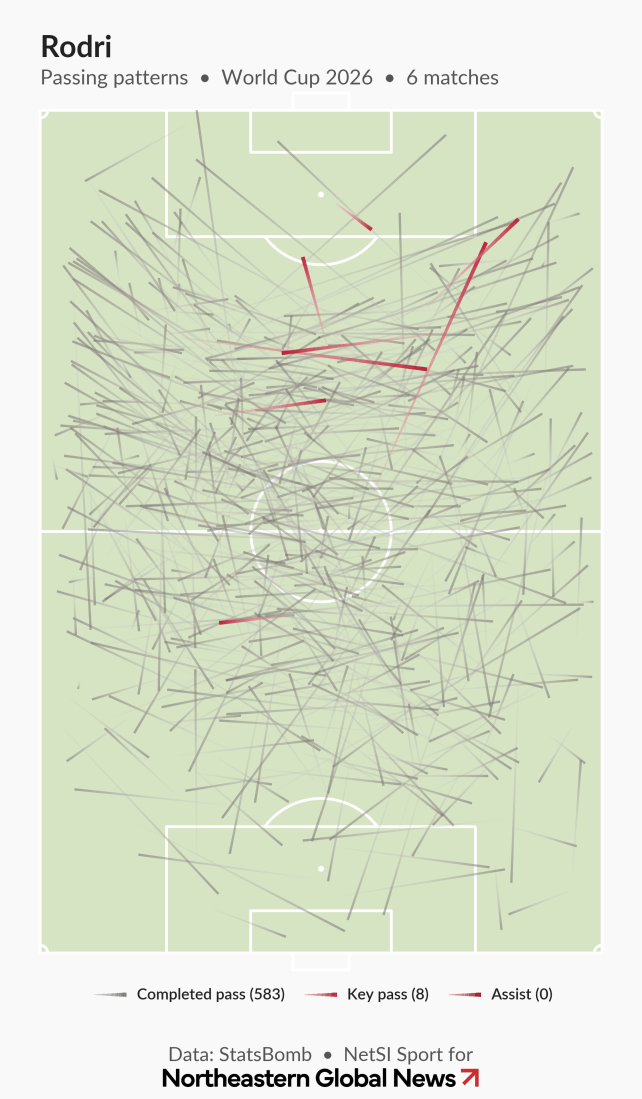
Spain’s Rodrigo Hernandez Cascante, or Rodri, is at the top of the list in attempted passes. Excluding Spain’s semifinal match against France, Rodri, the team’s captain, has attempted 628 passes and completed 583 of them, for a completion rate of 92.8%. His closest competitor is his own teammate Pau Cubarsi, who, before the semifinals, attempted 537 passes and completed 510, for a success rate of 95%.
Most overall attacking threat
Argentina’s Lionel Messi is at the top or among the top in several key metrics, putting him squarely in the category of being the tournament’s biggest overall attacking threat, according to Northeastern’s NetSI Sport research group. For one, he leads the tournament’s attackers in progressive passing – which are long passes that put the ball closer to an opponent’s goal post — having completed 43 of them before the semifinal match.
Read more World Cup analysis on NGN Offside →
He also leads the attackers in on-ball value added, a measure used to determine a player’s impact when in possession of the ball, at +5.3. That’s nearly two goals higher than his closest competitor, Brazil’s Vinicius Junior, who has +3.45 of on-ball value added.
Combine that with the fact that he is in the 99th percentile of players in this World Cup for expected goals, assists, threats and key passes, he is largely considered to be one of the most versatile goal scorers on the pitch, according to NetSI Sport.

Data analysis provided by Brennan Klein, director for Northeastern University’s NetSI Sport research group.