She was ready to quit. Now she’s running in the 2028 Olympic Marathon Trials
It would take six years of training, countless miles and more than 10 marathons before Hannah Rowe broke through in March, earning a spot in the 2028 U.S. Olympic Marathon Trials.
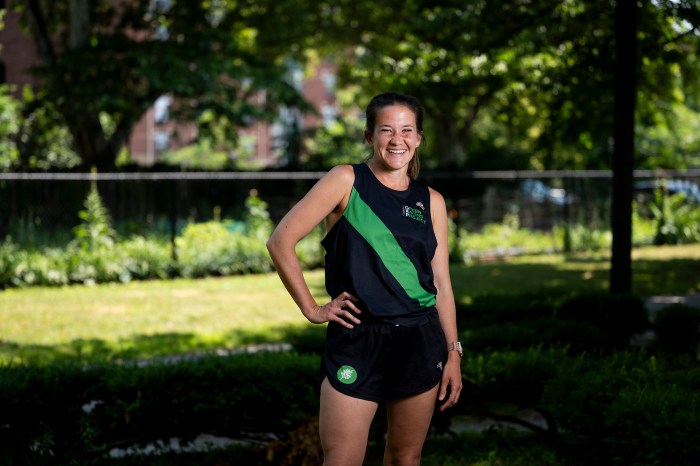

When USA Track & Field tightened its qualification time for the U.S. Olympic Marathon Trials following the 2020 games, elite distance runner Hannah Rowe thought it might be time to retire her running shoes.
“I was like, ‘Oh, I have no hope of hitting that time,’” Rowe, an assistant professor in Northeastern University’s Department of Communication Sciences and Disorders, told Northeastern Global News.
The U.S. track and field governing body announced in December 2021 that women looking to qualify for the Olympics must run a time of 2 hours and 37 minutes or faster. The adjustment shaved 8 minutes off the previous standard. That 8-minute margin effectively cuts out the hundreds of women who would have qualified under the 2020 benchmark.
Rowe was among the 512 women who would qualify for the 2020 Olympic Marathon Trials, a set of races that determine who ultimately goes on to represent Team USA at the Olympics. A 10-time Vermont state champion in cross country and track and former NCAA Division I runner at Dartmouth College, Rowe has spent years competing at the sport’s elite amateur level.
It would take six years of training, countless miles and more than 10 marathons before she broke through in March this year, running a 2:36:25 marathon at the McKirdy MicrOTQ held at Rockland Lake State Park in Valley Cottage, New York.
“I had the best race of my life,” said Rowe, who described the finish as “the most meaningful athletic accomplishment” she had ever achieved.
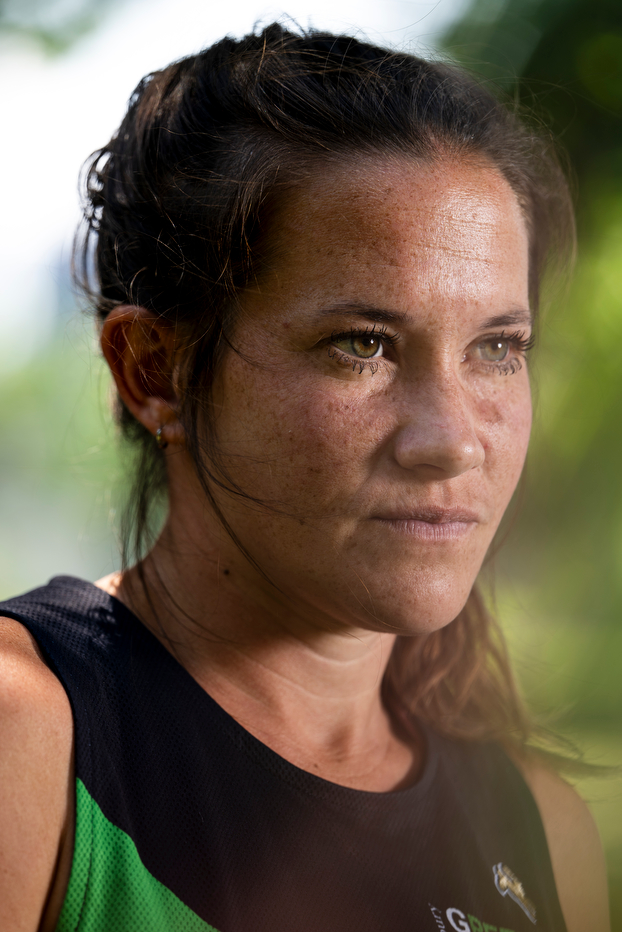
She will compete at the 2028 U.S. Olympic Marathon Trials in March 2028, where about 200 women will contend for a chance to become Olympians.
She has raced for several clubs in Washington, D.C., California and Boston before joining Vermont’s Green Racing Project, a semi-professional team that develops Olympic-level athletes.
In 2023, she achieved a time of 5:33:43 during the USATF 50k Trail National Championships at Ragged Mountain in New Hampshire. Then, she clocked a 56:38 race at the 6-mile uphill USATF Vertical Mountain National Championships at Loon Mountain Resort in Lincoln, New Hampshire, in 2024.
In other notable results, Rowe finished third at the 2024 Cambridge Half Marathon in 1:15:21, fourth at the 2024 Mount Washington Road Race in 1:18:33 and improved to third there in 2026 with a time of 1:18:09.
But growing up, marathon running wasn’t Rowe’s choice extracurricular; she was “obsessively” devoted to soccer and basketball throughout middle and high school. During soccer practice one day, the high school track coach made note of the fact that she always placed first during the team’s conditioning runs. It was shortly thereafter that she discovered competitive running.
“I remember this conversation very distinctly,” Rowe said. “He found me at lunch in the cafeteria, came over to me and said, ‘How does free college sound to you?’”
It would prove a fateful pivot, but one Rowe said she resisted at first, citing her attachment to soccer. “He was right,” she admitted.
Taking up cross country, then, she became a three-sport, four-year standout at St. Johnsbury Academy, a private, coeducational boarding and day school located in St. Johnsbury, Vermont.
“I got full-ride offers from a lot of universities, but I ended up going with Dartmouth, which doesn’t give athletic scholarships,” she said. “They gave me enough financial aid that I could go for about the cost of state-school tuition, so that was nice.”
At Dartmouth, Rowe fell in love with distance running. She helped lead the school to a top-ten national ranking. Rowe also competed at the NCAA Cross Country Championships and raced alongside two future Olympians, she said. While completing her master’s degree and Ph.D., she ran for Georgetown Running Club and the Boston Athletic Association, respectively.
Editor’s Picks


Her training and fitness intensified in the lead-up to the 2020 Summer Olympics in Tokyo. For all post-collegiate elite or semi-professional runners, she said, the goal is the Olympic qualifying race. And, in 2020, the women’s qualifying floor was a 2:45 marathon — a standard she felt was within her grasp, based on her training.
With a minute to spare, she ran a course that granted her a spot in the 2020 marathon Olympic trials in Atlanta, Georgia, which took place in February — weeks before the COVID-19 pandemic upended the world. During the trials themselves, her performance was lackluster, she said. But the experience only strengthened her resolve to return four years later.
The only problem was: the goal post shifted, and for Rowe, the new standard — just to qualify for the trials — was almost “insurmountable.”
Still, she put herself to the test.
“I’m just a very high-energy person, and I love pushing myself and testing my limits,” she said.
Colleagues say many of the same qualities that propel Rowe to her successes in distance running define her work as a researcher studying stuttering and motor speech disorders at Northeastern.
“(Professor) Rowe brings the same perseverance, discipline, and stamina she has cultivated on the road into everything she does, whether that is pushing the boundaries of scientific knowledge in the research lab or inspiring the next generation of clinicians and scientists in the classroom,” Emily Zimmerman, chair of Northeastern’s Department of Communication Sciences and Disorders, told Northeastern Global News in an email.
While she celebrates this year’s qualifying triumph, Rowe said she has “no delusions” about her chances of making Team USA at the 2028 Olympics.
“I’d have to quit my job at Northeastern, move to altitude, and train with professional runners full time,” she said.