This co-op helped an underwater robotics startup map the seafloor
Shalini Agrawal, a robotics student at Northeastern, developed software for an autonomous submersible to capture images and videos of the ocean floor.


While aboard Orpheus Ocean’s research vessel off the coast of Cape Cod, Northeastern University graduate student Shalini Agrawal entered commands on her laptop for an autonomous underwater vehicle to dive deep into the water below.
From there, the company’s flagship submersible the Orpheus AUV made its descent.
The second-year robotics student had spent months testing out the robot in a water tank near the company’s headquarters in New Bedford, improving both its camera systems and state estimation capabilities — its understanding of its position, orientation and velocity in the water.
So getting the opportunity to test out the software and hardware systems she developed for the autonomous underwater vehicle, or AUV, was a completely different experience, she said.
It was what Agrawal had hoped for when taking on the co-op.
Spun out of the Woods Hole Oceanographic Institution (WHOI) in 2024, Orpheus Ocean is a robotics startup that aims to disrupt underwater robotics by offering AUV services at more cost-effective prices compared to traditional deep-sea robotics companies.
Its flagship machine, the Orpheus AUV, was developed at WHOI. The submersible is capable of reaching ocean depths of up to 6,000 meters (3.7 miles) and is used for a range of applications, including material collection, high-resolution image taking, and deep-sea monitoring, according to the company.
Agrawal was inspired to do a co-op at the company because its work intersects with what she is learning in her master’s program at Northeastern University, including robotics sensing and navigation, mobile robotics, and autonomous field robotics, which involves designing robots to operate in unstructured and complex environments.
She was also, of course, interested in learning more about the emerging underwater robotics industry and its applications for deep-sea exploration, she said.
“Underwater robotics is actually growing a lot right now,” she said. “We say that space is unexplored, but lots of the ocean is also unexplored. You don’t know what’s down there until you go there.”
During that week in April on the waters of Cape Cod at Kingman Yacht Center, Agrawal, along with her manager and a crew of others, tested the robot for an upcoming mission for a client who wanted to use the company’s low-cost and affordable submersible to take pictures of unexplored parts of the ocean off the coast of Hawaii.
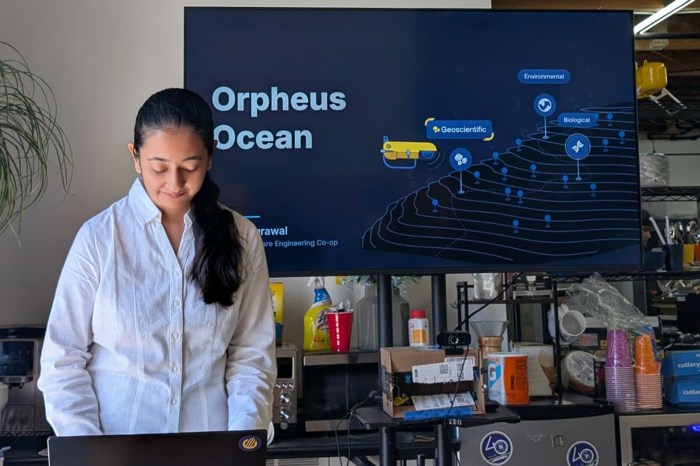
And as part of that mission, they were testing out the camera system Agrawal had reverse-engineered to work with the robot’s overall autonomy system, which allows it to navigate the deep regions of the ocean all on its own. While the camera system initially shipped with Windows software, Agrawal wrote new code that allowed the camera’s live feed to channel into the company’s Linux-based robotics software system instead.
She also worked on integrating the camera with the AUV’s lights so that they would only turn on when an image or video is taken.
Editor’s Picks





The camera system worked for four days while testing without any problems. On the last day, there were some camera buffering issues, but Agrawal was able to solve the problem pretty quickly, and the system worked well for the remainder of the test, and during the Hawaii mission, she said.
Kiki Sarpong, senior robotics software engineer at Orpheus Ocean and Agrawal’s manager, said that Agrawal “played a vital role that whole week.”
Her contributions to the camera system allowed the crew to capture just the images they needed before heading to Hawaii, he said.
“We were very pleased with the results,” Sarpong said.
But that project was just one example of Agrawal’s contributions, he said.
“At the time she came, we had just lost an engineer, so she was vital in terms of her contributions,” he said.
What stood out about Agrawal was her dedication and her ability to innovate, he said, highlighting that she offered a great foundation for the team to build off her work on the camera system and photo-mosaicking tool.
“Everybody in the company would say that they loved the work that she did,” he said.
Agrawal said while she initially wanted to pursue a career in medical robotics, after this co-op, she is actually more interested in pursuing field robotics — with a particular focus on the sea.
“Field robotics is where I want to go,” she said. “Underwater robotics has taken over my mind. I want to see what’s down there. I want to work on the sensors. And I want to work on making it more autonomous and safe out there.”