3 things to watch for when you attend a World Cup game
Going to a live professional soccer match offers much more to notice about teams’ and players’ strategies than what can be seen on TV.
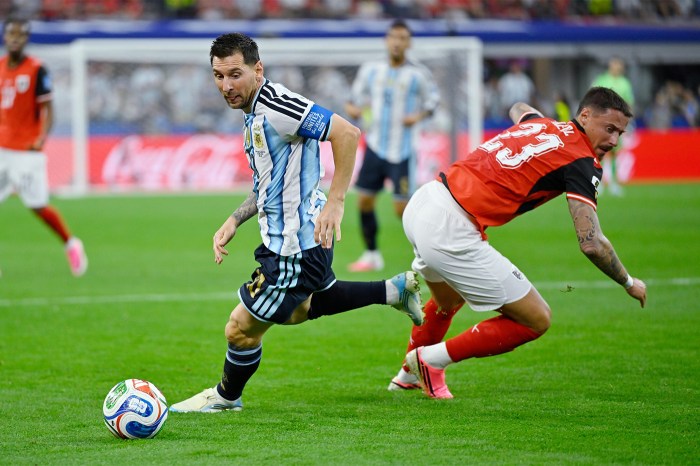

Thousands of fans attending World Cup matches this summer are experiencing professional soccer live for the first time — the atmosphere, the spectacle, the goals. But underneath all of it is another game entirely. The pass you didn’t see coming. A player’s subtle movement to corral a pass. The strategy that cracked open the defense.
Brennan Klein, director for Northeastern University’s NetSI Sport research group, offers three things to watch for in person — because once you learn to notice them, you can’t unsee them.
Vision
It’s natural to watch the ball and the players around it. But so much is happening elsewhere on the pitch, with players who aren’t in possession of the ball. Argentina star Lionel Messi, for instance, is constantly scanning the field, turning his head side to side to find opportunities to jumpstart his team’s offensive attack. “Messi is remarkable at looking for gaps in the defense,” Klein says. “I try to ask what he’s looking at, what he sees that makes him change his behavior.”
Another example during this World Cup came in the United States’ first match against Paraguay. U.S. midfielder Malik Tillman made a 60-yard pass through four defenders, putting the ball into an open space for Folarin Balogun to then gather it, dribble, and score. The graphic below shows this play.
Creativity
Soccer is a difficult sport to master, even though the pros make it seem easy. Watch for how they gracefully trap and control passes with their feet, and how subtle body movements direct what happens next. A player might turn his shoulders away from a defender and receive a pass in stride to quickly dribble up the pitch. These creative decisions don’t necessarily show up in the data, but what happens next does.
Read more World Cup analysis on NGN Offside →
Ivory Coast, for example, has inventive dribblers like Yan Diomande — featured in NGN Offsides’ players to watch article — that “create opportunities out of individual brilliance,” Klein says.
The graphic below shows the series of long dribbles and carries Ivory Coast has executed in its first two matches.
Passing triangles
In soccer, players often pass in triangle formations. This approach isn’t just a way to kill time. It’s a strategic tactic for breaking down defenses, drawing defenders out of position and creating space for the offense to advance.
The graphic below maps Spain’s triangular passing against Cape Verde (left) and Saudi Arabia (right). Cape Verde’s tighter defense compressed Spain’s triangles, while Saudi Arabia’s looser defense gave Spain more room — and more opportunity for fast winger Lamine Yamal and his teammates — producing larger triangles spread across the pitch.