The Obama and Trump libraries are going digital. Some historians aren’t sure that’s a good idea.
As the Obama Presidential Center prepares to open on June 19, and with Donald Trump proposing a site in downtown Miami for his future library, experts say the concept of these institutions has radically shifted.

When Richard Freeland, an emeritus distinguished professor of history at Northeastern University, was doing research in the late 1960s for a book on President Harry Truman, he frequently made use of the former president’s library.
Low-slung, modest in design and scale, and tucked away on a hill overlooking the Kansas City skyline in Independence, Missouri, the Harry S. Truman Presidential Library and Museum is a repository for everything that could be recorded and preserved during Truman’s presidency.
That included a whole slate of materials: presidential papers, correspondence, memoranda, policy drafts and meeting notes, photographs and audio recordings, even the odd glimpse into private feuds and other personal dramas, such as with a Washington Post writer who was critical of Truman’s daughter’s musical performances.
For Freeland, who was looking to document how the Truman administration’s early Cold War policies contributed to McCarthyism, the library was an indispensable resource.
“So far as I could tell, I had access to anything I wanted,” Freeland told Northeastern Global News.
That was more than 60 years ago. But, more than a dozen presidents later, as the Obama Presidential Center prepares to open on June 19, and with Donald Trump proposing a site in downtown Miami for his future library, experts say the concept of these institutions as primarily scholarly repositories has radically shifted. Such places are now widely seen as vehicles for legacy-branding, commemoration and even architectural grandeur, the experts say.
“I think we’re starting to see a trend toward more pretentious structures and self-glorification,” Freeland said. “The question becomes: what will that mean for historical memory?”
The modern library system
Truman’s was the first library built under the auspices of the 1955 Presidential Libraries Act, which established the private funding and public maintenance structure for the museum-style archives. Prior to Franklin D. Roosevelt, who believed that presidential records ought to be part of the national heritage, such documents were not systematically preserved and were often burned, discarded or otherwise lost to history, experts say.
Instead, the 1955 act envisioned a set of institutions that functioned primarily as archives and research libraries rather than monuments to their namesakes. The act also encouraged other leaders to preserve their papers and “historical materials” for public use once they were out of office.
“It was just basically understood that they were property of the president,” said Ted Miller, a teaching professor of history at Northeastern University, who said that the concept of a presidential library is still “fairly new in the American experience.”
But in the digital age, the debate over whether a president’s records are private or public takes on a new dimension when the records themselves are scattered across platforms and other private channels, blurring the line between personal correspondence and government business, experts say.
That could complicate how future libraries classify and preserve scholarly material, Miller said.
The digital shift
When so much public decision-making today leaves a digital trail rather than a paper one, the physical libraries as archival institutions are less central for purposes of research than they once were. At the same time, the museums and centers associated with former presidents have grown to be seen as instruments for legacy-building, branding and even revisionism, critics say.
“The presidential libraries have served a useful purpose with respect to paper records and artifacts,” said Martin Blatt, who taught in and directed the public history program at Northeastern.
But, he noted, the duality at the heart of these more modern institutions — that they are brought into being through private money, usually a foundation, with vested interests, and maintained by the National Archives and Records Administration (NARA) through public dollars — may pose problems in the digital age. The growing emphasis — on the public-facing side of presidential centers — on digital curation and immersive exhibits gives presidents and their financial allies new opportunities to frame their legacies and present favorable narratives of their administrations.
“They’ve always been a celebration of the particular individual president,” Blatt said of such libraries, “a commitment to serving as a shrine, a worshipful place where whatever deficiencies or critiques could be made of a president are whitewashed and eliminated.”
The Richard Nixon Presidential Library and Museum was something of a case study in the tension between legacy-management and public education. Prior to its takeover by the NARA, the library was condemned for downplaying the ex-president’s wrongdoing in the Watergate scandal in its exhibit, which portrayed him as the target of politically motivated investigations.
When federal archivists assumed control nearly 30 years later in 2007, they dismantled the exhibit and debuted a new one in 2011 that more rigorously addresses “abuses of governmental power, secret Presidential taping and the role of the three branches of government and the media in this constitutional crisis,” according to federal archivists.
The episode presaged a battle over who gets to preserve and interpret the documentary legacy of a presidency. In the aftermath of Watergate, lawmakers moved to prevent Nixon from retaining control of his White House tapes and papers, passing the Presidential Recordings and Materials Preservation Act of 1974.
“That’s when the fight begins,” Miller said. “Are presidential records public or private property? Nixon was insistent that he wanted to keep his tapes, and didn’t want to have his papers released.”
Editor’s Picks


The Obama Center, Trump’s efforts
As former President Barack Obama’s President Center — a library, museum and community space — prepares for its grand opening on Juneteenth, there are new questions being raised about the public function of these modern presidential institutions.
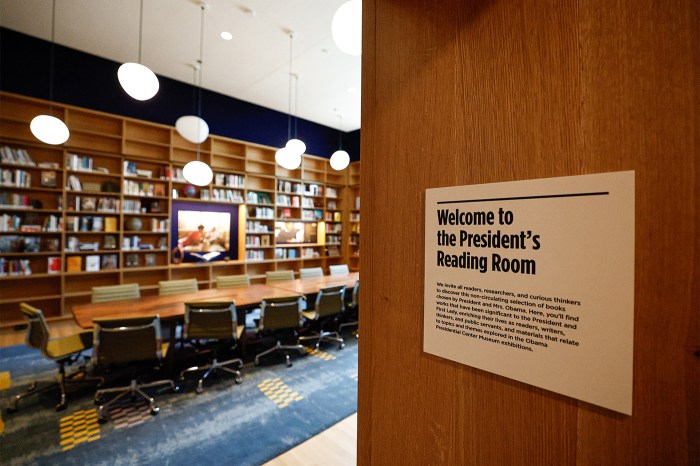
The Chicago center has also helped generate the first “fully digital presidential library” in a departure from the traditional model. The National Archives will instead keep Obama’s presidential records in digital form in existing archival facilities, while the center itself will be run by the Obama Foundation as a private museum dedicated to his life and legacy, as well as a civic space.
Though technically not a presidential library in the traditional sense — it will instead house a branch of the Chicago Public Library — the Obama President Center has partnered with NARA in the digitization and preservation of the former president’s records. But that is about the extent of the federal archives’ involvement.
That fact makes some historians uncomfortable. The new model presidential center model represents a departure for Freeland and Miller, who hold up the John F. Kennedy Presidential Library and Museum in Boston as a site that served to burnish the Kennedy legacy, with its mix of memorabilia, artifacts and immersive exhibits, including an Oval Office exhibit and replica desk. But NARA had a hand in steering the presentation of those materials.
“The Kennedy library does what he did, which was glorify public service and its positive aspects,” Freeland said.
Others suggest doing away with the concept of the presidential library altogether.
“If there are no paper records and no books, then calling it a library might seem misplaced,” Blatt said of the Trump proposal, adding that he does not think these centers “contribute in a positive way to American culture.”
The Obama Presidential Center wasn’t without its share of friction. Built on the South Side of Chicago’s Jackson Park, it encountered significant resistance from locals and activists in Chicago over the prospect that the onslaught of visitors to the area and need for amenities to accommodate them would drive up rents and push out the predominantly Black and brown resident population.
Trump’s suggested presidential center, slated for a site on the campus of Miami Dade College, is being proposed as a towering Miami skyscraper that would be emblazoned with Trump’s name and packed with similarly branded displays, a replica of the Oval Office and other monuments to his political legacy, according to early concepts published about the project.
It has also generated controversy. Residents have sued, alleging the allocation of the parcel, which was conveyed to the president’s foundation by Florida Gov. Ron DeSantis, is a violation of the Emoluments Clause. The provision prohibits federal officeholders from accepting certain gifts, payments or benefits from governments without congressional approval, and the plaintiffs argue that no such approval was obtained for the land transfer.
Still, the White House has stood by the project — and its description as a library.
“The Trump Presidential Library will be one of the most magnificent buildings in the world and a living testament to the indelible impact President Trump has made on America and its people,” a White House spokesperson, Davis Ingle said in a statement, the Washington Post reported.
The popularity of the prospective Trump project remains to be seen; but some experts believe that whatever the outcome, the concept of immortalizing the legacy of a U.S. head of state in the form of a privately run presidential center will last.
“I do think they will persist, so long as the president is still the single most powerful individual in the world,” Blatt said.


