Researcher investigates how people get into the urban mix
Do modern cities still offer the opportunity to meet people from different income levels, social and ethnic groups and backgrounds?
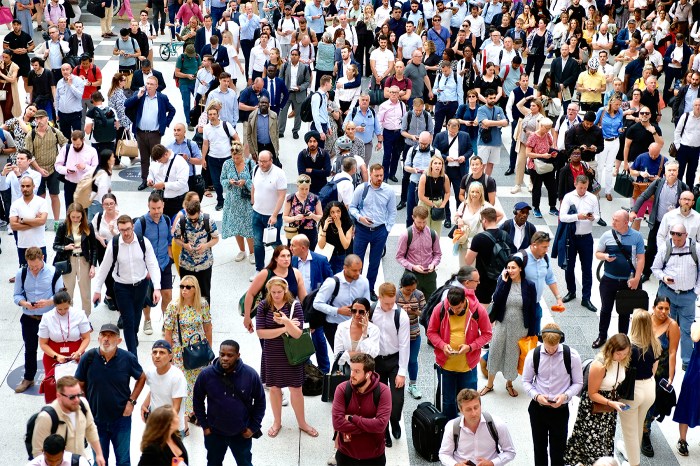

For millenia, people have been drawn to cities for opportunities, jobs and the possibility of sharing a sidewalk with diverse and interesting groups of people.
But does urban mixing, or the opportunity to meet people from different income levels, social and ethnic groups and backgrounds, still exist in modern, global cities and other highly populated areas? Especially cities with legacies of strong ethnic neighborhoods, segregation, and decades of suburbanization?
New research from Northeastern University finds mixing still occurs, but the mixing depends less on the place where you live than the places you visit each day.
“Most of the mixing that people experience throughout the day is not because of where they live … [it’s] because of what they do,” said Esteban Moro, a professor of physics who leads the Social Urban Networks group at Northeastern’s Network Science Institute.
The research was published in late July in Nature Cities, a journal that publishes research, commentary, and analysis on urban environments and human-nature-technology dynamics in cities.
To investigate urban mixing, Moro examined travel surveys from Boston, Chicago, Hong Kong, London and São Paulo. Published between 2011 and 2018, the surveys interviewed more than 200,000 residents across the five cities and included information on an individual’s home address, income, socioeconomic background and where they went throughout the day.
The researchers used the surveys to measure whether the study participants’ daily activities included people who were similar or different in household income than themselves. They then measured the diversity of household incomes in the person’s residential neighborhood using U.S. Census data.
Both variables were measured on a scale of 0 to 100, with 0 representing no diversity in either daily travels or residential surroundings and 100 meaning that all different groups of, say, income levels in a population, were encountered or located nearby. Researchers then compared the two variables.

Researchers found that the type of things you do are responsible for more than half of the mixing that an individual experiences through the day, across all five cities. For example, Chicagoans experienced an estimated 12% more mixing from their daily travel than they experienced in their immediate neighborhood.
That’s not to say that every location visited in the course of a day necessarily encouraged mixing or resulted in the same amount of mixing. There is likely less mixing of incomes among diners at an expensive restaurant than among visitors to a public library or the clientele at a gym, Moro provided as an example. In fact, the most mixing in Boston occurred at the city’s Logan Airport, Moro said.
Editor’s Picks




The researchers found that public transportation facilitated mixing in all five cities – although there were some nuances in who used that public transportation.
Public transportation in Boston and Chicago, for example, primarily enabled low income residents to visit areas that they didn’t normally go to and where, upon arrival, they mixed with people from different income brackets. In São Paulo, the mixing was more direct, Moro said, as a broader range of socioeconomic groups use public transportation.
As to which residents were mixing, Moro said the research revealed a few surprises.
Although youth was generally associated with more mixing – individuals aged 25 to 34 in Chicago and Boston and individuals 18 to 24 in the other cities mixed the most, according to the research – people aged 55 to 65 were less likely to mingle with those in different life strata than people aged over 65, Moro found.
He said this supported the idea of retirement as a “second youth,” where you can do more activities and explore more than in your working years.
Another surprise related to gender.
“We were expecting to find a little bit of difference in the mixing of males and females, especially in other countries [than the United States] in which there are very distinct roles that are played by males and females as caregivers or householders,” Moro said.
But the research found no difference in mixing among men and women across the cities, with one caveat: female caregivers are less mobile and more segregated than men or women who are not caregivers.
Moro said the research has implications for urbanists who want to encourage mixing.
While increasing affordable housing options in a wealthy neighborhood is a popular and important way of encouraging mixing, policies based on people’s behaviors – say, offering opportunities for people to visit museums they have never been to or attend new events – can accomplish similar goals, Moro said.
Lily Song, assistant professor of race and social justice in the built environment at Northeastern, cautioned that urban mixing should not necessarily be encouraged just for the sake of it.
She noted that mixing among different groups often occurs in inequitable situations – for example, a barista earning minimum wage serves artisanal coffee to wealthy customers, an Uber driver frequents higher-income neighborhoods for better tips, or a mother leaves her children with relatives while working as a nanny.
Instead, Song emphasized that city amenities should be “affordable, abundant, and accessible” to all societal demographics. Then “you’re going to get people from different walks of life, different stages of life, using these spaces together,” she said.