What does data science say about the top World Cup teams?
Northeastern NetSI Sport gives a data-driven look at the top countries competing in the FIFA World Cup 2026.

Soccer is like a dance, and every team competing in the FIFA World Cup 2026 will bring its own signature style and choreography to the pitch.
Team Spain employs a more direct style of play, prioritizing attackers Nico Williams and Lamine Yamal, for example. Team Portugal places a major focus on its midfielders such as Bernardo Silva.
And nowhere are these play styles revealed more clearly than in the work of Northeastern’s NetSI Sport research group, which maps, analyzes, and visually highlights teams’ passes, goals, interceptions and more to identify patterns and trends.
So what can the data tell us about how the countries ranked in the top five — France, Spain, Argentina, England and Portugal — might compete in this year’s World Cup?
Northeastern Global News spoke with Brennan Klein, director of the NetSI Sport Research Group, and Ashley Phillips, head coach for Northeastern University’s women’s soccer team, to understand how these top countries fared during previous tournaments and how that might inform their approach this year.
Included in each team’s analysis are passing cluster maps, which show the team’s five most overrepresented passing patterns, and average passing network maps, which show players’ most common positions and passing directions among teammates.
This list of the top teams is based on the FIFA/ Coca-Cola World Cup 2026 unofficial Men’s World Ranking, according to Klein, and the data for the analysis was provided by Hudl StatsBomb, a sports analytics company.
France — The talented attackers
Analyzing France’s most common passing clusters for the 2022 World Cup, one thing became clear, Klein explained – the team tended to rely on attackers Kylian Mbappé, who dominated the upper left side of the field, and Ousmane Dembele, who dominated the upper right.
During the 2024 UEFA European Football Championship, or Euro Cup, the passing pattern shifted to prioritize Mbappé’s shooting abilities, Klein said, which is reflected in the 2024 passing cluster map.
Read more World Cup analysis on NGN Offside →
Going into this World Cup, Klein forecasts Mbappé to play a more central role as opposed to the left-hand position he has held for the last two tournaments to make room for the other players that make up the team’s “phenomenal attacking talent.”
That includes Dembele, who in December won FIFA’s Men’s Player of the Year, and right winger Michael Olise, who had an “outstanding season” for the German sports club F.C. Bayern Munich.
“It’s a much stronger lineup this cycle and it’s a much scarier one for teams to contend with,” Klein said.
Phillips added: “They’re a very entertaining team to watch.”
“There are possession-based teams that want to hold the ball the whole game, and there are teams that just want to score goals. France is very much: ‘We want to score goals,” she said.
Spain — The young stars
In the 2022 World Cup, Spain employed a tiki-taka style, which involves short, consistent passes across the midfield, Klein explained, clearly represented in its 2022 passing cluster map.
In the 2024 EuroCup, Spain adjusted its approach, leveraging the playing style of two of soccer’s biggest rising stars — Williams, a left flank winger, and Yamal, a right flank winger, Klein noted, helping transform its passing network.
During the games, Yamal led the team in 19 chances created, which are opportunities in which he passed the ball to a teammate that led to a direct shot attempt, Klein said. He also made eight big chances, which are situations in which a player is expected to score a goal. Williams created the second-highest number of big chances during the cup at four, he said.
Spain went on to win the 2024 EuroCup with this new strategy, Klein said.
Based on the data, Klein forecasts Spain to continue with this strategy and rely on Yamal even more as his status and game have improved over the past two years.
Phillips said Spain will likely employ a more traditional tiki-taka style with an updated, more direct play style.
“I do think they are going to look to keep it and stretch teams on either side,” she said.
Argentina — “Get the ball to Messi”
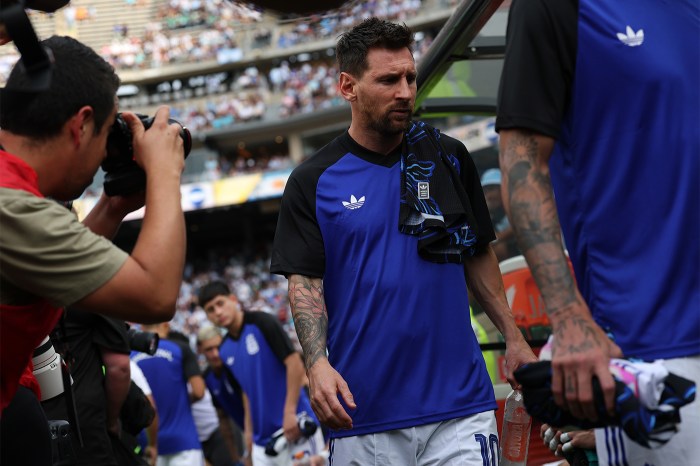
Team captain and forward Lionel Messi was key to Argentina winning the World Cup in 2022, Klein explained, with its passing cluster largely dominated by passing systems trying to get him the ball to score.
“The reason they were so successful in 2022 was that everything went according to plan in terms of getting Messi the ball,” he said. “The whole team is built around winning the ball back and getting the ball to the midfielders who are extremely good at getting the ball to Messi.”
Klein forecasts the team to follow a similar strategy of relying on Messi this year, but at 38, his age may be a factor in the team’s chances. Messi scored a total of seven goals during the 2022 tournament, ranking as the team’s top goal scorer.
The team also won the 2024 Copa America, South America’s premier men’s football tournament, using a similar strategy, but Messi was pressed a bit higher up the field, according to the data.
Phillips added that what sets Argentina apart is its adaptability, having the ability to “break teams down into possession but also play off counterattacks,” making note of Messi’s role in the games with support from other attacking players, including Julián Álvarez.
“Those players have all done it before,” she said. “They’ve played on the stage and they’ve been successful,” she said.
England — Direct players thrive
England’s showing at the 2022 World Cup was “conservative” and risk-averse, Klein said, with the team losing to France in the quarterfinals.
As the 2022 passing network highlights, the team’s biggest attacking threats — captain and striker Harry Kane and right winger Bukayo Saka — didn’t receive nearly enough passes, Klein said.
The team seemed to have learned its lesson by the 2024 EuroCup, by contrast, Klein said, with Saka and Kane receiving more passes this time around.
The team almost won it all, but lost to Spain in the final match of the tournament with a score of 2-1.
Klein said Kane will serve a pivotal role in England’s strategy with major assistance from Saka.
Both have matured in their respective roles and have improved significantly in the past few years
Kane’s shot conversion percentage, or the number of shots that have been actual goals, this year is 28.7%. In the 2022 World Cup, when it was only 16%, Klein said.
England, Phillips added, “is a very direct team,” which will be an asset for this year’s games.
Portugal – The strong midfield
Portugal’s biggest strength in the 2022 World Cup was its strong control of midfield and the team’s ability to pass the ball out wide to more creative players, such as left back defender Raphael Guerreiro and attacking player João Félix, Klein said.
In 2024, the team adopted a more wing-style of play, which prioritizes play in the field’s flanks, while still retaining its strong midfield, he said.
Passes became higher and wider to superstar players such as midfield attacker Bernardo Silva and center forward striker Cristiano Ronaldo.
Phillips said she expects the team to employ a tiki-taka style of play like neighboring Spain, leveraging its strong midfield.
Klein agrees.
“The key to success is to control the midfield and try and find a way to sneak the ball to Ronaldo, who is extremely good at scoring goals,” Klein said the data shows.
“In previous years, you wouldn’t be able to wrap your head around Portugal winning the World Cup in a way that Ronaldo wasn’t a key player throughout, but this time it seems like if they get really far, it will be due to this extremely talented generation of midfielders.”


