Meteors are ‘extremely common.’ What makes the one over New England ‘rare’?
Meteors happen all the time. But sometimes, when they happen makes them all the more rare. What experts say about meteors, meteorites, bolides, sonic booms and what happens when space stuff falls to Earth.
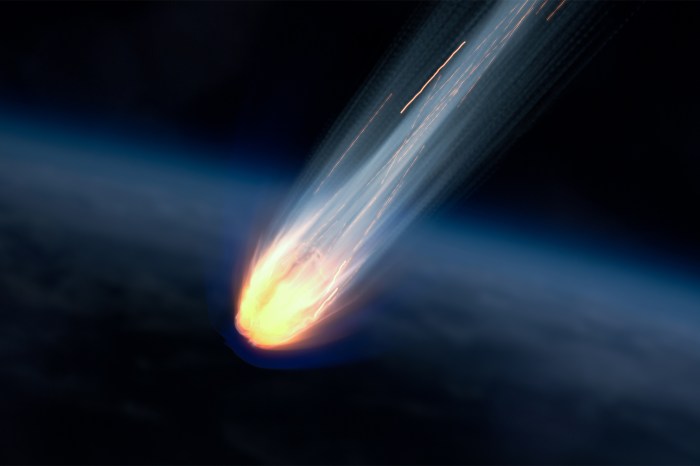

A sonic boom shook Boston and the larger New England area with the force of 230 tons of TNT. The source came from outer space.
The Saturday afternoon event triggered shockwaves online, with thousands inquiring what could have caused houses to shake and a sound heard as far away as New Hampshire and Rhode Island.
But the reason was revealed soon after: a meteoroid about 5 feet in diameter that weighed more than 12,000 pounds blasted through Earth’s atmosphere at roughly 42,000 miles per hour, according to NASA. The meteor went 26 miles through the atmosphere before it shattered — the reason for the sound — into meteorites that fell into Cape Cod Bay.
Some on social media were quick to blame an earthquake or explosion rather than something celestial, but meteors actually falling toward Earth all the time, experts said. And the one over Cape Cod Bay, referred to as a “daytime bolide,” was a rarity, according to Jacqueline McCleary, an assistant professor of physics at Northeastern University.
“Bolides are sort of an extreme version of your average, run-of-the-mill meteor,” she said.
So what made this meteor event so rare? Can they be predicted? What would have happened if meteorites hit land instead of water?
Here is what experts had to say.

Meteors, meteorites, asteroids. What’s the difference?
Here’s how the National Aeronautics and Space Administration defines the different space objects that we may come across.
An asteroid is a rocky body that orbits the Sun and is smaller than a planet. Comets also orbit the Sun, but are made of ice and dust.
A meteoroid refers to a piece of an asteroid, comet or planet, whether it’s a fragment that breaks off on its own or the result of a collision. It can be metallic or nonmetallic.
A meteor is the streak of light that a meteoroid emits when it heats up as it enters the atmosphere. This is what is colloquially referred to as a “shooting star.”
A meteorite is a fragment of a meteoroid that reaches Earth.
A bolide is an “exceptionally bright” meteor able to be seen across a wide area. It is also called a fireball.
Northeastern Global News, in your inbox.
Sign up for NGN’s daily newsletter for news, discovery and analysis from around the world.

What made the New England incident ‘rare’?
“Most of the material that the Earth intersects [with] is just interplanetary dust and those are just totally invisible,” said Robert Lunsford, who monitors fireballs all over the world for the American Meteor Society, a New York-based nonprofit that collects data on meteors and promotes research of amateur and professional astronomers. But meteors are “falling all the time,” he added.
Each day, roughly 48.5 tons of meteoric substance falls on Earth, NASA says. The majority of this is vaporized. It just might be hard to spot because they occur during the day or over the vast oceans.
Two days after the meteor in Cape Cod Bay, more than 200 people reported to the American Meteor Society a nighttime meteor above the Ohio-Michigan border. A month prior, a meteor was witnessed just after midnight from Vancouver Island before it vaporized over the Pacific Ocean.
But these instances are “much more numerous than one of these ‘super ones’ that happen during the daytime,” Lunsford said.
This type of meteor is rare for its size, brightness and the fact that it happened during the day. A lot of light has to be produced by an “extraordinarily large meteor” to be visible during the day, Lunsford said, and people would have had to have been directly facing the meteor to see its brilliance.
“For one particular location, it happens once in a generation,” Lunsford said.
McCleary added: “Odds are the next big one will happen over the ocean and maybe some ship will see it. Lightning does strike twice once in a while, and so I certainly hope we get to see some again in the coming years because it’s really cool.”
Can we predict where and when meteoroids and meteors will show up?
Yes and no. But mostly no.
Space is not empty, and Earth’s orbit can intersect with fields of space debris, McCleary said.
“This is inherently a stochastic or random process, because these cosmic debris fields, these little asteroid belts or groups, are randomly placed,” she said. “They’re so small and so faint, we can’t count them.”
Experts generally know when Earth will be passing through debris fields from comets or asteroids, which can produce meteors. For example, every August, debris from the comet Swift-Tuttle produces the Perseids meteor shower. But the Cape Cod meteor didn’t happen during any expected event, making it a random occurrence.
Unlike meteoroids, asteroids are large enough that scientists and researchers can track their trajectories. The Center for Near Earth Object Studies keeps tabs on asteroids and comets that range in size from 10 feet to 25 miles and have orbits bringing them within 120 million miles of the Sun. On Wednesday, a 21-foot asteroid named 2021 KN2 was set to come within 2.1 million miles of Earth, its closest approach.
“It’s very rare that we see something that small and can predict and warn people where it’s going to hit,” Lunsford said.
A network of government space agencies, observatories and citizen astronomers has recorded only 11 times when an asteroid was detected before it made impact on Earth. In 2022, a 6.5-foot asteroid was discovered only two hours before it would make an impact.
What if the Cape Cod Bay meteorites had hit land instead of water?
If the word “meteor” evokes an image of destruction that eliminates dinosaurs or razes cities, think again.
“By the time it reaches the surface, we’re talking about small fragments,” Lunsford said. “Those big ones in the movies don’t happen.”
The sonic boom that accompanied the meteor gave the meteor society a heads-up that something from space had made it to Earth.
“That indicates to us that some of it survived down to the lower atmosphere. There’s a possibility for meteorites to show up on the ground,” he said.
Meteorites typically range from one to 10 grams, but in the case of the Cape Cod Bay incident, radar data suggested that some of the meteorites ranged from 40 grams to several kilograms, according to a summary of the event from Meteorite Falls from NASA’s Astromaterials Research & Exploration Science.
“Certainly wouldn’t want to be hit on the head with one, but the chances of that happening are pretty remote,” Lunsford said.
Editor’s Picks




Landside meteorite impact is not unheard of. A meteorite crashed through a home in Hopewell, New Jersey, in 2023. Earlier this year, small meteorites hit a home in Germany, according to the European Space Agency.
Does climate change have an impact on meteors?
Both McCleary and Lunsford said “no.”
“Climate change is an atmospheric phenomenon happening at mostly the lower levels of the atmosphere,” McCleary said. “Meteors, the big ones like bolides, enter way, way up at the top, like 100 kilometers – so the edge of the stratosphere, going into the ionosphere – where man-made climate change doesn’t have a huge effect.”
Noted Lunsford: “These are going to strike the earth no matter what’s going on in our atmosphere.”
The Cape Cod meteor debris field is reachable by boat. Should you go looking for fragments?
The meteorites fell into water with a depth of 100 feet, the Meteorites Falls summary reported.
“Most meteorites are strongly attracted to a magnet, and these ones are within reach of a 100-foot length of rope dangled off of a boat. In case anyone is interested in such factoids,” the summary said.
But Lunsford cautioned against going on a wild goose chase for these meteorites for a few reasons.
“We don’t know if this particular one had a high metal content. It needed to have a lot of iron or nickel to be attracted to a magnet. A lot of these are totally made of stone,” Lunsford said.
Plus, the size of the meteorites are likely very small.
“This is even worse than a needle in a haystack. It would be a waste of time to try and find it,” he said.