Northeastern researcher says teachers improve instruction with more feedback from peers
Professor Jaci Urbani found that educators benefit from meeting regularly to ask probing and sometimes difficult questions about their teaching techniques.

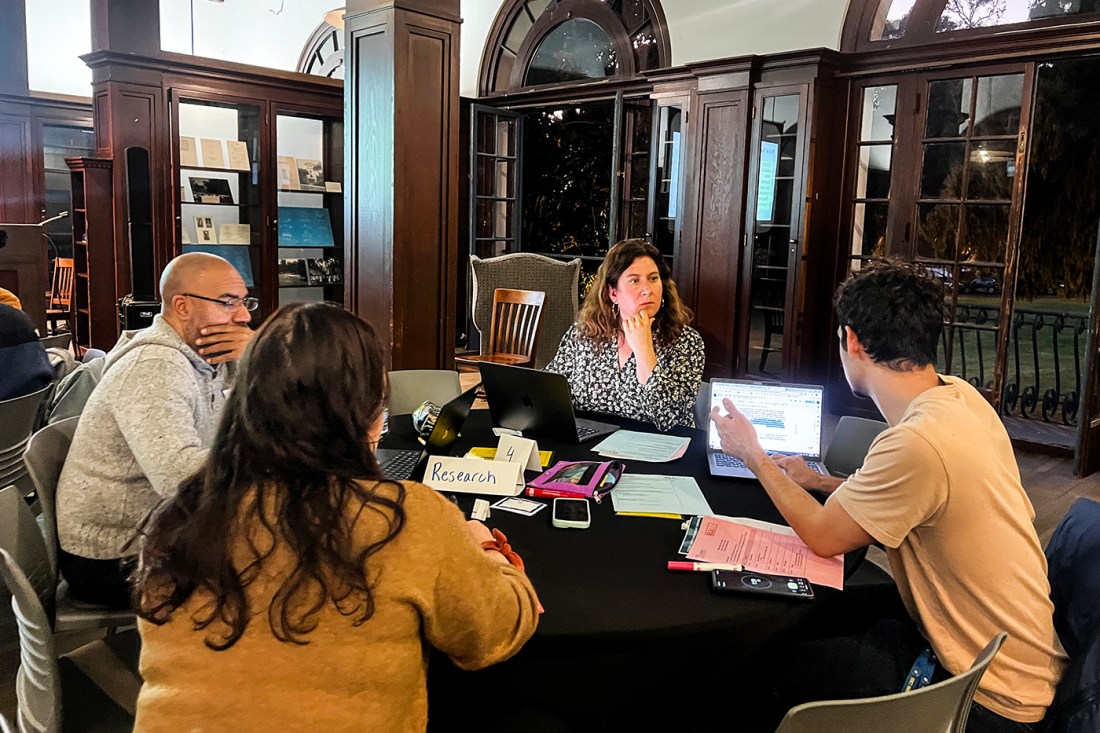
OAKLAND, Calif. — Teachers who work with English language learning students benefit from honest feedback from peers on their instruction, a Northeastern University researcher says.
Observing teachers of all grade levels during monthly collaborative coaching sessions in Oakland, associate professor of education Jaci Urbani found that when educators meet regularly to ask probing and sometimes difficult questions, instruction improves.
“In most professional development, teachers sit and listen,” Urbani says. “But this was a form of professional development that was very active. Teachers would come with their own questions and their own inquiry, and for those particular individuals, there was a real impact on their reflection, which they will then bring into their next year of teaching.”
In monthly sessions organized and facilitated by Lead by Learning, a Northeastern University center on the Oakland campus, teachers with the Oakland Unified School District who teach English language learners met to share dilemmas, student work and plenty of feedback.
The sessions are called “supportive challenges,” and they are designed as opportunities for discussion.
“We know about culturally responsive learning but still, kids aren’t achieving,” Urbani says. What teachers need, she adds, are opportunities to talk frankly about where they can improve. “Teaching is a very nice profession,” she says. “But the more constructive feedback is: ‘Here’s what I noticed,’ or ‘Maybe try this.’”
Sometimes when a teacher is unsure about how to improve student learning, they make assumptions about what might be going wrong, says Jennifer Ahn, executive director of Lead by Learning.
For example, Ahn says, one teacher who participated in the monthly sessions couldn’t understand why one of her students didn’t want to complete a writing assignment and wondered if he wasn’t completely literate in his home language. With encouragement from her peer teachers she decided to speak with the student one-on-one about writing.
“She decided to ask him some questions, and his huge barrier was that he didn’t like his handwriting,” Ahn says. “As a teacher that can be a real game-changer because it was a very technical fix.”

Thirty percent of students in Oakland public schools are English learners, says Amy Stauffer, a secondary language specialist with the Oakland Unified School District. In California, language acquisition is integrated into content learning, including science, math and literature, she says.
Monthly peer conversations help Oakland teachers help track whether approaches are working at the classroom level, she says. She calls it “street data.”
Editor’s Picks


“Sometimes in education we just see what the state data tells us,” she says. “Street data is helpful because you can set a goal and track to see if that goal is moving. Small steps of progress can move to bigger progress.”
In interviews that Urbani conducted during the Lead by Learning sessions, one high school teacher reported dramatic improvement using “street data.” When her students were reluctant to speak during class discussions, the teacher provided students with scripts so they could respond to questions, but that didn’t work. Following a suggestion from other teachers, she asked students what they thought would help. They said that they would rather take notes themselves than use the script. After that, student participation doubled.
“Being in this group really pushed me to get data,” the teacher reported. “And that data was really informative. In a normal classroom situation, we’re left to process on our own.”
A former classroom teacher herself, Urbani recalls making assumptions about a parent whose child was struggling academically. She says she used to wonder why the parents didn’t help their child with their homework.
“I hate to say it, but I just felt frustrated,” she recalls. “I tried to reach out and couldn’t reach the parent.”
But during a conversation with another teacher, Urbani says, she learned that the parent was raising her children on her own, that she worked two jobs and that her sick mother had just moved in with her.
“She just literally didn’t have the time to sit down and help her son with homework,” Urbani says. “I think having those kinds of conversations before you become a teacher could make a really big difference.”


