Northeastern students tackle math challenges in Budapest with problem-solving skills
Hungary’s challenging math tradition explored by Northeastern students in a five-week program, sharpening problem-solving skills through discovery-based learning.


Sean May began his journey at Northeastern University as a computer science major. Over time, he realized something was missing — the satisfaction he received from solving mathematical puzzles and thinking critically about complex problems.
“My dream field to go into is quantitative analysis,” says the rising fourth-year student. “Trying to find patterns between things.”
To pursue that passion, May began shifting his coursework to focus more on mathematics last year. This summer, he joined 21 students in Budapest, Hungary, for a five-week Dialogue of Civilizations led by Gabor Lippner, an associate professor of mathematics at Northeastern.
The Dialogue of Civilizations “Mathematical Heritage of Hungary” immerses students in the country’s tradition of mathematical problem-solving. Students experience a unique teaching method pioneered by Hungarian mathematician Lajos Pósa — an approach that has helped a nation of only 10 million achieve outsized success in academia and international math competitions.
A different kind of math class
Lippner, who grew up and earned his master’s and doctoral degrees in mathematics in Hungary, developed the dialogue with a Northeastern colleague several years ago. In Budapest, students take two courses — Number Theory and Exploration of Modern Mathematics.
The former is a regular math course, Lippner says, that students can take at Northeastern during the regular academic year. However, the dialogue version of the course is more interactive, he says, because students learn the material by solving a set of problems.
“We go more deeply into parts of the material,” Lippner says. “I believe that students learn more out of this type of instruction.”
Lippner developed the second course, Exploration of Modern Mathematics, specifically for this dialogue. It’s based on Pósa’s curriculum for training talented high school students. Lippner went through this program himself as a student and later served as Pósa’s teaching assistant.
“This mathematical approach is more engaging and discovery-based,” he says. “It doesn’t directly feed into anything applicable, but instead of teaching you more theorems or theory, it teaches you how to approach problems in an independent and creative way.”
Many Hungarian public school teachers have embraced this approach, which encourages students to develop their own ideas by asking open-ended questions rather than treating math as a set of rules or recipes.
During the course, students work on problems that look nothing like typical mathematical exercises.
“It’s basically just solving brain teasers the whole time,” May says. “It’s really interesting.”
“The goal of it is to allow the students who are doing these problems to experience what it’s like to really struggle with a problem where you don’t know anything [or] how to approach it,” Lippner says. “There are no recipes or formulas, no equations to plug into. You have to get creative about it and struggle with it, and it’s still fun.”
As a teacher, he guides students when they get stuck, he says, but makes sure they still experience the discovery of the solution themselves.
“He’s trying not to just give away everything, but he’s very good at leading you to figure it out yourself without just leaving you stuck there,” May says.
Two teaching assistants help lead the dialogue, including Hungarian math teacher Eszter Bora, whose doctoral thesis focuses on Pósa’s method.
“It’s really important for this program to have a good teacher-to-student ratio,” Lippner says. “We are monitoring all the groups at the same time and helping whenever needed.”
“That way of learning is very different from back in the U.S. and Northeastern, where it’s very lecture-heavy with the traditional homework model,” says George Foster, a rising computer science and math junior. “Whereas this is much more ‘go out and solve it on your own,’ which is super nice because it empowers you more.”
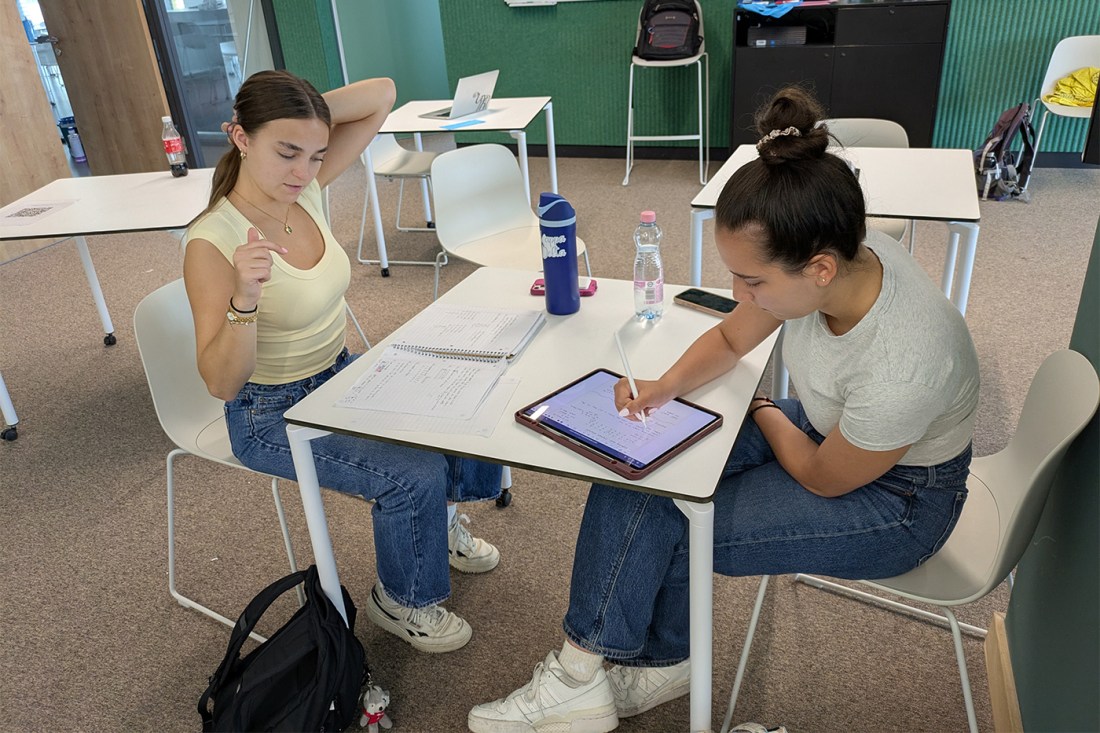
Students work in pairs or trios, which Lippner says makes math less isolating. May enjoyed bouncing ideas off his partner and finding solutions independently from the rest of the class.
The schedule was demanding — half-day classes six days a week, totaling 18 to 20 hours of math training.
“It’s very intense,” May says. “I really haven’t had an experience like this ever, where I’m just sitting down for hours with a peer of mine, just discovering things and solving problems.”
Foster says he also appreciated Lippner’s humor, which lightened the mood when problems became challenging.
Life in Budapest
Editor’s Picks



Students stayed at the renovated Gellért Campus of Corvinus University on the west bank of the Danube River, with panoramic city views.
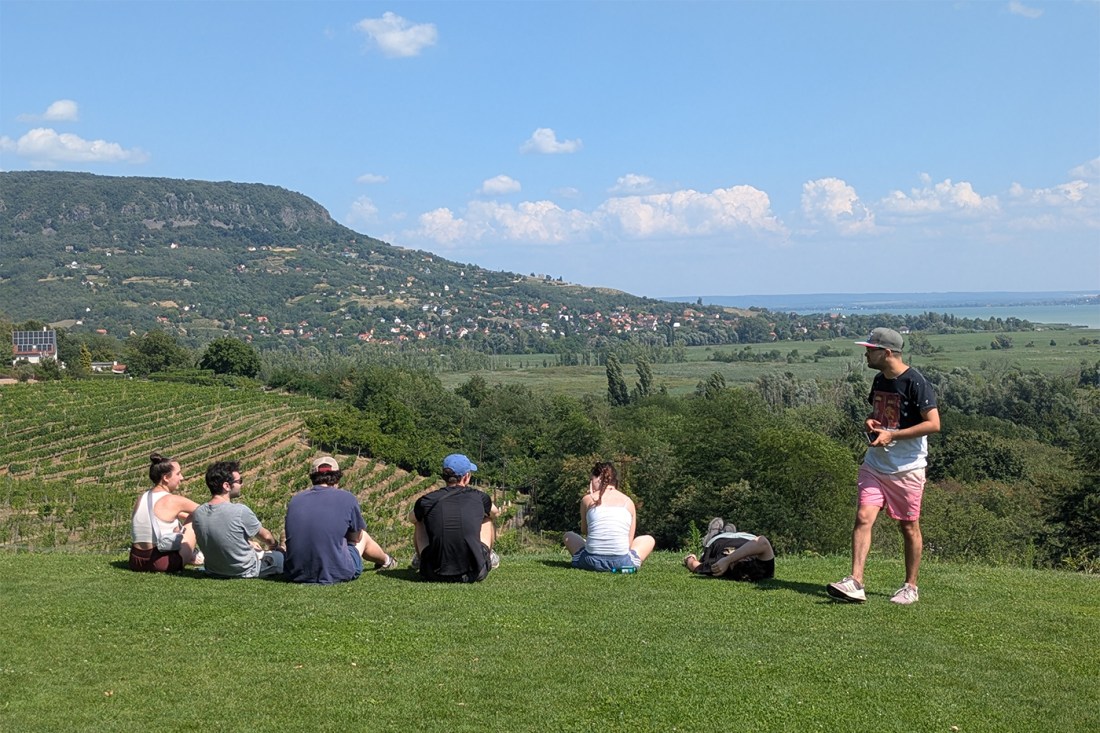
In the afternoons, they would explore different cultural sites such as the Buda Castle, the Hungarian Parliament and museums, and do different activities such as a cooking class.
“We try to squeeze as much time for cultural experiences into the program as the math allows,” Lippner says.
The students also had some free time to explore the city on their own.
Building skills and confidence
The dialogue strengthens critical thinking, Lippner says, and builds confidence to tackle problems independently. It trains students to think out-of-the-box and not get stuck when they don’t immediately know the solution.
While they master a few specific math tools, the biggest takeaway is attitude, Lippner says, and “realizing that you’re able to do something that you previously were unable to do.”
“I’ve definitely become a lot more confident in how competent I am with math,” May says. “Because a lot of these problems are very difficult and it’s a bunch of different types of problems, too. There’s a lot of ways of thinking that you have to develop, and I feel like I’m just getting a lot better.”
Lippner says he enjoys the more personal experience of a dialogue compared with regular on-campus classes.
“The dialogue setting allows a lot of outside-of-class connection,” he says. “We become more like a family by the end, a quite tightly knit group, and it allows me to get to know my students better and allows them to get to know me better.”


