How the brain reacts to live music
The study is an inaugural research collaboration between Northeastern and its Boston neighbor, New England Conservatory.

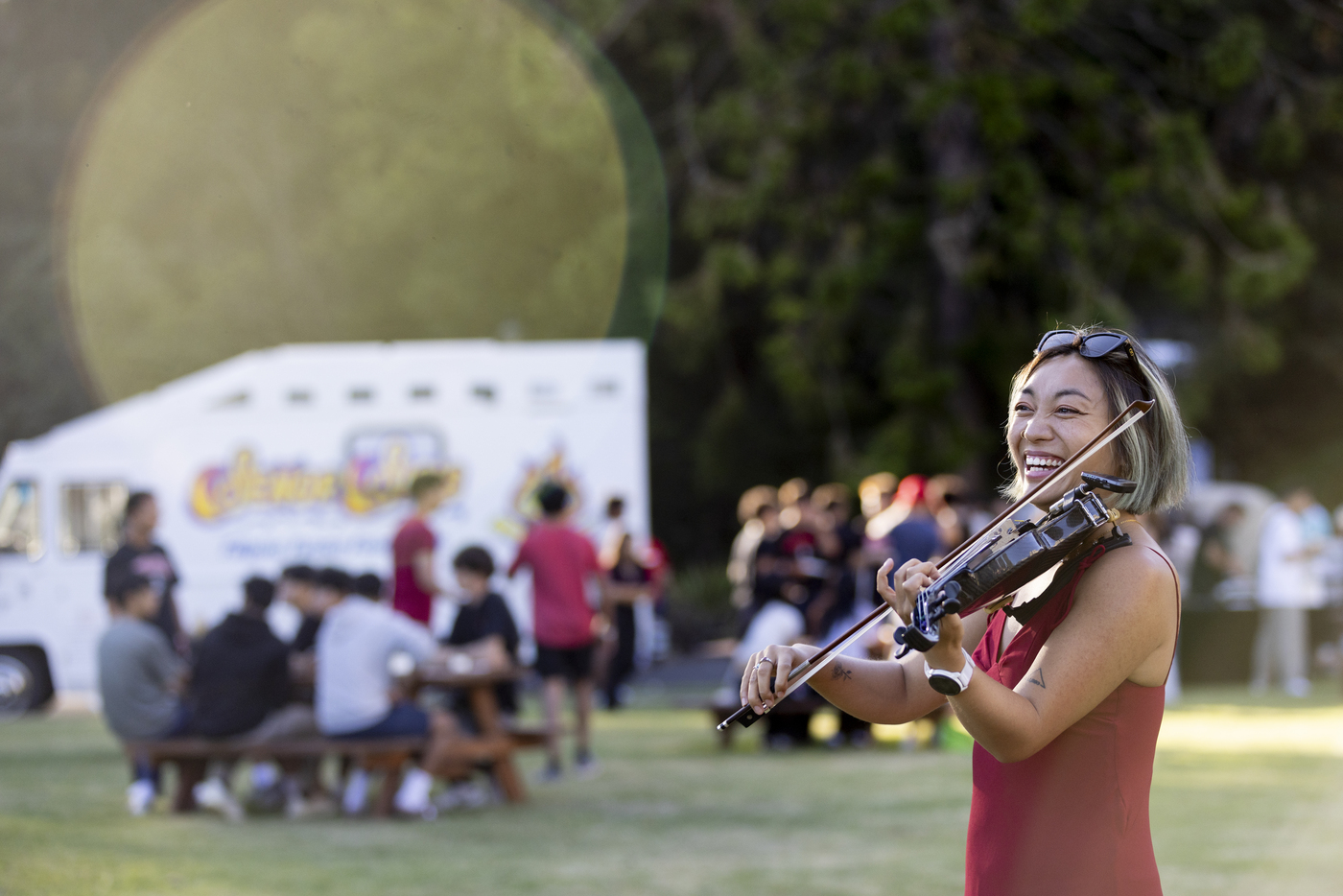

We have high fidelity vinyl and home audio systems that rival the quality of the sound systems at the local movie theater and we even have high-quality recordings that we can listen to on our preferred personal music device. But there’s just something about hearing live music as it’s being played in real time.
Northeastern University brain researchers have an idea what that something may be.
“Live performance tunes brainwaves to music,” said Psyche Loui, associate professor of creativity and creative practice in the music department and director of the Music, Imaging and Neural Dynamics (MIND) lab at Northeastern University.
In other words, just as a musician tunes his or her instrument to a pitch or an orchestra, our brains do some tuning as well.
“The rhythms in the brain actually align with rhythms in music,” explains Arun Asthagiri, a PhD student in the MIND lab. That alignment becomes stronger during live performance, Asthagiri explains, which may be a way that live music actually creates greater engagement and stronger encoding of the sounds in the brain, he said.
The research was published in March in the journal Social Cognitive and Affective Neuroscience, a publication of the Social and Affective Neuroscience Society (SANS), which is committed to research investigating the neural basis of social and affective processes.
The study is also an inaugural research collaboration between Northeastern and its Boston neighbor, New England Conservatory, where Asthagiri studied violin performance.
The research is based on a common representation of sound and brain activity: waves.
In sound, a wave’s frequency, or the number of times a sound, measured in vibrations, repeats itself in a second, is measured in Hertz. A 200 Hz sound wave means it vibrates 200 times per second, and a higher pitch or tone on a musical scale corresponds to more vibrations per second, Loui explained. She also said that humans can hear sounds that range from 20 Hz to 20,000 Hz. Think the lowest note on a large pipe organ or the tectonic rumbling in a movie to a dog whistle only audible to the sharpest hearing young children (hearing degrades over time).
At the same time, our brain also perceives patterns in sound that exist well below 20 Hz, what’s known as rhythm.
Editor’s Picks




“To give an example, if a violinist plays their open A string, they are creating a sound with a fundamental frequency of around 440 Hz (which we can hear),” Asthagiri said. “Imagine they keep playing that pitch one time every second. Then, they’re creating a pattern or a rhythm at 1 Hz that a listener can perceive but won’t hear directly as a separate sound.”
The connection with music comes in because brain activity – or the regular patterns of electrical activity produced by the synchronized firing of neurons – is also measured in waves.
In the study, researchers measured the brain activity via electroencephologram (EEG) of 21 participants as they each listened with their eyes closed to recordings and live performances — in a concert hall — of violinist Joshua Brown. A “rock star violinist” according to Loui, Brown played two fast pieces and two slow pieces from J.S. Bach’s Sonatas and Partitas for Solo Violin.
The researchers found that listeners’ brainwaves synchronized with the musical waves — meaning the patterns in the waves’ frequency aligned — and that this synchrony was especially strong when listening to live music with a faster rhythm.
It’s a phenomenon called “phase locking.” Asthagiri offered an analogy to explain it: Imagine a birds-eye view of runners on a racetrack, with one runner representing the brain signal and another the sound signal, he said.
“A stronger phase locking would be if two runners keep a very consistent relative distance along the loop,” Asthagiri explained. But, “If one runner was kind of lagging and then following and then leading over time — if their relationship was inconsistent — that would be low phase locking.”
When asked to rate the performances, the listeners also rated the live performances as being more engaging, more pleasurable and less distracting, Loui said.
“So, if you were feeling more engaged by the live performance, your brain was also more engaged by the live performance,” Loui said.
Asthagiri cautioned that there are many other factors in live performance that might make it more engaging than a pre-recording. These include being in a room with other audience members and a performer on stage, as well as the soundwaves filling a concert hall and making it vibrate. The participants were also conservatory students, and it’s possible they had an affinity to the music they were listening to.
Nevertheless, Loui said the study has implications on understanding why humans engage with and enjoy music. Loui said the lab plans to do follow-up studies incorporating live performances of choral versus solo singing, singing versus speaking versus chanting, conversation versus reciting poetry, and more.
This higher level of engagement “doesn’t have to be only for a classical music performance,” Loui said.


