Affordability, corruption, debt? The factors leading to Europe’s mass demonstrations
Widespread discontent led to mass demonstrations across Europe, but the issues driving them vary, Northeastern University experts say.

As student protests over conditions in schools recently spread from a Paris suburb to across France, a different movement was building in Spain.
In Madrid’s Retiro neighborhood, a central district of the Spanish capital, the forceful eviction of an 87-year-old woman galvanized demonstrations against the country’s housing crisis.
María del Carmen Abascal, who had lived in the apartment for 71 years, became a national symbol for struggling renters. Abascal, known widely as “Maricarmen,” died in the hospital on Oct. 8.
Such conflicts have led to mass demonstrations across Europe that are occurring more or less simultaneously, but the issues driving them vary, experts say.
Triggered by overcrowded classrooms and staffing shortages, the protests and riots in France reflect a widening cost of living and burgeoning fiscal crisis, experts say. The unrest in Spain and Portugal have focused on housing affordability stemming from gentrification, rising rents and an influx of wealthier foreign residents that has intensified competition for homes.
“There are different grievances that are at the core of these protests, and those [grievances] depend on which country we’re talking about,” said Marianna Griffini, assistant professor in international relations and anthropology at Northeastern University’s London campus.
In Greece, protests have similarly focused on workplace safety and deteriorating conditions in public schools, while unrest in Albania has centered on opposition to the government, corruption and rising education costs.
The Albania protests have been fueled by allegations of corruption within Prime Minister Edi Rama’s government, including claims that officials have used public office to benefit politically connected business interests.
Pockets of Italy and Belgium have also seen demonstrations and clashes in recent days. The unrest has zeroed in on rising living costs and low wages in Italy, and austerity measures, budget cuts and rising education costs in Belgium.
As was the case with the 2011 Arab Spring protests, the movements taking shape in Europe respond to a complicated interplay of political and economic grievances that are difficult to disentangle, Griffini said.
Griffini said gentrification has driven longtime residents out of neighborhoods in Spain, either because rising living costs have made them unaffordable or because property developers have taken over. A significant share of renters — 43.5% in Barcelona — spend more than 30% of their overall income on housing, according to the Bank of Spain.
In Portugal, an influx of wealthy foreigners, “digital nomads,” or remote workers who can live and work from anywhere with an internet connection, and European retirees has increased competition for housing and pushed prices higher.
Foreign buyers accounted for 29% of residential property transactions in Portugal in 2024, up from 25% in 2019, according to the Bank of Portugal. Portuguese home prices rose 19% year over year in the fourth quarter of 2025, according to a 2026 International Monetary Fund report, which noted that “prices have surged” in recent years.
Editor’s Picks


It’s been grist for political opposition in both countries, Griffini said.
“Spain and Portugal have been suffering a lot from the housing crisis, and the populist radical right — Vox in Spain and Chega in Portugal — have capitalized a lot on this,” Griffini said.
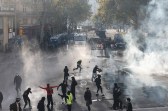
The unrest in France began on September 17 after high school students took to the streets in the largely working class Paris suburb of Créteil. The localized protest escalated as unions, workers and extremist groups seized on the situation to air their own grievances, leading to violence and curfews. President Emmanuel Macron has called for calm and vowed to meet with protesters this week.
As some political leaders attempt to fan the flames of protest, they face an increasingly disillusioned and restless population that has grown wary of incumbents, said Sara Raimondi, associate professor in politics and international relations at Northeastern University London.
“Whether the issue is housing, whether it is depleting conditions of education, they all are manifestations of the stark social realities around Europe,” Raimondi told Northeastern Global News. “The responses are nested within the particular political reality of different countries.”
A factor potentially fueling the rioting is social media and the spread of videos on platforms like TikTok and YouTube. Young generations are possibly using these tools to “mimic actions that they see elsewhere” and justify their own behaviors, Raimondi said.
Griffini said some rioters might express anger or test boundaries, with social media potentially amplifying their appetite for confrontation.
Raimondi said she does not expect the rioting to become global at this particular time.
“It will probably be difficult for it to be a common trend [globally] because there are so many different causes,” she said. “Without a clear articulated goal that unifies the trends, different movements might lose momentum.”
What’s certain is that political parties, especially opposition parties, are also “mobilizing political sentiments” to benefit their own agendas, she said.
For example, in a video message posted on Sunday, Marine Le Pen, leader of France’s far-right National Rally, blamed an “exhausted and disoriented Macronist administration that is running out of steam” while positioning herself as the candidate who will restore order to France. The French presidential election is in April.