Northeastern’s bioinformatics escape room allows guests to become genetic detectives
The gamified escape room experience introduced the next generation of scientists to the complex field of bioinformatics and its wealth of professional opportunities in the Bay Area.

OAKLAND – On a hot weekend in July, Bay Area science lovers queued up for their turn to moonlight as a genetic detective tasked with identifying a mysterious animal species based solely on a fragment of its DNA, part of an “escape room” experience hosted by Northeastern University.
One by one, the savvy scientific investigators donned lab coats and got to work, inspecting the incomplete genetic code and translating its three-character DNA codes into letters that could be rearranged to form clues about the species in question. Once they cracked the puzzle and entered the correct letter sequence into a cylindrical “cryptex” tool, the animal was revealed and the game was won.
The interactive display at the Open Sauce science fair in San Mateo was created by Northeastern’s Jen Cassano 一 chemistry professor and faculty coordinator for the Oakland bioinformatics master’s program 一 and graduate student Aamna Zia Ullah Sheikh. Drawing on themes from Northeastern’s bioinformatics master’s program, whose inaugural Oakland cohort will graduate in 2027, Cassano and Sheikh aimed to introduce the next generation of scientists to the complex field of study and its particular importance in the Bay Area.
Bioinformatics combines biology, computer science and data analysis to help researchers make sense of large amounts of biological data, including DNA, said Maxim Wolf, director of the bioinformatics master’s program. The discipline can be applied to areas ranging from cancer and infectious disease research to population genetics, agriculture and drug discovery.
“Bioinformatics is this kind of interdisciplinary field that requires pulling in a lot of knowledge of programming, AI, quantitative skills like statistics, and combining them with deep knowledge of biology,” Wolf said.
One of the most defining achievements in bioinformatics was the Human Genome Project, an international research effort completed in 2003 that mapped all the DNA base pairs of the human genome. In 2012, the bioinformatics-informed discovery of the CRISPR-Cas9 system, a tool for editing living genes, allowed scientists to add, change or remove parts of a cell’s DNA with unprecedented accuracy.
Today, the crossover of bioinformatics tools with artificial intelligence means massive biological datasets can be analyzed at lightning speeds, giving pharmaceutical scientists the ability to develop new drugs faster than ever.

For example, Wolf said, “if we understand how the processes within the cell are causing cancer to grow in a way that it’s not supposed to, we can target those specific processes and try to fix the cancer from spreading.”
Despite bioinformatics’ essential function across industries, many researchers, computer scientists and students remain unfamiliar with it as a career path, Sheikh said. When she decided to enroll in Northeastern’s program in 2024, she often found herself having to explain the field to others.
“No one really knew what bioinformatics was, and that is a little concerning to me,” she said. “It’s something that’s very critical, especially in the Bay Area.”
South San Francisco is the birthplace of biotechnology, Sheikh said, owing much of its star status to Genentech, regarded as the world’s first biotech company and headquartered on the affectionately named bayside street, DNA Way. As of 2023, there were more than 150,000 life science workers employed across 3,741 life science establishments in the Bay Area, according to membership association Biocom.
Cassano said she came upon the idea to create a bioinformatics escape room as she was looking for ways to introduce newcomers to this industry ripe for professional opportunities. An escape room enthusiast herself, Sheikh said while they did not have the equipment to “trap” participants in a room, their puzzle would follow the same cadence of a traditional escape room, forcing players to solve a sequential series of clues using tools and other items in order to escape 一 or, in this case, to identify the mystery animal species.


She and Sheikh designed the puzzle to mimic a common bioinformatics research pipeline, beginning with raw genetic code then using various search and comparison methods to draw conclusions about the specimen’s identity. Bioinformaticians often think like detectives, Wolf added, looking for clues within data to figure out the mystery of how a gene functions or where a medical condition is coming from.
The outdoor booth was designed to look like a computer lab, complete with monitors, science equipment and even a replica of a DNA sequencer.
DNA stores biological information using four chemical bases: adenine (A), cytosine (C), guanine (G), and thymine (T). And DNA is read in groups of three bases, called codons, organized in various arrangements like CTA, GTT or ACT. For this puzzle, the codons corresponded to individual letters in the alphabet. AAC corresponded to the letter B, ATT to the letter O, and so on.
Escape room participants were given a handful of codons and asked to decode them using that letter key, ultimately revealing a hidden password that led them to their next clue. Later steps had participants search a large biological database for matching letters, which helped them identify specific traits of the mystery animal and rebuild its original DNA sequence using the new information.
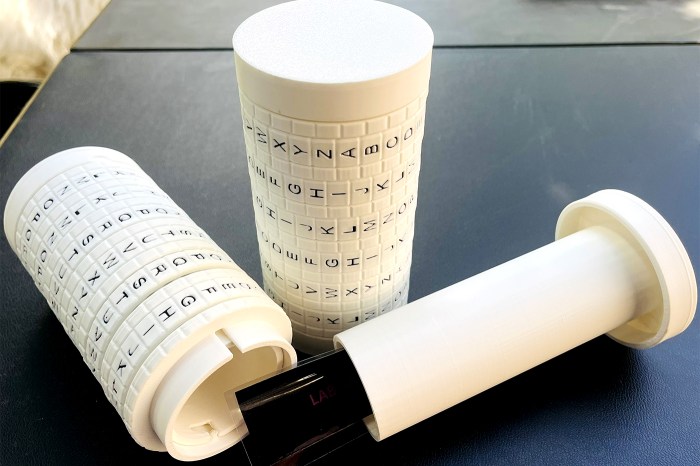
The final sequence was entered into a “cryptex” tool, which Sheikh and Cassano created with 3D printers at the Oakland campus Makerspace, modeling it after the device invented by author Dan Brown for his “Da Vinci Code” mystery thriller. The spinning tube had rotating letter rings which, when properly aligned, opened to reveal a small inner compartment and the answer to the puzzle’s mystery species: a Husky.
The five-step puzzle left Open Sauce attendees with a basic understanding of bioinformaticians’ role in a biology laboratory, Sheikh said. The escape room became a popular destination for the tens of thousands of fair attendees during the two-day fair, she added, at one point boasting a two-hour waitlist.
“I think that’s because people love playing games,” said Sheikh, who will rejoin Cassano in October to present the escape room at the Bay Area Science Festival, which is a one-day STEM festival aimed at educating and inspiring the next generation of scientists. “If they enjoyed that escape room, then maybe they’ll go home and search up what [bioinformatics] is.”
As Wolf envisions the future of Northeastern’s bioinformatics MS program, now with around 400 students across the campus network and online, he said the gamification of learning is worth further exploration.
“I think it can be an easy way to teach somebody something new in a fun way,” he said of the escape room concept. “Just imagine what you could do if you had a bigger mystery, a bigger problem to solve.”