A deal may resolve the Strait of Hormuz, but not the war
An anticipated deal between Iran and Oman would manage shipping in the strait, but has not yet been finalized.
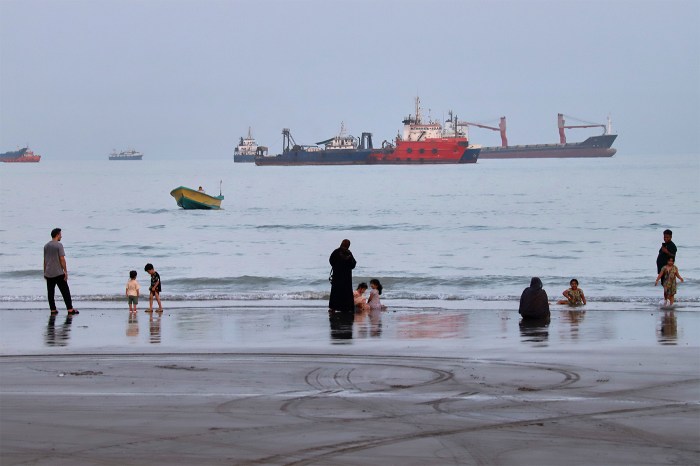

The Strait of Hormuz has emerged as the key flashpoint in the Iran War.
But don’t expect an anticipated deal between Iran and Oman, which was which was announced by both Iranian state media and U.S. President Donald Trump last week, to manage shipping in the strait to resolve the conflict, Northeastern University experts said.
“In many ways, there’s no real option to end the Iran war without solving the Strait of Hormuz,” said Jonathan Rock Rokem, associate professor of politics and sustainability at Northeastern University London.
While the anticipated deal “might help,” Rock Rokem continued, “it’s not going to secure U.S. interests.”
He added, “To end the war a larger deal would need to be agreed with the United States, which includes… some other major issues.”
The Strait of Hormuz is located between Oman and the United Arab Emirates in the south and Iran in the north, and it connects the Persian Gulf with the Gulf of Oman and the Arabian Sea. It is the only sea passage in and out of the Persian Gulf to the open ocean.
As such, it is also a major chokepoint in the world energy trade, with a fifth of the world’s oil and liquified natural gas typically moving through the strait.
But Iran effectively shut the strait down following the U.S.-Israeli attacks that killed Supreme Leader Ali Khamenei on Feb. 28.
The U.S. responded with a naval blockade of Iranian ports on April 13, lifted the blockade on June 18 during a ceasefire and then reinstated it on July 14.
Pablo Calderon Martinez, associate professor of politics and international relations at Northeastern University London, called the current situation “a stalemate.”
“[The supposed deal] should be the end of the conflict, or certainly get us on track to end the conflict,” Calderon Martinez said. “But I’m starting to believe it’s the preference of Iran to elongate it as much as possible.”
Editor’s Picks


Details on the potential deal between Iran and Oman are sketchy. The deal reportedly would allow vessels heading into the Persian Gulf to use a channel controlled by Iran and close to its coast while ships leaving the gulf would travel on a channel near Oman, according to the New York Times on Wednesday.
But experts were skeptical that a deal will actually get done.
Rock Rokem said a pattern has developed in the war – Iran escalates the conflict, prompting the United States to retaliate and escalate further, then Iran, at the last minute, calls for talks and de-escalates.
“That’s happening almost weekly now,” Rock Rokem said. “That’s the new normal.”
Rock Rokem also cautioned that there is a lot of spin, misinformation and distrust. On Monday, for instance, Trump called Iran “duplicitous.” Iran’s state news agency quoted Esmail Baghaei, the spokesman for Iran’s foreign ministry, saying “if certain third parties do not obstruct the process,” a joint statement from Iran and Oman outlining the deal “is currently in the final stages of review and drafting.”
Meanwhile, Iran has suggested it is in this conflict for the long haul, stressing its 2,500 year history and success in repelling foreign invaders including Alexander and the Mongols.
With the upcoming midterm elections and the continuing unpopularity of the war in the U.S. — even among Trump’s political base, support for the war dropped 13 points from 50% to 37% between May and July, according to a Politico poll — Iran has the incentive to continue the pattern, both experts said.
And Iran can do that with their control of the Strait of Hormuz.
“Iran can pretty much close down this strait whenever it wants with relatively low cost to itself in terms of military personnel and resources,” Calderon Martinez said. “And the U.S. cannot keep it open on its own because the costs are too high.”