Rare ‘doublet’ earthquake that hit Venezuela will test nation’s resources, expert says
Once an oil-rich nation with investments in building standards and disaster preparedness, Venezuela has fallen into economic turmoil, testing its ability to respond to the latest disaster, experts say.
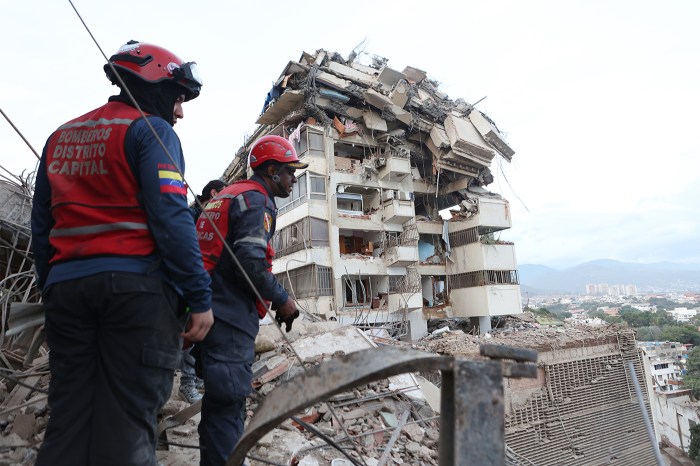

Venezuela was rocked by back-to-back earthquakes Wednesday evening in a disaster that will test the nation’s emergency response and recovery capacity as it copes with economic and political crises, disaster relief and engineering experts said.
The destruction was driven by a rare seismic “doublet,” or back-to-back quakes, according to the U.S. Geological Survey, or USGS, which monitors seismic activity. The federal agency noted that the “high casualties and damage are probable, and that the disaster is likely widespread.”
As of Friday, at least 920 people had been killed, with thousands more injured and missing, according to interim President Delcy Rodríguez. The USGS projected that the death toll could run into the thousands.
Once an oil-rich nation with investments in building standards and disaster preparedness after prior disasters, Venezuela has fallen into economic turmoil, testing its ability to respond to the latest earthquake, said Daniel Aldrich, a Northeastern professor, director of the university’s Resilience Studies Program and co-director at the Global Resilience Institute.
“At one point, it had the financial capacity to enforce construction standards, inspect buildings and make sure builders weren’t cutting corners,” Aldrich said.

More than 7.9 million Venezuelans have left the country since 2014, according to the United Nations High Commissioner for Refugees, or UNHCR, which called it one of the world’s largest displacement crises. Officials attribute the exodus to shortages of food, medicine and essential services, as well as economic hardship.
A magnitude 7.2 initial shock struck first at 6:04 p.m. local time, with a larger magnitude 7.5 mainshock 39 seconds later. The closely spaced epicenters and rapid succession of two powerful earthquakes subjected northern Venezuela to two rounds of severe shaking in less than a minute, amplifying the potential for widespread structural damage, according to USGS.
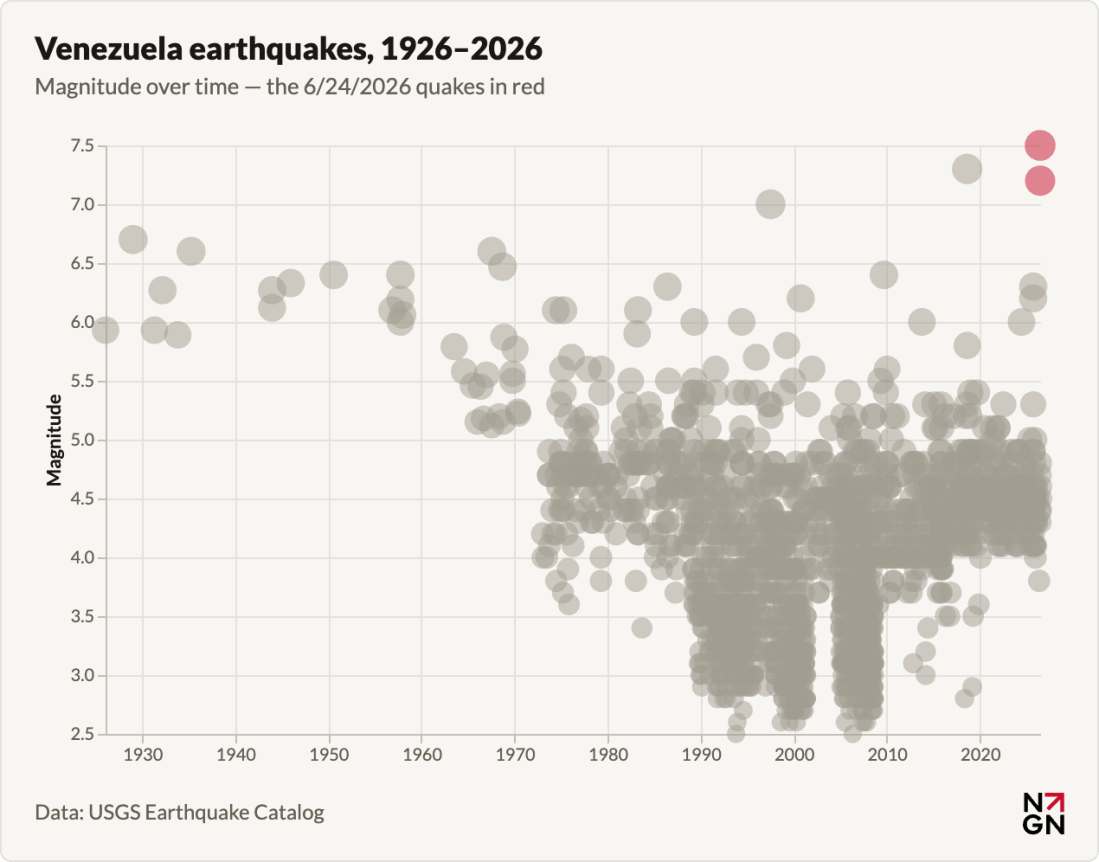
Northern Venezuela has a long history of damaging earthquakes, including a notable magnitude 6.3 earthquake in Caracas in 1967, which killed more than 200 people and injured hundreds more, according to USGS. While major earthquakes are relatively uncommon in the immediate area affected by Wednesday’s doublet, the region also experienced a pair of magnitude 6.2 and 6.3 earthquakes in September 2025 that injured more than 110 people and caused extensive structural damage across western Venezuela, according to USGS.
Editor’s Picks


Some experts suggested that many of the collapsed buildings were made of non-ductile, or “brittle,” concrete — an assessment with which Mehrdad Sasani, a professor of civil and environmental engineering at Northeastern University, agrees.
“A building’s ability to survive an earthquake depends largely on how much it can move,” he explained. “More ductile structures can absorb more energy and deform without collapsing. Brittle structures can tolerate much less movement before they fail.”
Sasani is an expert in building collapse and community and building resilience. He noted that Venezuela’s current seismic code dates to 1982, when officials adopted a more modern generation of earthquake-resistant building standards to shore up deficiencies identified during prior seismic events.
“Buildings designed before those codes were implemented would be much more susceptible to collapse,” Sasani said. “Even in the United States, before the mid-1970s, many buildings were not properly designed to withstand earthquakes.”
USGS officials said that many of the ruined structures were made of unreinforced brick masonry and adobe block construction, where walls lack the steel reinforcement typical of more modern buildings. Those structures, Sasani said, are less capable of withstanding severe ground shaking because they are heavier and less able to absorb the energy generated by a quake.
U.S. Secretary of State Marco Rubio said that the State Department is rapidly deploying resources to the region to assist in the aftermath of the quakes.
Northeastern Global News, in your inbox.
Sign up for NGN’s daily newsletter for news, discovery and analysis from around the world.

“America stands with the Venezuelan people during this difficult time and at the direction of President Trump, the State Department is immediately deploying search and rescue teams, medical resources, and humanitarian assistance to Venezuela,” Rubio said in a social media post.
It remains to be seen how swiftly U.S. support might make a difference. Aldrich suggested that the dismantling of the U.S. Agency for International Development, or USAID, has left future international disaster response in a more precarious position.
“In the past, there was a highly skilled, high-capacity system that would have responded immediately,” Aldrich said. “Now it’s going to be much more ad hoc. That assistance is no longer systematized or built into a regular process.”