Attacks on desalination plants in the Middle East threaten vital freshwater supplies for civilians
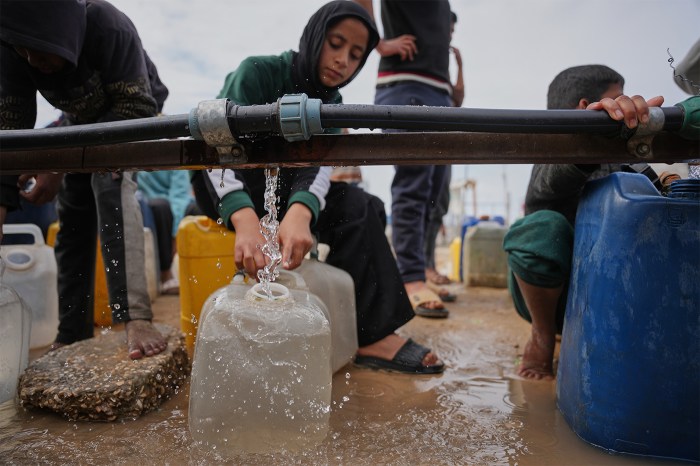

As the war in the Middle East unfolds, Northeastern University experts in politics, sustainability and international law are increasingly concerned that recent military attacks on desalination plants that provide the bulk of the region’s freshwater could become regular occurrences.
Iranian officials have accused the U.S. of striking a water desalination plant they say supplies 30 villages, while Bahrain said Iranian drones damaged a desalination plant there, though supplies remained online.
Even more so than oil, countries in the Middle East, including Israel, run on water pulled from the sea or brackish groundwater and converted into freshwater, said Auroop Ganguly, Northeastern distinguished professor of civil and environmental engineering.
Without the hundreds of desalination plants that dot the desert region, millions of people would be left without water for drinking, cooking and agriculture.
Bahrain, for instance, relies on seawater desalination for almost 95% of its potable water, while Iran relies on desalination mainly in the southern and coastal regions “although that may change as … both surface water and groundwater [become] scarce,” Ganguly said.
The recent attacks are “causing quite a lot of anxiety across the region, especially in these Gulf states that aren’t used to this kind of military violence and are now suddenly finding their civilian infrastructure on the front line,” said Jonathan Rock Rokem, an associate professor in politics and sustainability at Northeastern University in London.
“Water is a key resource that people need to survive. It’s a much more important resource than we think in the West. In the West, we take it for granted,” he said.
Desalination plants represent tempting targets since they are situated along the coasts of the Gulf and Mediterranean and drones and rockets don’t have to penetrate as far inland, Rokem said.
In addition, they are sometimes attached to power plants, due to high energy needs to run their hydraulic systems, he said. The fact that the power installations might also serve the military can create a scenario in which an enemy combatant sees an attack on the complex as a legitimate wartime goal.
Editor’s Picks




However, the legitimacy of such attacks may not be easy to defend. Attacks on civilian infrastructure can be considered a violation of international law under the terms of the Geneva Conventions, a set of treaties and protocols that form the basis of international humanitarian law, said Zinaida Miller, a Northeastern professor of law and international affairs.
Article 54, which was added to the conventions in 1977, says “that you can’t attack objects indispensable to the survival of human life,” she said. “It’s pretty clear that that includes water installations,” Miller said.
“Of course, we [also] have long-term enforceability problems in international law,” she added.
For starters, international law prohibits countries from going to war unless it’s in self-defense or with the approval of the U.N. Security Council, but the U.S. and Israel launched the war with Iran on their own terms, Rokem said. “We are in a very different reality than we were a few years ago. The U.N. is much weaker.”
For now, it remains to be seen whether more attacks will continue. Iranian President Masoud Pezeshkian apologized Saturday for attacks on neighboring nations, but Iran then initiated new attacks on Gulf countries on Tuesday.
Attacking desalination plants could “threaten the ability of countries and societies to thrive or even survive … potentially leading to global destabilization,” Ganguly said. “Oil built the Persian Gulf. Desalinated water keeps it alive. War threatens both.”