What are the chances the Democrats win back the House and the Senate? What history tells us about the midterms
The midterms determine control of the House and Senate, and include races for seats in thousands of state and local offices.
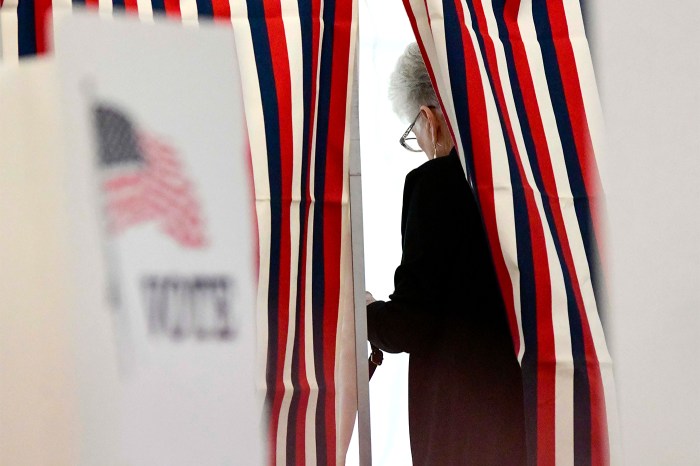

If history is any judge, then the Democratic Party is positioned to make gains in the 2026 midterm elections, which are now less than a month away.
On average, the party in power loses about 25 seats in the U.S. House of Representatives during the off-year elections, which take place midway through a president’s four-year term and typically serve as a referendum on the incumbent party, said Nick Beauchamp, an associate professor of political science at Northeastern University.
That power shift is usually a result of several baseline factors — presidential approval and the state of the economy, which tend to account for a lot of what’s driving public sentiment, Beauchamp said.
The midterms determine control of the House and Senate, and include races for seats in thousands of state and local offices. The Republicans hold a slim majority in the House, with 218 members to the Democrats’ 214. They also command the Senate.
Election observers note that while the progressive wing of the Democratic Party has enjoyed electoral success in the primaries, that impact has mostly shone through in smaller, less consequential races.
The Nov. 3 contest, they contend, will involve larger structural forces that trump ideology. They include the anti-incumbency mood that has swept elections around the globe, a deepening dissatisfaction with President Donald Trump as shown in several national polls, the economy and rising inflation tied to the U.S. war with Iran.
Editor’s Picks


The combined effect of those forces could blunt the GOP’s effort to redraw their congressional maps to favor Republicans. Ten states redrew their congressional maps mid-decade, with the changes projected to give Republicans a net gain of about four House seats, according to an analysis from the Cook Political Report, an independent, nonpartisan political analysis organization.
“All things being equal, we should expect a fairly large swing in the House,” said Beauchamp, who has developed and presented midterm prediction models at conferences.
The race for control of the Senate could come down to a small number of fiercely competitive races, which are mostly too close to effectively forecast using modeling, Beauchamp said. The Republicans currently hold a 53-47 majority in the U.S. Senate, meaning the Democrats would need to flip four seats to take control.
The success of the Democrats’ campaign to flip the Senate rests on the ability to appeal to a broad coalition of voters, said Lucas Holtz, a senior political adviser with Third Way, a national think tank and advocacy organization.
That dynamic can be seen in candidates such as Roy Cooper in North Carolina, James Talarico in Texas and Mary Peltola in Alaska, who have sought to distance themselves from the Democratic Party’s more progressive wing by presenting themselves as closer to the center-left, Holtz said.
“If Republicans succeed in holding the Senate and the House, it will be because they were successful in spending hundreds of millions of dollars to brand the Democratic nominee as far left,” he said. “So far, Democrats are not playing into Republican attacks by running on a far-left agenda — they are running on a mainstream playbook and offering a clear break from the status quo of the Democratic Party.”
Candidates affiliated with or backed by the Democratic Socialists of America have made headlines over the primary season, but are unlikely to account for much of the party’s potential gains, Beauchamp said. Many are running in deeply Democratic districts where Republicans have little chance of winning, he said.
Are there other historical parallels to draw upon in gauging the odds of a blue wave?
Holtz points to the 2006 midterms, which took place amid the U.S.’s unpopular war in Iraq, growing economic concerns and rising energy costs linked to high oil and gasoline prices.
He said the political factors that made the difference in the midterms include then President George W. Bush’s “abysmal” 38% approval rating, polling showing strong support for Democrats on key issues and the Democrats endorsing center-left candidates capable of flipping “ruby red states and districts blue.” Democrats ended up gaining 31 House seats and six Senate seats, taking control of both chambers.
Trump’s approval rating rests at around 32%, according to the latest national Reuters/Ipsos poll, which is hovering around historic lows for a president heading into the midterms. But one major difference this year likely impacting the number of seats Democrats might win is the Republican-led redistricting effort, which could give the GOP an advantage in several competitive House races, Holtz said.
The Democrats are currently leading the generic congressional ballot, a measure of national preference for either party, by about nine points.
“Despite Republicans’ redistricting efforts last year, we are expecting Democrats to flip about 18 to 20 seats in the House, for a majority of around 232 seats,” Holtz said.
The Democrats will be viewed as “change agents” as voter sentiment overwhelmingly signals a desire for a course correction, said Becca Siegel, chief insights officer at the Center for American Progress Action Fund, a progressive policy institute and advocacy organization.
“We’re certainly in a moment of global anti-incumbency,” she said. It is a fact that can be seen, Siegel said, in electoral contests around the world, including in Brazil, where the more left-leaning President Luiz Inácio Lula da Silva fell behind right-wing challenger Flávio Bolsonaro in Sunday’s first-round vote, triggering a runoff; and in Hungary, where Viktor Orbán’s right-wing populist Fidesz party lost power in April after 16 years in government.
But the anti-establishment mood is also playing out within political parties, including in Democratic primaries, Siegel said.
“It seems to me that this historical pattern might hold” in a few weeks time, Siegal said, indicating that a sizable Democratic swing in the House might be in the cards.