Zoo animals get innovative new toys from this groundbreaking class at Northeastern
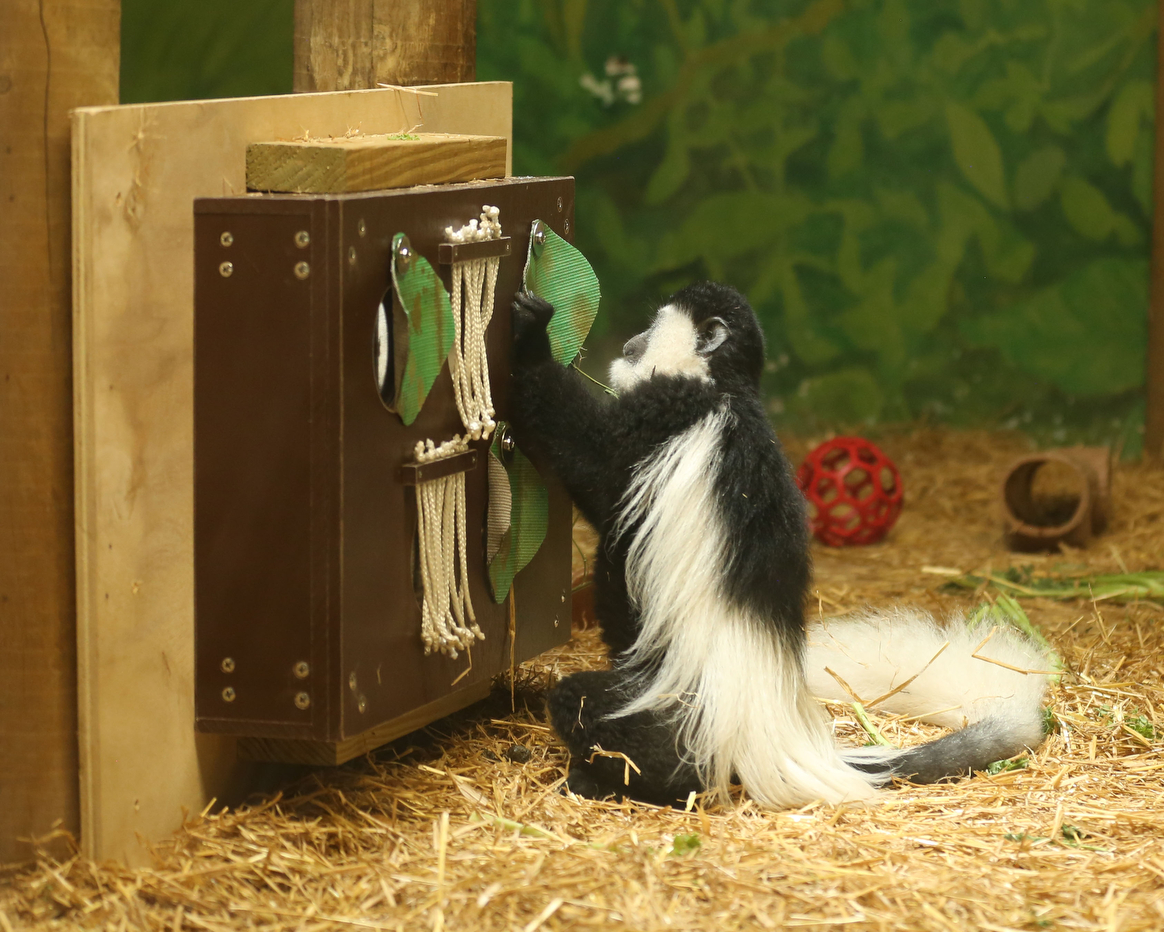
In Rebecca Kleinberger’s first-of-its-kind class, students designed puzzles, scented bubble dispensers and musical swings to enrich the life of zoo animals. They were a big hit with animals and visitors alike.


Hudson loves a good puzzle.
The Stone Zoo’s 9-year-old arctic fox is inquisitive to the point that most toys just aren’t enough. For an animal that needs complex cognitive enrichment, it can be hard to find something that will keep him on his toes and not sink into boredom, lethargy and potentially unhealthy behaviors.
Luckily, he has a new puzzle. Thanks to a Northeastern University professor and her student who created a box that, when rotated the right way, will release treats, Hudson is living his best life –– and attracting more visitors to his habitat.
The project, called Outfoxed, emerged from a first-of-its-kind class taught by Rebecca Kleinberger, an assistant professor at Northeastern University and director of the Interact Animal Lab, that challenges students to design innovative toys and enrichment tools for animals in an exercise that goes beyond the classroom.
Two student projects, Hudson’s puzzle box and a scented bubble dispenser for a pair of elderly black bears, are still being used by the Stone Zoo.
“It was a whole crazy enterprise that I had no idea how we were able to pull off,” Kleinberger said. “There’s really no such class anywhere else in the world.”
Students work on real challenges — not abstract problems — for real animals set forth by the Stone Zoo, New England Aquarium and Tandem Vet Care, a Boston area pet health provider.
Students break into teams focused on a specific animal and spend the class designing and iterating on the ideas for enrichment tools through hands-on work. They take field trips to the zoo and aquarium to observe and study the animals they are designing for and even consult with staff who care for the animals.
“You need to get into the user’s mind, even if the user is non-human,” said Somil Shah, who worked on the arctic fox project while he was an information systems master’s degree student at Northeastern and a graduate research assistant in the Interact Animal Lab.
Designing products for animals comes with a different set of challenges and considerations than designing for humans, Kleinberger explained. The goal is to create something engaging but not addictive. A tool needs to enrich an animal’s life, but that can only be evaluated purely by studying body language and behavior since conversations are impossible.
Northeastern Global News, in your inbox.
Sign up for NGN’s daily newsletter for news, discovery and analysis from around the world.
“Everything is made for our own view, perception, bodies and interests,” Kleinberger said. “When you work with animals, you have to completely put the animals at the center. It’s about their motivation.”
The students who were able to deploy their projects with real animals did so over a three month period, as they monitored how the animals interacted with these creations and then re-designed when necessary.
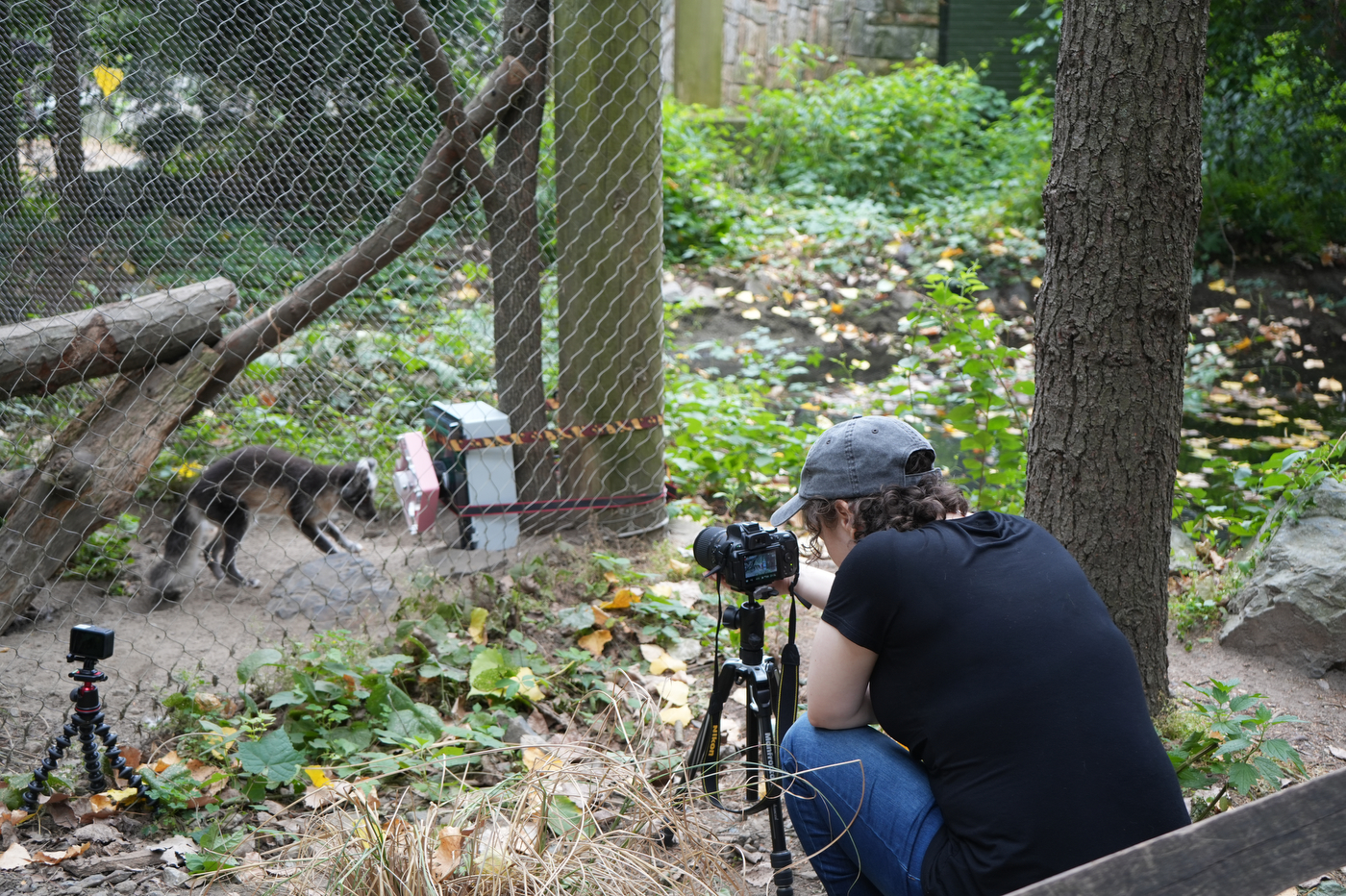
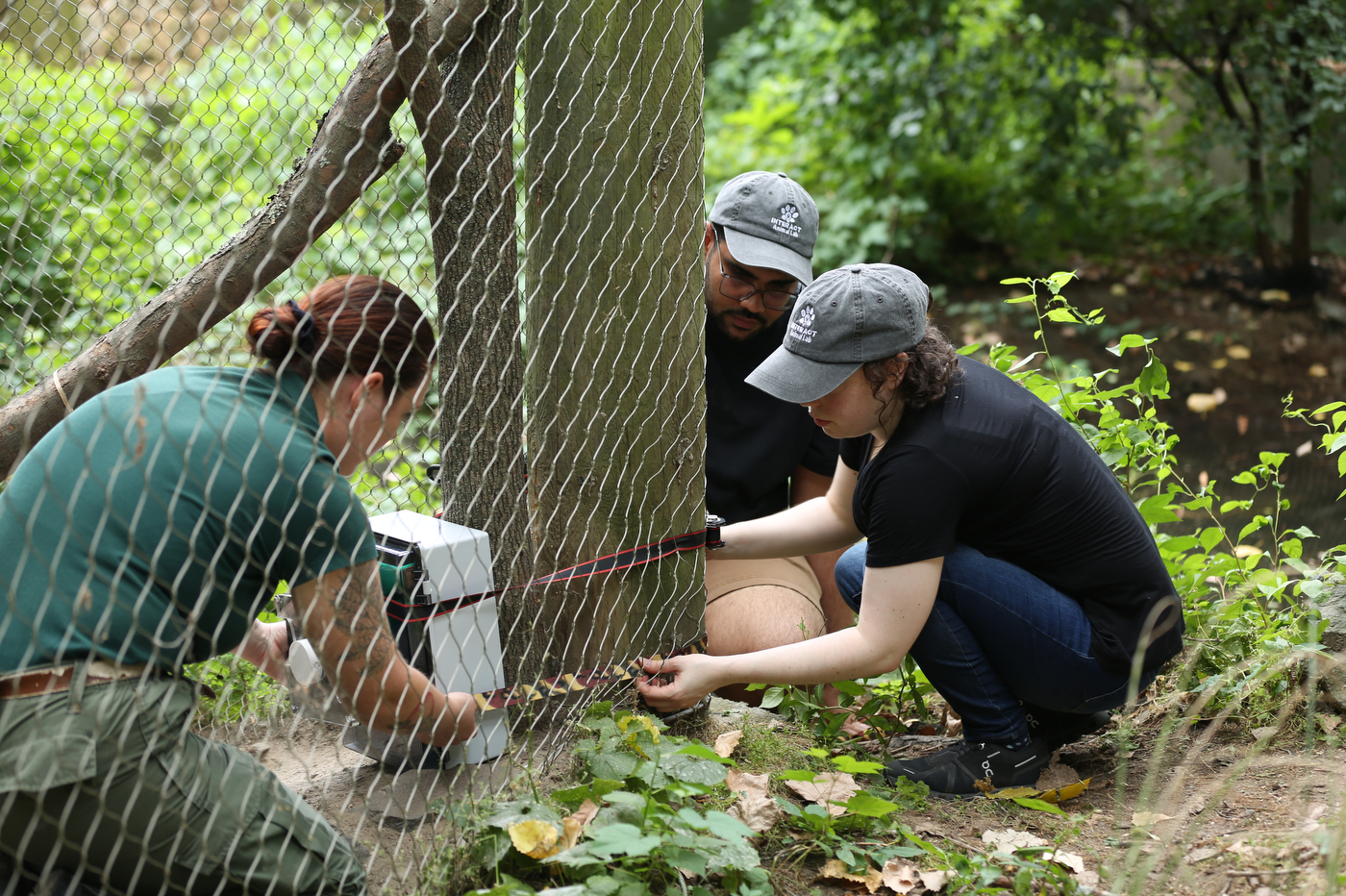
When designing their puzzle, Shah and his team quickly learned they had to outfox the fox. Their rotating puzzle, which releases treats out of an opening when tipped in the right direction, was too easy for Hudson at first. They made the puzzle more and more challenging by putting additional obstacles inside the box for the treats to hit. They even had to design the box so that Hudson had to rotate it in different directions in a specific order to get his treats.
“The last puzzle was very difficult for him, but he managed to get it in the end,” Shah laughed.
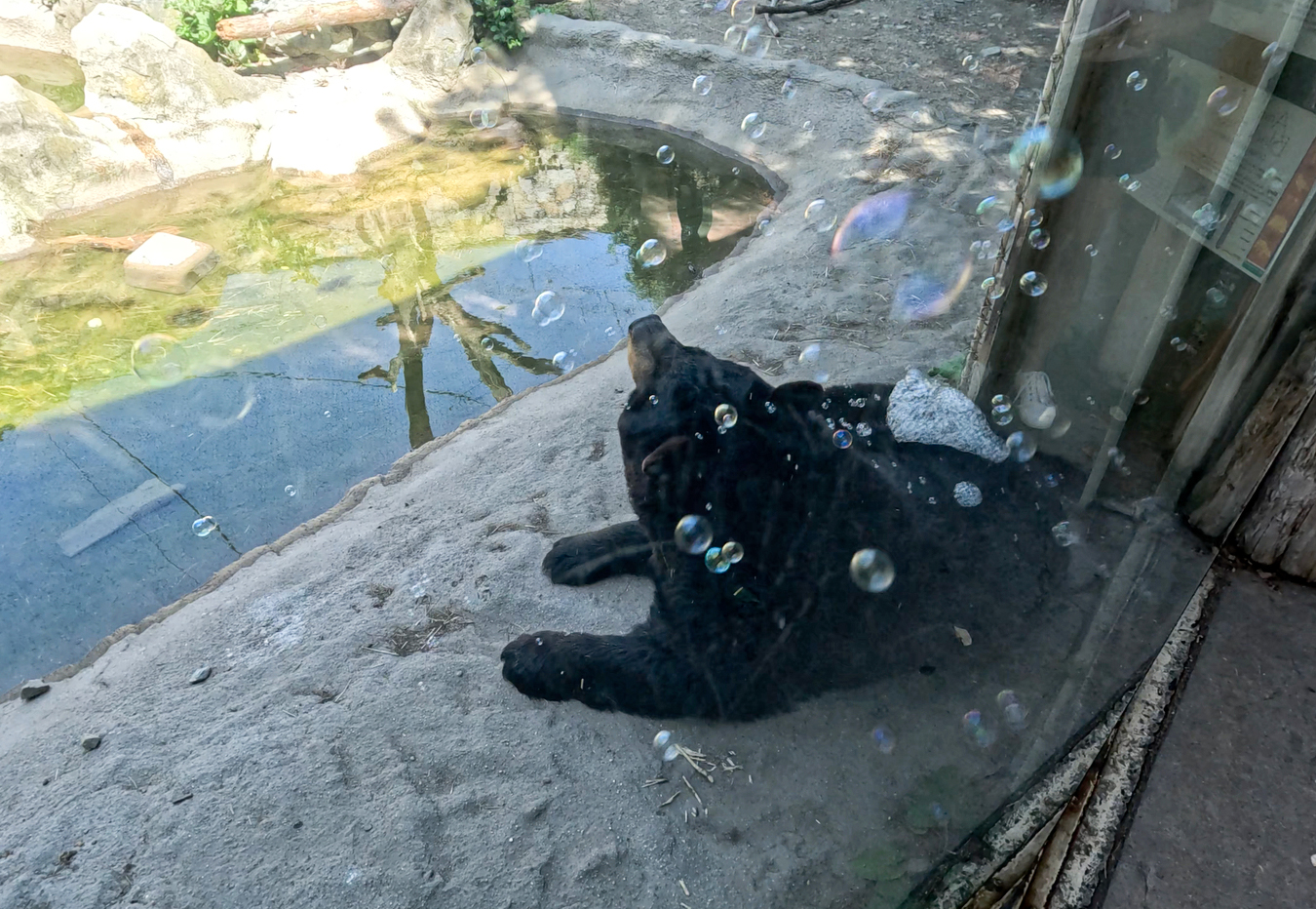
Arushi Aggarwal, a senior computer science student, had the opposite challenge. She had to design her project, BearBubbles, a scented bubble dispenser, for the Stone Zoo’s pair of elderly black bears, Bubba and Smoky.
Both bears are nearly 20 years old, double the age of what most black bears live to in the wild. They move less and have signs of arthritis, but the zoo was intent on engaging them in something akin to “gentle bear yoga,” Kleinberger said. The problem is that the only thing that gets Bubba and Smoky moving is food, and due to their weight and health, food-based enrichment is a no-go.
But Aggarwal learned that black bears have one of the strongest senses of smell in the animal kingdom. Working closely with the zookeepers, she designed her scented bubble dispenser based on flavors that the bears are attracted to: maple bacon, peanut butter and, oddly, lemon, which is one of their favorite snacks. She then installed heat sensors that would set off the bubble machines when the bears’ heat signature is detected at a certain distance.
“One of Rebecca’s biggest ethical pillars of the work she does is animal agency and how we make sure that even if animals don’t know they’re in control of the work we’re doing, they retain that control anyway,” Aggarwal said.
Editor’s Picks


BearBubbles provided the exact kind of multisensory enrichment Bubba and Smoky needed, she explained. They watched the bubbles fall. Their ears would perk up every time they heard the machine’s motor start up. They would stick their snout into piles of bubbles to catch a whiff. They also engaged with the bubbles physically, licking and scratching them and even eating leaves that the bubbles landed on.
Both Outfoxed and BearBubbles were also big hits with visitors to the zoo. Both projects drew more visitors to the habitats and resulted in them staying longer, which gave zoo staff an opportunity to educate them about the animals and the need for conservation, students explained.
Aggarwal, whose computing speciality is robotics, has always been interested in bringing computer science beyond the screen but had never seen one of her projects deployed in the real world.
“The fact that this was not only physically tactile but physically deployed and available to a population that I could see actually needed it, it made me understand why I’m in the field of computing,” Aggarwal said.
Kleinberger said her class has become something more profound than she ever hoped it would be. Her students’ work has had a real impact on the lives of animals and given the public a new understanding of animal health and care.
But she hopes sheds light on how this kind of work can open up ways of thinking about designing for people with different needs, interests and perspectives too.
“This notion of designing for very different bodies and very different minds raises the question of, how do I even know that your mind and my mind work the same?” Kleinberger said. “When you work with animals, you realize how far it can stretch.”