Northeastern University research collective ‘the first open repository’ of Latin American public design
The design of public sector programs often gets lost in the shuffle of changing administrations. The Public Design Collective at Northeastern chronicles those programs in Latin America.
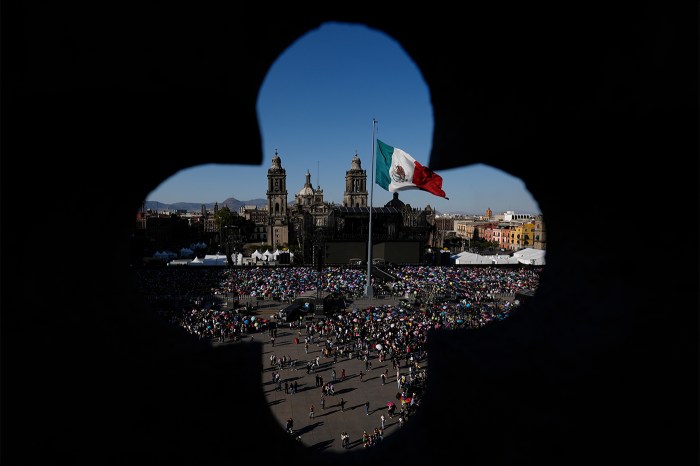

Governments come and go, but their legacies are often in the public service projects they initiate, complete or even leave unfinished.
The public may bear witness to the projects, but for the designers behind public services and others interested in replicating, renovating or otherwise completing a project initiated by a previous administration, it’s more than just paperwork that gets lost in the shuffle of administration changes.
The history and operational procedures behind those public service projects, including what worked and what didn’t, can be hard to find — especially in regions with high government turnover, such as Latin America, according to Sofía Bosch Gómez, an assistant professor of art and design at Northeastern University.
A new research collective at Northeastern aims to bridge that gap. The Public Design Collective will be “the first open repository of public design in Latin America,” Bosch Gómez, the founder of the collective, says. The collective includes researchers, data visualization specialists and a wide network of collaborators.
Tina Rosado, a data visualization specialist and researcher with the Public Design Collective, says that public design focuses on government-sponsored public services, like public libraries or public education, but underlines that there are still “design practices and design philosophies embedded in the methods used to innovate public policy and services.”
Northeastern Global News, in your inbox.
Sign up for NGN’s daily newsletter for news, discovery and analysis from around the world.
She uses motor services as one illustration. “People need licenses,” she says, “and it’s a painful process,” citing the wait times and bureaucracy. Governments frequently try to improve on the process, but often focus on technological improvements, Rosado continues, without ever visiting local offices.

But a design-focused approach, she continues, would begin with the users first, with designers visiting “the office and seeing the processes and the pain points that people are facing.” Public design, she says, starts with a human-first mentality.
Bosch Gómez says that, “when we talk about public sector work, it’s work for and within government,” but it also has a significant design component “in understanding what their users or residents need, implementing participatory processes” and connecting the citizen to the state.
The Public Design Collective is focusing on Latin America because, in that region, “we see political cycles being very aggressive, in the sense that administrations come in and basically start over from scratch, because they want to be distinctive,” she continues.
Editor’s Picks


But this desire for distinctiveness often means that a previous administration’s public services are abandoned, to the extent that even their methodologies go unrecorded, she says.
For instance, in a forthcoming study that will publish later this year, Bosch Gómez says that her team analyzed over 700 publications detailing over 500 public design-oriented projects in Latin America, across four languages — Spanish, Portuguese, French and English. They discovered that “fewer than 20% described the methods they actually used. Entire regions, like the Caribbean and most of Central America, are barely represented at all.”
However, Bosch Gómez continues, “somehow Latin America has learned to work within those [political] cycles and create pilot projects that fit those time frames.”
As an example of something that works, she highlights a program in Bogotá, Colombia, called Manzanas del Cuidado, or “care blocks,” which are community centers scattered across the city with a focus on programming for women. The Public Design Collective would hope to retain an archive of the operations and procedures running the Manzanas del Cuidado, protecting innovative thinking from being lost to future practitioners and the public who might benefit from it.
The need for the collective is all the more pressing because the other entities that could be doing this work are dwindling. The group published research last year that outlined the landscape of public sector innovation labs, centers that employ design experiments to improve on public works and services. “The work of these innovation units is continuously at risk of being disregarded since their influence is frequently limited by electoral cycles and changing political agendas,” according to the paper.
For instance, LabCDMX was a public sector innovation lab that ran a series of experimental programs in Mexico City focused on issues like walkability, making the city more playful, creative, etc. However, LabCDMX closed in 2018 due to a change in administration.
“There is a need to institutionalize many of these” public sector programs, Bosch Gómez says, “especially programs that have to do with social impact, access to resources and benefits.”
However, there are both geographic and linguistic barriers to the work of the collective. Countries like Brazil and Mexico will naturally focus on their own concerns, she notes, and the fact that Portuguese is the national language of Brazil while Spanish is the national language of Mexico doesn’t help things.
As the Public Design Collective studies material across multiple languages, they hope to “bring light to the differences so we can communicate better between groups,” Rosado says. Providing an open repository for public service workers, designers and scholars “elevates the discourse of public design as a thing in itself,” she says.