Tracking flights and missiles, Northeastern’s global security team moved quickly
In the days and weeks leading up to the joint U.S.-Israeli strikes in Iran, Northeastern University’s global security team had more than inkling that something big was coming.


It began with a phone call on Thursday, Feb. 26.
Khushal Safi, Northeastern’s associate vice president for global safety, received word from a key security contact in the Middle East that a military confrontation was — in his words — “more likely than not” to take place imminently.
The following day with credible intel in hand, Northeastern University’s global security team leapt into action.
“We started triggering our response,” Safi said.
Within hours, he and his team sent out a mass-communication blast via their global security operations center to every student, faculty or staff member they knew to be in or near potential conflict zones, warning them that the region could soon see missile fire and urging them to prepare to leave if necessary. Any Northeastern-sponsored traveler in the region received emails, texts and WhatsApps messages alerting them to the situation unfolding in the Middle East.
Countries impacted by the developing conflict are among the more than 150 countries that welcome Northeastern students participating in experiential learning programs, including co-op and study abroad. Combined with faculty and staff who travel on university business, including research and other projects, the university’s global reach spans all continents and keeps Safi’s team busy.
“Our community is all over the world and they count on us to keep them safe,” said Safi.
The team’s February 27 outreach had begun weeks prior to the U.S. strike on Iran, Safi said. In the days leading up to the escalation of hostilities, Safi and his team had already called students and faculty in the region, sometimes multiple times a day, to coordinate travel and extraction plans for those looking to leave.
In January, the U.S. military had started to build up a massive presence in and around the Persian Gulf, deploying aircraft carriers, destroyers and fighter squadrons in a show of force pointing to something far beyond a routine military exercise.
Negotiations between the United States and Iran over nuclear ambitions had continued as the world waited for a potential outcome.
Safi’s sources in the region had begun to warn that the university might need to prepare an evacuation plan — a delicate, time-sensitive task that would require convening numerous stakeholders, assessing what countries posed the highest risk and coordinating flights or routes out of the region.
In the case of a student studying abroad in Amman, Jordan, the global security team worked with the student over the phone to develop an initial shelter-in-place plan, since flights were cancelled in Jordan. Safi and his team provided all the information the student would need, from what Jordanian sirens sound like to how much food, water and phone battery charge she would need for 72 hours.
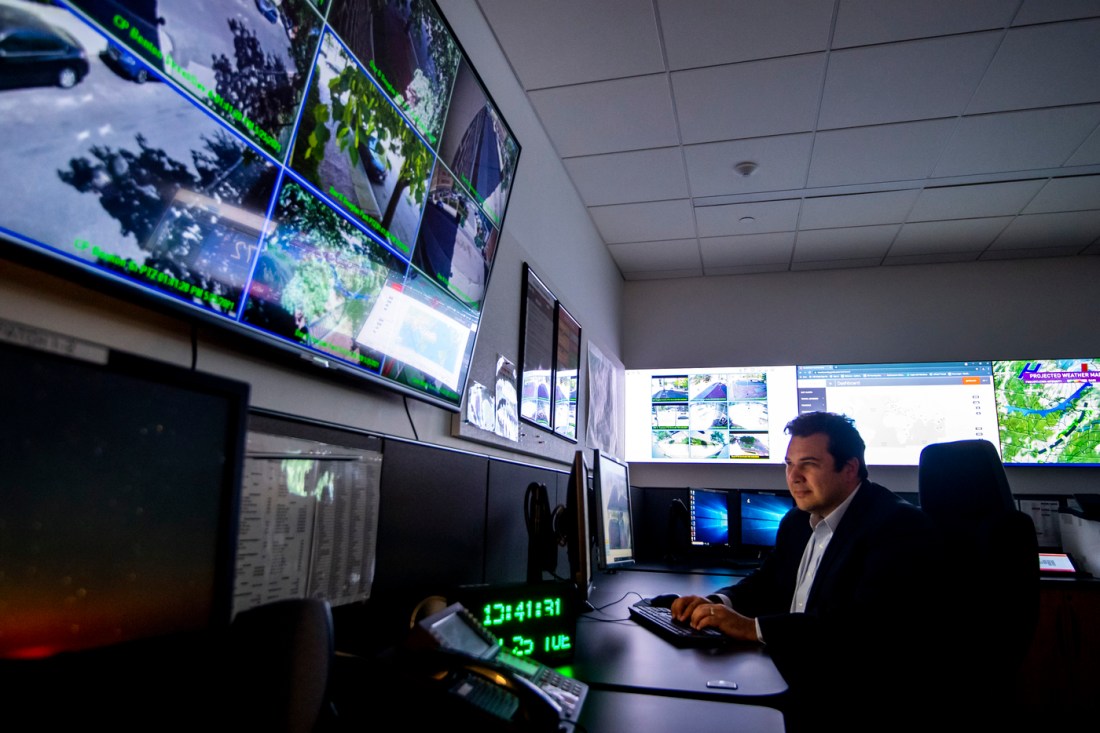
Having spent a career in counterintelligence, Safi now leads the university’s Global Safety Operations Center, or GSOC, a 24/7 hub that monitors global risks and security-related events to keep students, faculty and staff safe while traveling for university-sponsored programs. Between the operations center and his Boston home, Safi set up WhatsApp chains to establish secure communications with the students and key partners.
On Feb. 28, the U.S. and Israel began a bombing campaign across Iran.
Working with the university’s global safety office, the Office of Global Services, the student support hub We Care and the Global Experience Office, Safi and university leaders helped to relocate students in sensitive areas while making sure the disruption does not impact them academically. They diverted faculty members and others who were scheduled to fly through the region and created communication channels that enabled daily contact with those community members as the situation unfolded.

For the student in Jordan, Northeastern’s global security team communicated with the student’s host institution, Amideast, about their plans to evacuate students, which involved students securing travel to Morocco. Safi had to wait a day before his team found an available flight out of Jordan. Once flights were available, it took his team 24 hours to secure a flight to Casablanca and work with Crisis24, a partner risk management company, to set up private transport directly to the airport for the student, along with five non-Northeastern students located there.
“Ultimately, it’s the best-case scenario,” Safi said. “Now, she’s going to be able to finish her studies out of Morocco.”
A large part of the global security team’s job is this kind of logistical gymnastics work. Once they know of a potential risk, they are constantly tracking flights, airport closures and openings and potential border crossing routes.
Safi and his team are part of private groups on WhatsApp with nonprofits, companies and other partners in the region who they can get tips from and share information with. Safi got a tip from Raytheon, for example, about a flight that had 20 open seats and was accepting U.S. citizens.
“Logistics is the wild card,” Safi said. “If you want to go today, you could definitely go today, but if you don’t have any means, you can’t get out.”
One faculty member had a flight booked to Tel Aviv on Friday, Feb. 27. Wishing to remain anonymous for this report, he told Northeastern Global News that he had been concerned about the escalating situation for the last couple of weeks.
Early Friday morning, he received a call from Safi.
“He was pretty compelling that something was coming imminently and I knew to listen to his expertise,” the faculty member said. “As it turned out, the flight I didn’t get on from Newark to Tel Aviv was diverted to Athens, and had the flight made it to Tel Aviv, I’d be stuck there now.”
The relocations were something of a logistical nightmare.
“We’re getting information in fairly real time on incidents, airspace openings and closures and flights that are available,” Safi said. “When someone contacts us, we’re pushing that information right back out so they can try to get on the next flight.”
For those who couldn’t immediately catch the next flight home, the guidance from Safi was simple: stay put, monitor airline apps and embassy alerts, and only go to the airport once a seat is confirmed. Airports themselves had become potential targets, and flights were being canceled with little notice.
Whatever you do, he warned members of the Northeastern community, don’t check out of your hotel until the plane’s wheels are off the ground. In a conflict zone, where airspace could close without warning, even a confirmed ticket was no guarantee a flight would leave.
Only a handful of students were in areas vulnerable to the conflict. Two were extracted, while two others, both on co-op, are still in the region and staying with family. One was on co-op in Qatar at the Global Studies Institute, stationed near international embassies there. Another was on co-op in Dammam, Saudi Arabia, working with Aramco, the state-owned energy company. Two were participating in study-abroad programs: the student in Jordan, who has since moved to Morocco, and a student in Cairo, Egypt, who was not deemed at risk and remains in place.
Other students and faculty members were stranded in countries outside the conflict zone, in countries such as India. But their return travel would take them through the unfolding war, Safi said.
One third-year economics student on co-op, in his home country of Qatar, had been in regular contact with Safi and his team for some days prior to the initial strikes. On March 6, he said, from his house, he could see airstrikes in the distance and plumes of smoke on the horizon — far enough away from where he is staying with family.


“You can really hear the missile interceptions,” said the 21-year-old, who requested anonymity. “But I still feel very safe.”
On March 2, Mora Namdar, assistant secretary of state for consular affairs, posted on social media, urging all American citizens abroad to “DEPART NOW” from 14 countries in the region, citing what she described as “serious safety risks.”
Typically, evacuation instructions for diplomats and U.S. citizens are disseminated through formal State Department travel advisories and embassy alerts.
Safi also immediately formed an active working group on Microsoft Teams with Katherine Macfarlane, senior director of Northeastern’s study abroad program, to assess the warning and determine whether students needed to be relocated. He and Macfarlane are then able to send near-constant updates to one another about the status of students abroad. Some diplomats criticized the State Department for acting too slowly and lacking a proper plan amid what is now a full-blown war in the Middle East.
Ultimately, Northeastern officials deemed the situation “too fluid” not to act, Macfarlane said.
“What’s tough about these situations is that things can seem very calm on the ground — and are very calm on the ground — in these countries,” Macfarlane said. “But things can change so fast, and what we don’t know in this case is will something happen to make it impossible for the students to leave.”
For students or faculty working or studying abroad, Safi said it’s important to register with the State Department’s Smart Traveler Enrollment Program, or STEP, which allows embassies to send alerts about security risks, evacuation flights and airspace closures.
They should also closely monitor airline apps and enable notifications, he said, as carriers often update routes or release rebooking options before broader advisories are issued. In a rapidly evolving crisis, those real-time updates can make the difference between getting out quickly or being forced to seek alternative measures, Safi said.
Although the global security team’s work largely covers students, faculty and staff on university-sponsored travel, Safi said there are outstanding cases that still require his attention.
Ryan Rivera Cabrera, a second-year behavioral neuroscience student, flew into Dubai on Feb. 22 to serve as chair of a Model United Nations conference. The event was scheduled to end on Feb. 28, the day that the U.S. and Israel jointly launched their strike on Iran. For the next few days, Cabrera remained locked down in his hotel, only 10 minutes from Dubai International Airport, both his only chance of escape and a target for an eventual Iranian strike.
Every few hours, often in the middle of the night, everyone in the hotel would receive an urgent missile alert from the UAE government and they would descend into the hotel’s underground parking to shelter in place. During that time, Cabrera tried to secure a flight back to the U.S. in every way he could.
He received guidance from the global security team, who advised him on potential flight paths. Using that advice, Cabrera then spent hours on the phone with commercial airlines trying to find a flight that would get him home quickly and safely.
He eventually secured a seat on one of the first flights from Dubai to New York City, which got him home on March 5. Even then, Cabrera said he wasn’t able to breathe a sigh of relief until the plane touched down stateside.
“I wasn’t confident in it until we landed,” Cabrera said. “The entire plane was emotional, and it was unlike anything I’ve ever seen.”


