Meet the junk artist behind the iconic flame-throwing guitar in ‘Mad Max: Fury Road’
Found object artist Michael Ulman never had Hollywood dreams, but now he’s a part of movie history. His work on the legendary “Mad Max: Fury Road” embodies how he repurposes mundane objects into gallery worthy imagery.


In the Wasteland of “Mad Max: Fury Road,” the world is dead but not silent.
The wind blows across barren plains, the engines of monstrous vehicles roar through endless desert and an electric guitar strapped to a madman wails. If weapons, wheels and water are the religion of the Wasteland, this soundscape is its choir.
Since its release in 2015, the post-apocalyptic action film “Fury Road” has been heralded as one of the best movies of the 21st century by critics, audiences and filmmakers. Its relentless action, practical stunts, lived in production design and thematic depth, combined with a famously troubled path to the screen that almost rivals the madness of its post-apocalyptic setting, have made it into Hollywood legend. Even with iconic imagery packed into every frame of the film, one stands out: the flame-throwing guitar held by the aforementioned madman, known simply as the Doof Warrior.
For Michael Ulman, seeing the guitar on screen for the first time, flame arcing across the orange wasteland, was particularly impactful. After all, he made it.
“It was just insane,” Ulman said. “It was just the most amazing job I think I’ve ever, ever had and probably will ever, ever have.”
Ulman, a Boston-based found object artist and Northeastern University graduate, was part of many artists brought to Australia to work on “Fury Road.” Together, they built the vehicles and weapons that made the Wasteland into a living world with its own history and culture. Ulman and his fellow artists ultimately created a fleet of about 150 fully functioning, unique vehicles.
Northeastern Global News, in your inbox.
Sign up for NGN’s daily newsletter for news, discovery and analysis from around the world.

Having seen the original 1979 “Mad Max” at age 2, Ulman knew the aesthetic was similar to his found object work. Everything, from the clothing to the cars, is recycled and repurposed from the refuse of the world before the apocalypse.
But the guitar was different. It required Ulman to dedicate blood, sweat, steel and every skill he had honed over decades.
“Nothing will ever compare to that, ever,” Ulman said.
How Ulman went from crafting in his home studio to working on a blockbuster film is a testament to the idea that beauty is in the eye of the beholder. It’s the story of one artist’s tireless pursuit of the sublime through debris, junk and the mundane objects most would ignore.

A family business
Michael Ulman was born on Jan. 29, 1976, into a family of artists. His father, Martin Ulman, was also a found object artist and sculptor, while his mother, Judy Ulman, was a photographer and administrator in Northeastern University’s art and design department.
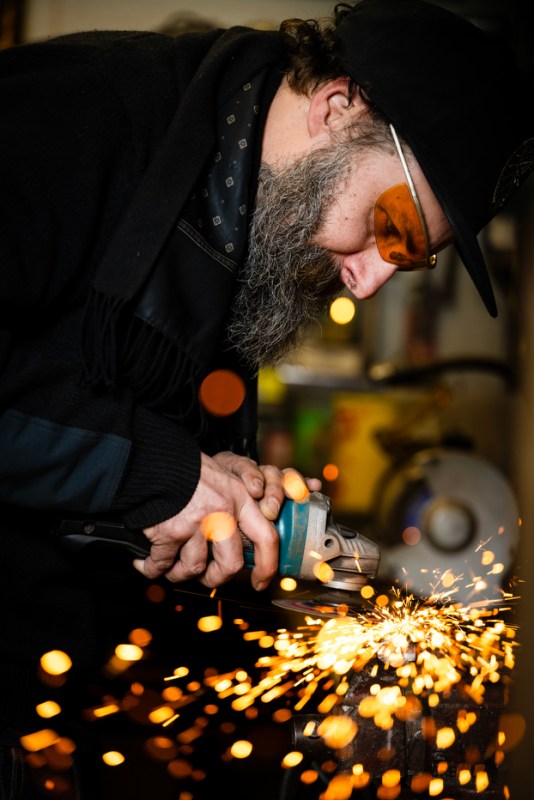
It was in the basement studio of his childhood home in West Roxbury, Massachusetts, where, at 10 years old, he got his first taste of welding while working alongside his father.
“I would load him up with the big welding gloves and he would be standing there holding these [sculptures],” Martin Ulman said. “It was fun. It was fun to work with him at that level.”
Those basement lessons stuck with him. When he went off to Northeastern, he explored every artistic avenue he could, but when he graduated in 2000 with his arts degree, he couldn’t ignore his calling.
“It definitely was a huge part of my process, learning different skills, learning what I didn’t like to do and including and incorporating what I wanted into my passion,” Michael Ulman said of his time at Northeastern.
Ultimately, he was drawn back to the idea that he could “take an object that had a mundane existence and change it into something super cool,” he said.
Need for speed
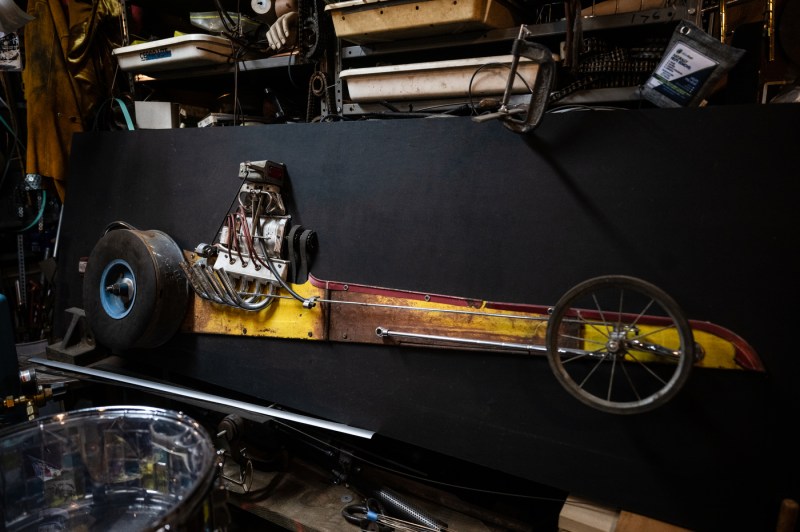
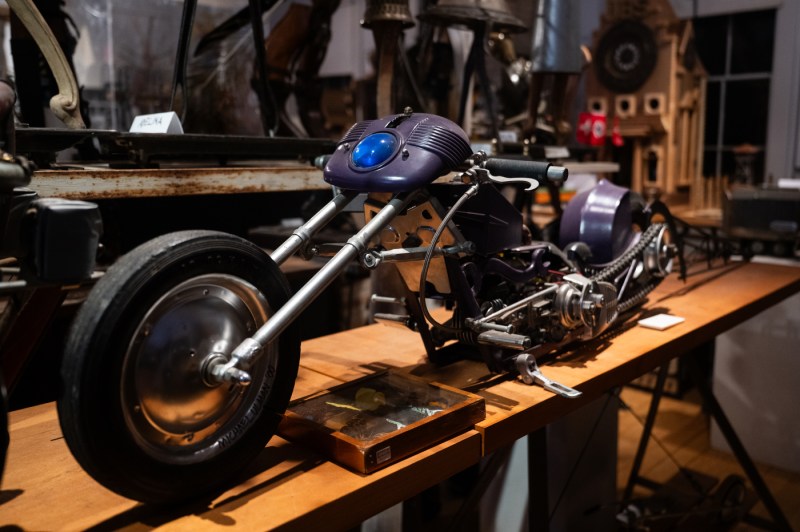
Unlike his father, who sculpts pieces of political satire made out of everyday objects, Michael Ulman found inspiration in hotrods and motorcycles.
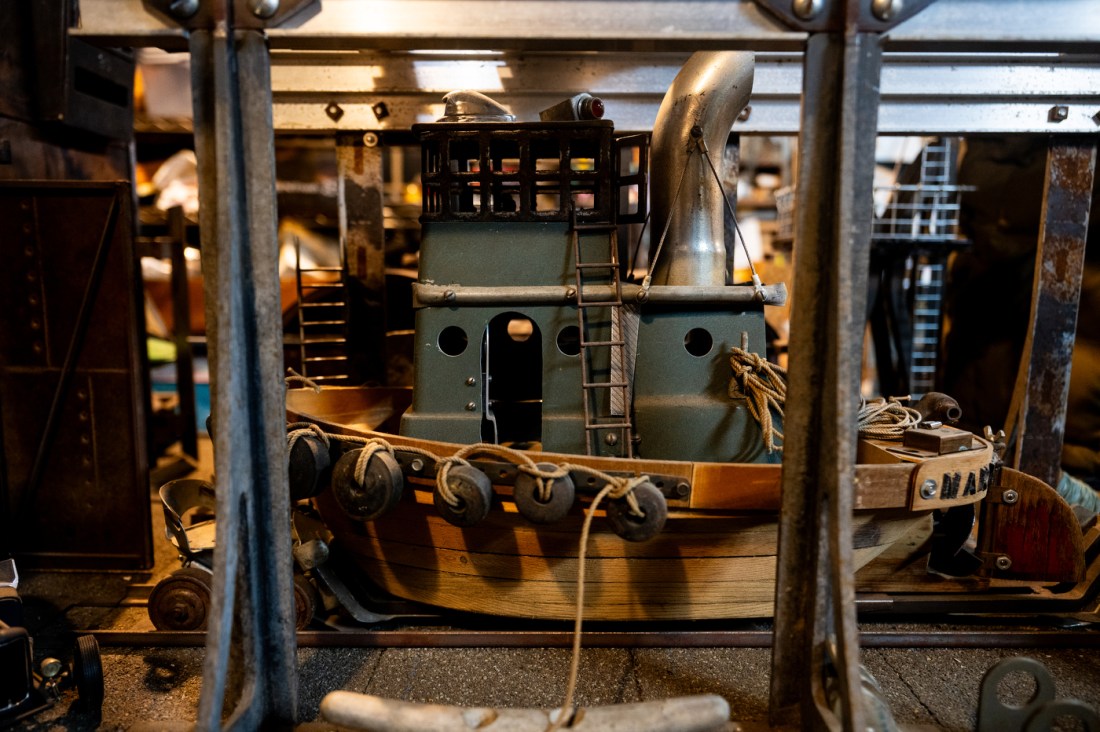
He started assembling vehicles out of anything he could find, from chainsaws to kitchen appliances.
“It’s almost like creating movement out of a static object, something that can never run just because it’s made out of parts that would never be able to run,” Michael Ulman said.
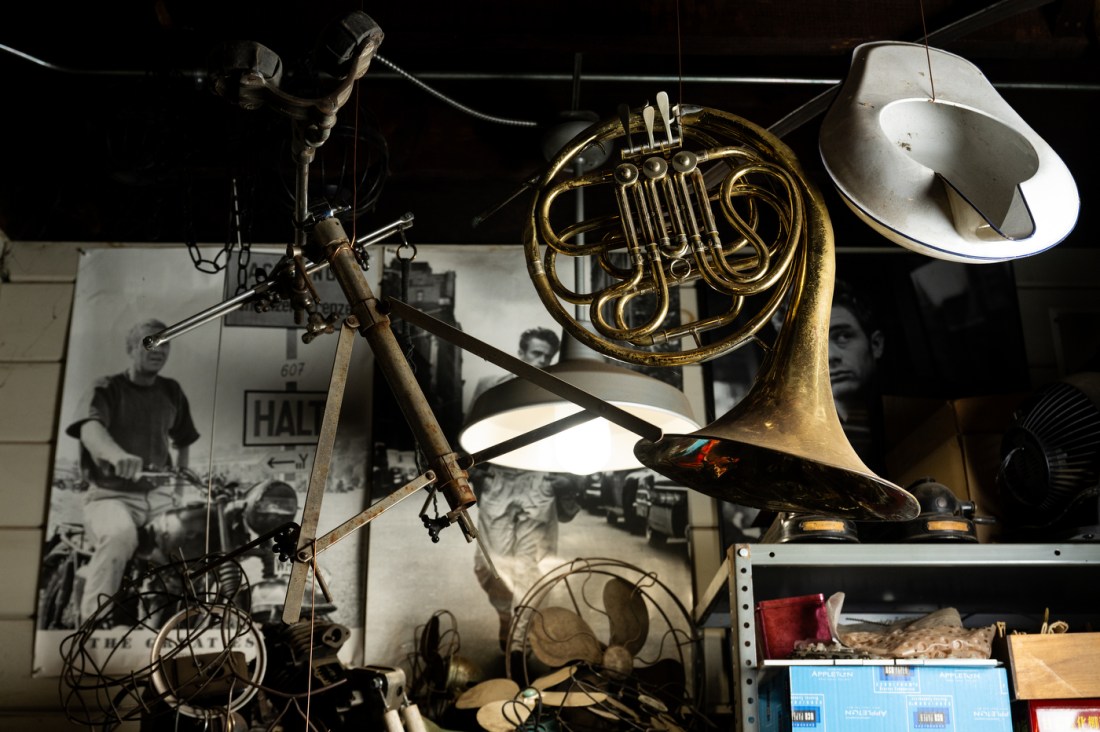
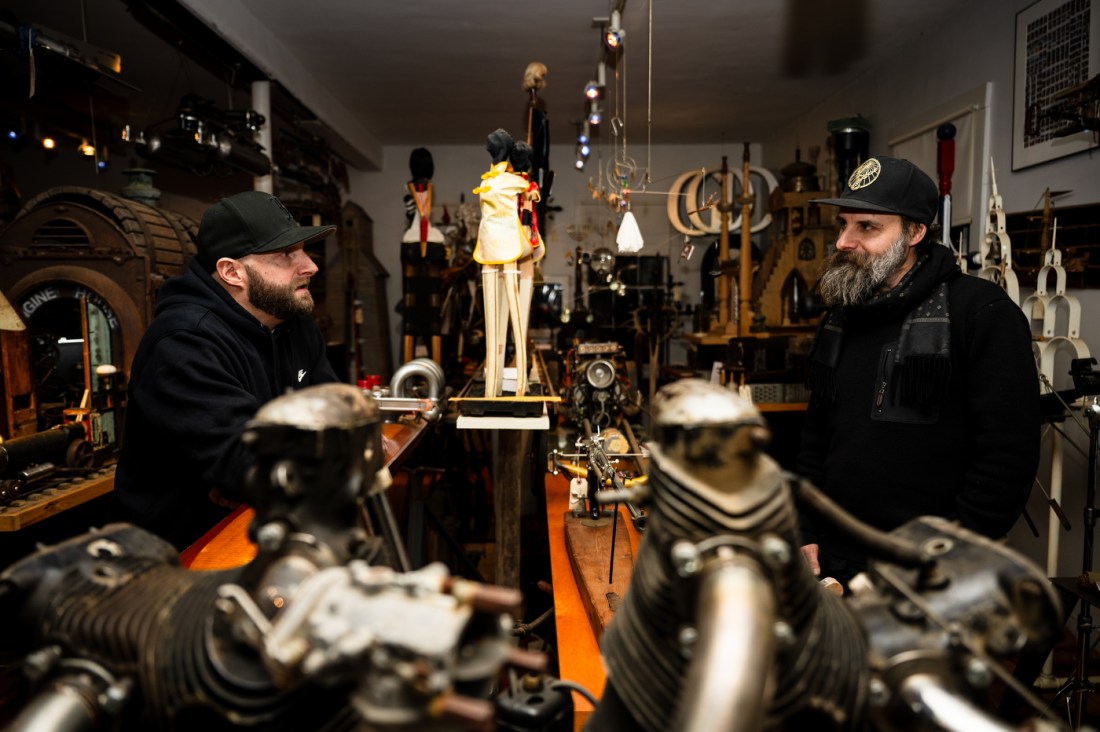
Michael Ulman’s work requires a scavenger’s approach to art. His hunting grounds are junk yards, flea markets, yard sales and antique shops. He strikes up relationships with chainsaw repair shops that will collect buckets of spare parts just for him.
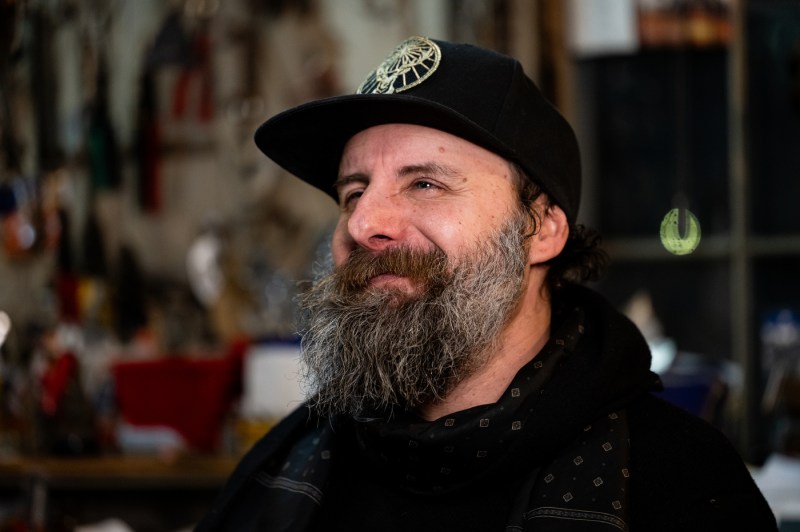
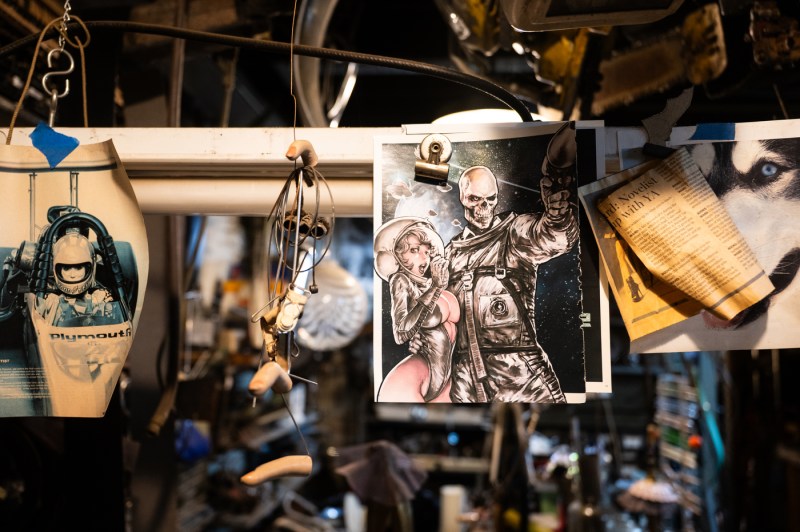
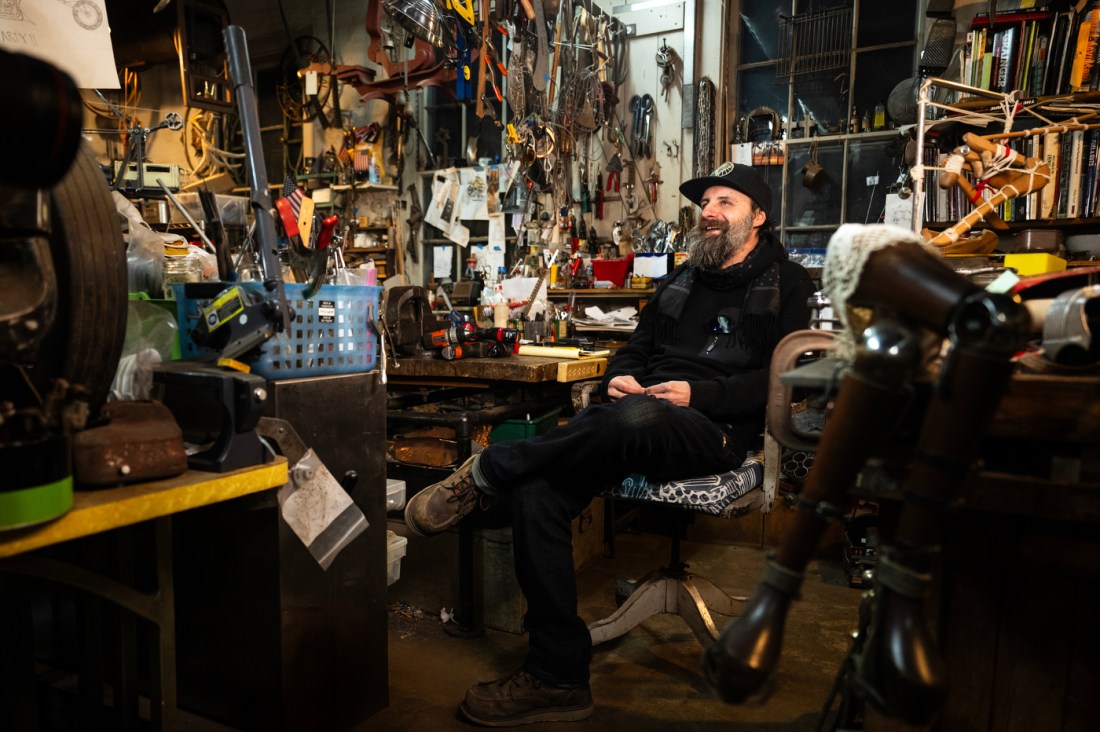
Amid heaps of junk, what draws his eye? There’s a certain “cool factor” that the artist is always on the lookout for, he said. Sometimes he has no idea what he’s looking for; other times he’s looking for a specific shape.
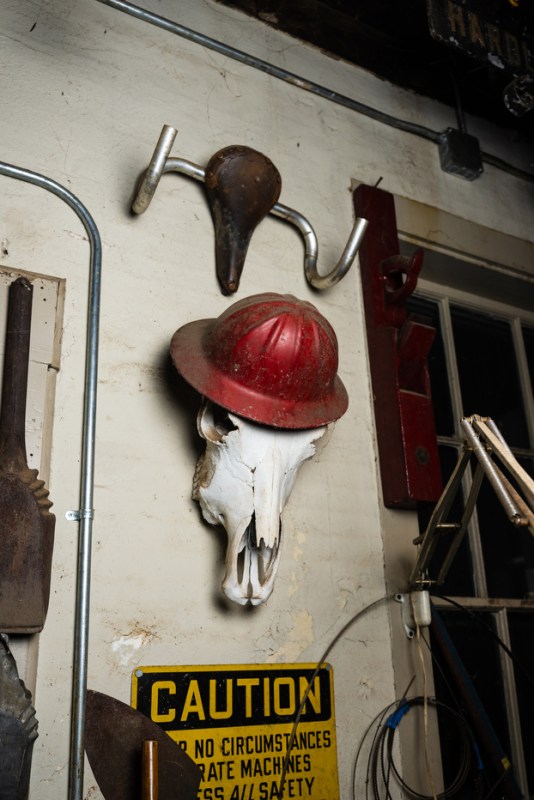
Roslindale Studio, the workshop next door to his house that now serves as the primary workspace for him and his father, is covered, floor to ceiling, in objects that might one day find a home in one of his pieces.
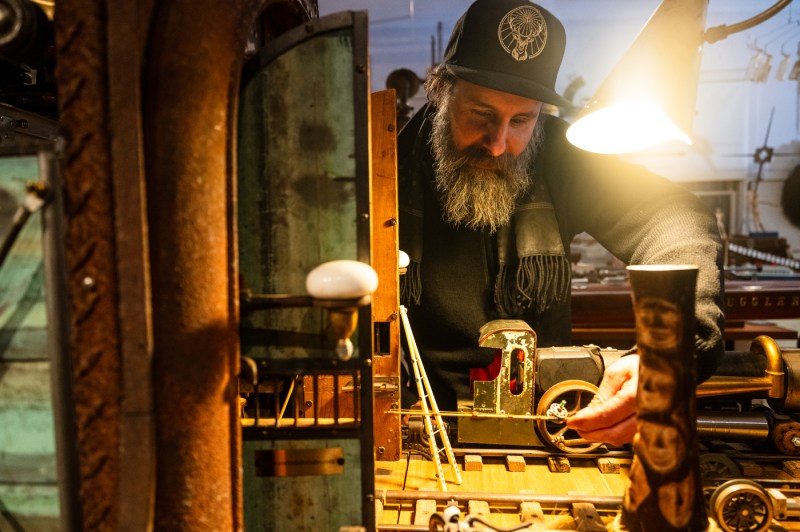
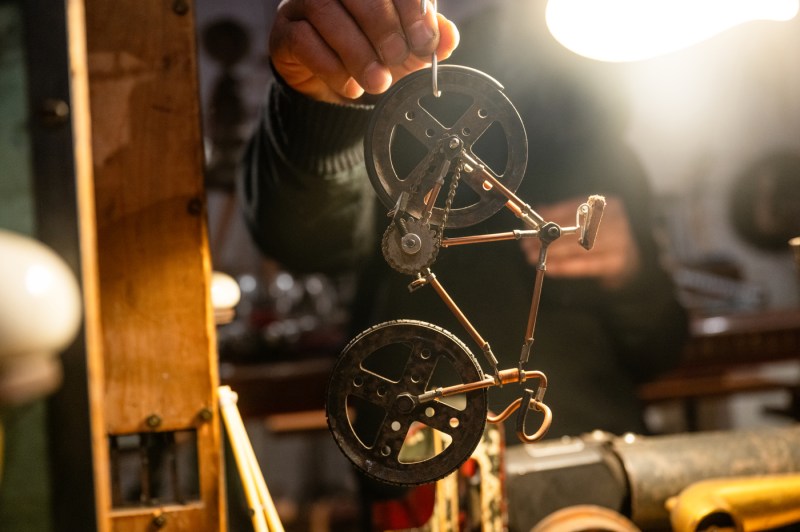
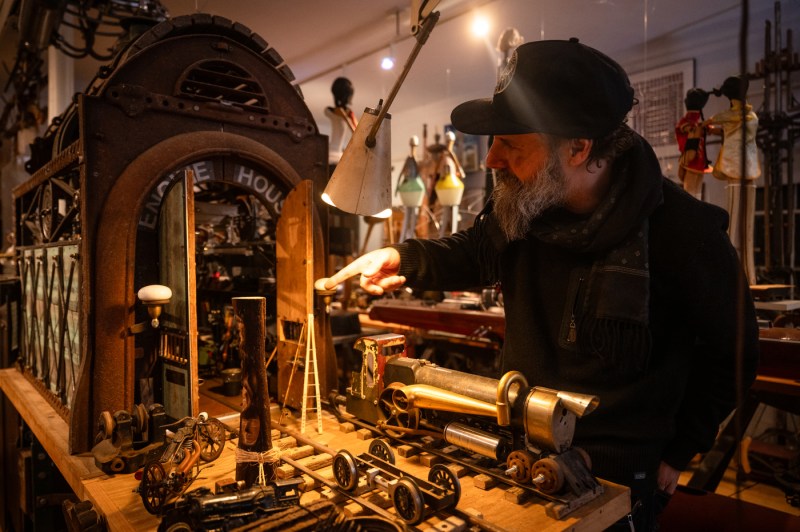
According to the other artists in his family, Michael Ulman has a notoriously fine-grained attention to detail. It will sometimes take him years to complete his found object sculptures, as he waits to find the perfect object to fit into a sculpture.
“I’ve got sculptures down there in the basement that have sat there for four years as he tries to come to some sort of closure on them and never does,” Martin Ulman said. “But that’s Michael.”

Riding on the Fury Road
Michael Ulman never had dreams of making it in Hollywood.
But in 2007, a vintage 1930s Ford hotrod he built out of a rusted mailbox became a minor phenomenon, eventually making its way into galleries like Device in Los Angeles and to the attention of “Fury Road” director George Miller, who was hunting for found object artists. In 2009, Michael Ulman received a phone call from Miller’s production company, Kennedy Miller Mitchell, offering him the job of a lifetime.
“‘Do you know ‘Mad Max’ was the first question?’ and I was just like, ‘Oh my god. Whoa, my god, here we go,’” Michael Ulman said.
Within three days he had a renewed passport, work visa and first-class ticket to Australia.
“It did not shock anybody that that happened,” said Jonathan Ulman, Michael Ulman’s younger brother and a well-regarded drummer and session musician in the Northeast. “You couldn’t name a more perfect movie for him to be involved in.”
The Sydney warehouse that he worked in for three months was a junk diver’s dream. Every day, trucks would come by and drop off piles of debris into a nearby parking lot, the Boneyard as it was called, for Miller’s army of found object artists to work through.
“They gave you a wad of cash and sent you to the junk yard and were like, ‘Pick whatever you want, bring it back, talk to the art director, see if they like it, do a sketch, say what you want to do,’” Micheal Ulman said.
The design ethos on “Fury Road” was to make objects the way the characters in the Wasteland would.
“Take salvage, put it together, fetishize it, and give it the most power it could possible have because you are then sending it off to do glorious battle in the wasteland against other vehicles, other men and what’s become a fairly terrifying nature,” production designer Colin Gibson said in Kyle Buchanan’s “Blood, Sweat & Chrome.” Northeastern Global News contacted Gibson for comment, but he did not respond.
For his first few weeks in Sydney, Michael Ulman largely helped build the fleet of vehicles. But then Gibson offered him the project that would define his career: the Doof Warrior’s flame-throwing guitar.
Editor’s Picks


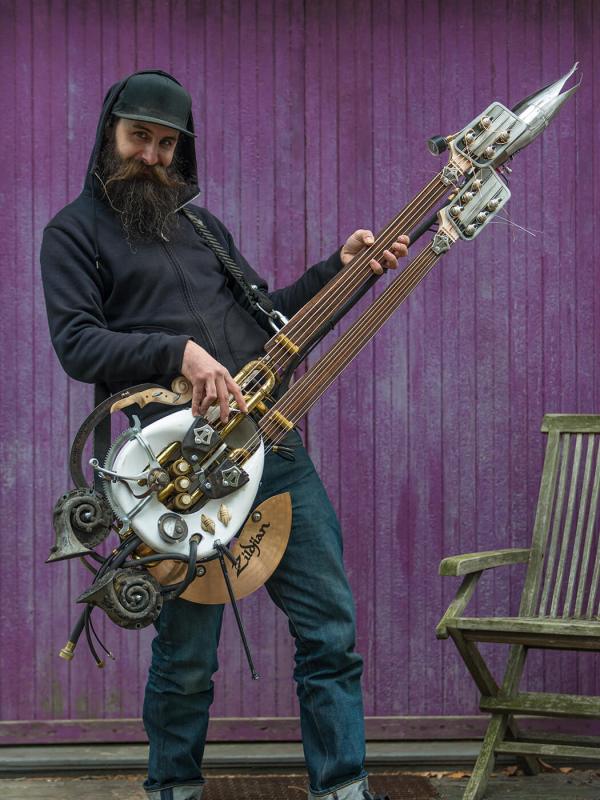
Gibson had three stipulations: it needed to have two necks, shoot 45-foot flames and be “really, really cool,” Michael Ulman said. Ultimately, he found inspiration in the most unlikely of places.
“I ended up making it out of a bedpan –– that’s what the body is –– slid it, clamshelled it in half and then shoved a French trumpet inside of it,” Michael Ulman said.
The rest of the instrument was covered with car horns and a Zildjian drum cymbal, all resting on a metal skeleton to hold everything in place.
He then worked with the pyrotechnics team to create a fuel system that fit into the guitar and allowed it to throw a 45-foot flame. The only thing it didn’t do: actually play music.
Industrial designer Matt Boug ended up installing all the electronics to make it so that Iota, the actor and musician portraying the Doof Warrior, could play it on set.
After three months spent in junker heaven, returning home and working his welding day job was a “wicked come down,” so much so that he took a few years off work, Michael Ulman said.
Seven years after his work on the film, “Fury Road” hit theaters. Martin Ulman and his family were seated on opening night. Building the flame-slinging guitar in Sydney was one thing, but seeing it in action on the big screen, he was “just blown away,” he said.
With his work immortalized on the silver screen, more than a decade later Micahel Ulman is still just focused on finding good junk. He doesn’t even bring up his work on the film, unless someone else mentions it first. Despite all the sound and fury he’s created in his career, Michael Ulman still prefers to let his work speak for itself.
“I just want to make stuff that I want to sit in front of and look at all the time,” he said. “I just want people to love it 50% of how much I love it.”