Rituals, routines and superstitions: How Northeastern students get ready for finals
Finals prep looks different for everyone, but it almost always involves some mix of ritual, self-care and even superstition.


As finals week bears down across Northeastern University’s campuses, stress levels undoubtedly spike.
But Northeastern students have their own set of routines and rituals that help them manage the stress — and even trick themselves into feeling ready.
Take Olivia Graham, a second-year business administration and psychology student, who performs “power poses” before each of her exams.
“It’s a sort of psychological thing that’s supposed to hype you up,” Graham said in describing the practice. One of her go-tos is the superhero power pose, which involves placing your hands on your hips and puffing out your chest.
“It makes you feel big,” she explained while taking a break from studying in the Interdisciplinary Science and Engineering Complex, or ISEC, on the Boston campus.
Finals week is a time when superstitions come alive. It is something of a tradition, for example, on the Boston campus for students to touch the nose of “King Husky,” an elegant statue located in Ell Center, as they walk past. The good-luck ritual picks up pace in December.
How do Northeastern students fight procrastination and give themselves the best shot at doing well on their finals? The prep looks different from person to person, and the odd mix of ritual, cramming and superstition can only take you so far.

Aaron B. Daniels, an associate teaching professor at Northeastern University, said that the most reliable path to success is steady, intentional preparation, consistent sleep, calm review and study habits that mirror the test environment.
“One of the best things to do is to get reliable sleep, with the same bedtime and wake-up times. This aids with memory consolidation,” Daniels said.
Daniels said that “cramming” — the practice, familiar to many, of trying to digest large sums of information in a short period of time — only works “if you’ve never learned any of the material,” and can actually backfire by interfering with your ability to retain information.
Other students turn to physical activity as a way to stay focused.
“It seems like the general student body tries to stay in shape somewhat,” said Evan Weinstock, a third-year economics and mathematics major, who serves as president of Elite Heat, a student organization devoted to training for obstacle course races like Spartan, Rugged Maniac and Tough Mudder. “A lot of my close friends work out consistently.”
On top of maintaining his fitness regime, the 21-year-old tries to stack a few good nights’ sleep in the lead-up to an exam. That’s because the night before a final, for Weinstock, is often adrenaline-riddled, with his sleep disrupted by feelings of “fight or flight.”
Ashish Thomas, a fourth-year computer science major, says he tends to hang around William E. Carter Playground Tennis Courts, where a hit with a friend helps him cope with the stress of finals.
“I always play tennis three times during finals week,” the 21-year-old said. “It’s the best time to play because nobody is on the courts.”
Colin Xu, a third-year student studying economics and business administration, has tried — successfully, he might add — to optimize his preparation by enlisting the help of a chatbot. Using generative AI helped him better manage his time and sleep, decide when to eat and even plan ideal coffee intervals to stay alert.
“I don’t want to feel groggy, I want to feel refreshed during the test,” said Xu, who was working on a final project alongside Weinstock in ISEC on Tuesday.
Over on the London campus, Ishaan Dixit, an electrical engineering student, has a physics exam coming up.
The first-year student’s favorite place to study is on a floor in Portsoken One that was newly opened in September and includes nine new classrooms, seminar space, huddle rooms and quiet study areas, and offices for employees.
“I like studying here on the eighth floor,” the 18-year-old said. “I typically come here at 8 a.m. There’s plenty of free space.”
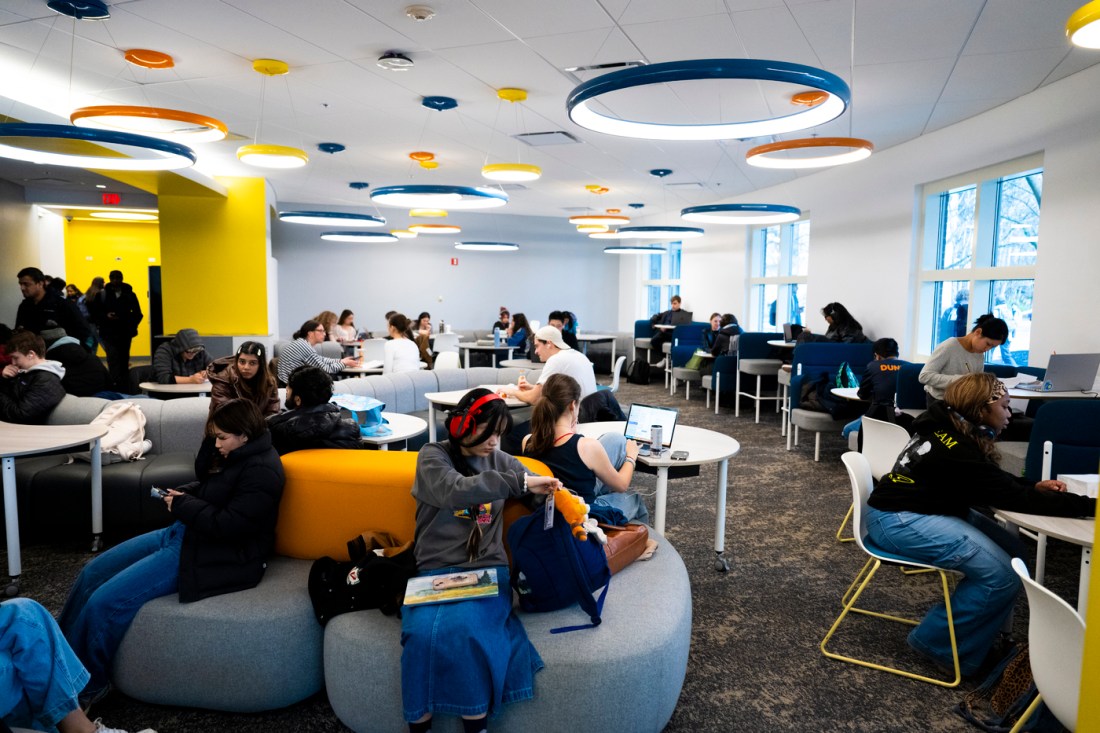
Dixit, from Pleasanton, California, said he is not an early riser, but has adapted his schedule to make sure he arrives on campus at a good time in the morning, adding that he concentrates best in the hushed environment that the top floor of Portsoken offers.
Portsoken has extended its opening hours to allow students a place on campus to revise ahead of their examinations. During the week of Dec. 1-5, the premises remained open until 10.30 p.m. each evening, with plans to keep it open between 10 a.m. and 6 p.m. over the weekend.
On one recent day, Bruno Arteaga and Cristina Carceller, both business students from Madrid, were discussing their study progress in one of the kitchen areas of Portsoken while taking a break from practicing past papers. The classmates have exams in maths and economics in the second week of finals, commencing Dec. 15.
Arteaga said he will always do some last-minute cramming the night before an exam at his dorm but tries to ensure he is wrapped up in time to get at least seven hours of sleep. After that, he uses tried-and-tested methods for preparing himself.
Editor’s Picks





“I don’t have anything specific that I do, but I just try to be relaxed and drink plenty of water,” the 18-year-old said.
For Carceller, her focus is on doing as many mock papers as possible ahead of the sitting so that there are as few surprises as possible when she reads the test questions.
In terms of rituals, the 19-year-old said she focuses on trying to get a good night’s sleep and having a long, hot shower in the morning.
“And I make sure I eat something,” she added. “I don’t usually eat breakfast but when I have an exam I do so that I have the energy I need.”
For most students on the Oakland campus, 2025 marks their first set of final exams as college students.
“I’m stressed,” said Irene Dong, a business and economics major. Studying with other students helps ease her anxiety and keeps her on task, she said. “I like to study in a group. It keeps me accountable.”
Dong, 18, was one of about 20 students who attended a workshop on study skills. Students were encouraged to incorporate physical activity into their study sessions, like taking a short walk, to give their brains a reset.
For Julia Rocha, 18, traveling off campus to study helps her to avoid socializing and maintain focus.
“I know people who go to the library or the health sciences building, but I go to a cafe,” said Rocha, who is undeclared. “It’s not too big and I can see everyone else there is doing work.”
A change of scenery works for Izzy Guerreiro as well. Guerriero intentionally moves from one study spot to another and said it helps her to retain the information she’s studying.
“I don’t like studying in my room. That’s my safe haven and I get distracted easily,” said the business and economics major. “I like the library where I can move around. It helps me stay alert.”
Studying with other students helped Guerreiro earlier in the semester with her most challenging class, calculus.
“I was struggling and my peers helped me get back on track,” she said. “Starting early was really important because once you fall behind, it’s really hard. Reaching out to my peers in the class helped.”
But Ada Lin believes studying with other students is a double-edged sword. On the one hand, it can be hard to avoid just chatting, the health sciences major said. On the other hand, she can help her peers, which in turn helps herself.
“If I know how to teach what I’m studying to someone else, I know I’ve got it,” she said.