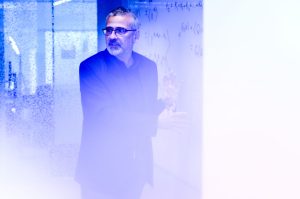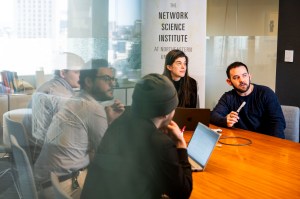
Alessandro Vespignani Sternberg Distinguished Professor of Physics, Computer Science and Health Sciences a.vespignani@northeastern.edu Expertise "big data" analysis, coronavirus, COVID-19, epidemics, forecasting how diseases and epidemics spread, Mapping, network science, pandemic, social and technological networks, Travel, Variants Alessandro Vespignani in the Press Wastewater sampling could be key to early warning of new disease outbreaks Testing wastewater is “more efficient than what we currently have, that is mostly testing people at the borders or trying to test in hospitals, but in a way that we are always late”, said Alessandro Vespignani, professor of computer and health sciences at Northeastern University and co-author of the Nature study. Fox News Northeastern University granted $17.5 million by CDC to become infectious disease detection, prep center Northeastern University in Boston will be given $17.5 million by the Centers for Disease Control and Prevention (CDC) to lead an innovation center focused on infectious disease detection and preparation, the university announced. GBH ‘We need to be ready’: CDC gives Northeastern $17.5M to spot next outbreak The COVID-19 Pandemic caught the U.S. off guard. Now, the CDC is investing more than $17 million in a new center at Northeastern University to make sure that doesn’t happen again. How Reuters pinpointed bat-virus risk zones worldwide Vespignani is director of the Laboratory for Modeling of Biological and Socio-technical Systems and the Network Science Institute at Northeastern University in Boston. Voice of America To Mask or Not to Mask? “For the next few weeks, we should see a decrease in epidemic activity. All of the indicators seem to go down,” Alessandro Vespignani said to VOA. Vespignani is the director of the Network Science Institute at Northeastern University and leads a team of infectious-disease modelers who have been developing COVID-19 projections since the pandemic began. Mexico has refused to close its borders during the covid-19 pandemic. Does that make sense? Alessandro Vespignani, a physicist at Northeastern University, was a co-author of that study. “Before the [coronavirus] pandemic, the mainstream thinking was, okay, travel restrictions do not have an effect,” he said. Fortune Omicron may be less severe than Delta, but it could hit the global economy even harder in 4 painful ways “Omicron was fast and furious in its growth and will be fast—hopefully not furious—but very fast also in its decline,” Alessandro Vespignani, director of the Network Science Institute at Northeastern University and a specialist in data science and computational epidemiology, predicted last week. “It should be receding sooner than other waves that we experienced in the past.” Omicron Will Surge Despite Biden’s New Plan, Scientists Say “We have been through this many, many times,” said Alessandro Vespignani, director of the Network Science Institute at Northeastern University in Boston. “At this point we know that there is a portfolio of interventions that can be layered on top of each other.” Uncontrolled Spread — Trump’s FDA head on the mishandling of the Covid-19 response Gottlieb points out: “On March 1, the CDC’s official tally of Covid cases rose from 15 to 75. Models developed later by researchers at Northeastern University show that by this date, the US probably had 28,000 infections.” As Omicron Variant Circles the Globe, African Nations Face Blame and Bans “You close down the boundary with Africa, then you close the boundary with Belgium, then you close the boundary with somewhere else,” said Alessandro Vespignani, a Northeastern University professor who has studied travel restrictions from early 2020 and advised government agencies in recent days on responses to the latest variant. “But every time you close […] Alessandro Vespignani for Northeastern Global NewsTwelve Northeastern scholars make ‘Highly Cited Researchers’ list by Tanner Stening December 9, 2025 COVID data revolutionized disease projection models. Northeastern researchers explain what’s next by Cynthia McCormick Hibbert July 2, 2025 How monitoring wastewater from international flights can serve as an early warning system for the next pandemic by Cynthia McCormick Hibbert February 12, 2025 The interaction between humans and artificial intelligence demands a new field of study, Northeastern researchers say by Cesareo Contreras December 16, 2024 ‘Italian National Day’ event at Northeastern celebrates the 78th anniversary of democracy in Italy by Schuyler Velasco June 1, 2024 What should stay open during the next pandemic? New model weighs protecting public health and the economy by Cynthia McCormick Hibbert November 16, 2023 Northeastern receives $17.5 million from CDC to launch infectious disease prediction center by Cynthia McCormick Hibbert September 19, 2023 Network Science Institute expansion to London creates new European hub for trailblazing academic field by Cynthia McCormick Hibbert July 27, 2023 Northeastern professor wins prestigious award for her work on the ethics of artificial intelligence by Cynthia McCormick Hibbert July 7, 2023 More than 50% of COVID-19 deaths could have been prevented with better global vaccine distribution by Cynthia McCormick Hibbert June 12, 2023
Wastewater sampling could be key to early warning of new disease outbreaks Testing wastewater is “more efficient than what we currently have, that is mostly testing people at the borders or trying to test in hospitals, but in a way that we are always late”, said Alessandro Vespignani, professor of computer and health sciences at Northeastern University and co-author of the Nature study.
Fox News Northeastern University granted $17.5 million by CDC to become infectious disease detection, prep center Northeastern University in Boston will be given $17.5 million by the Centers for Disease Control and Prevention (CDC) to lead an innovation center focused on infectious disease detection and preparation, the university announced.
GBH ‘We need to be ready’: CDC gives Northeastern $17.5M to spot next outbreak The COVID-19 Pandemic caught the U.S. off guard. Now, the CDC is investing more than $17 million in a new center at Northeastern University to make sure that doesn’t happen again.

How Reuters pinpointed bat-virus risk zones worldwide Vespignani is director of the Laboratory for Modeling of Biological and Socio-technical Systems and the Network Science Institute at Northeastern University in Boston.
Voice of America To Mask or Not to Mask? “For the next few weeks, we should see a decrease in epidemic activity. All of the indicators seem to go down,” Alessandro Vespignani said to VOA. Vespignani is the director of the Network Science Institute at Northeastern University and leads a team of infectious-disease modelers who have been developing COVID-19 projections since the pandemic began.

Mexico has refused to close its borders during the covid-19 pandemic. Does that make sense? Alessandro Vespignani, a physicist at Northeastern University, was a co-author of that study. “Before the [coronavirus] pandemic, the mainstream thinking was, okay, travel restrictions do not have an effect,” he said.
Fortune Omicron may be less severe than Delta, but it could hit the global economy even harder in 4 painful ways “Omicron was fast and furious in its growth and will be fast—hopefully not furious—but very fast also in its decline,” Alessandro Vespignani, director of the Network Science Institute at Northeastern University and a specialist in data science and computational epidemiology, predicted last week. “It should be receding sooner than other waves that we experienced in the past.”

Omicron Will Surge Despite Biden’s New Plan, Scientists Say “We have been through this many, many times,” said Alessandro Vespignani, director of the Network Science Institute at Northeastern University in Boston. “At this point we know that there is a portfolio of interventions that can be layered on top of each other.”

Uncontrolled Spread — Trump’s FDA head on the mishandling of the Covid-19 response Gottlieb points out: “On March 1, the CDC’s official tally of Covid cases rose from 15 to 75. Models developed later by researchers at Northeastern University show that by this date, the US probably had 28,000 infections.”
As Omicron Variant Circles the Globe, African Nations Face Blame and Bans “You close down the boundary with Africa, then you close the boundary with Belgium, then you close the boundary with somewhere else,” said Alessandro Vespignani, a Northeastern University professor who has studied travel restrictions from early 2020 and advised government agencies in recent days on responses to the latest variant. “But every time you close […]