Robotics helped kick-start this grad’s career at Tesla
Joshua Joseph overcame setbacks to succeed in the world of autonomous machines. Now he’s mentoring fellow huskies
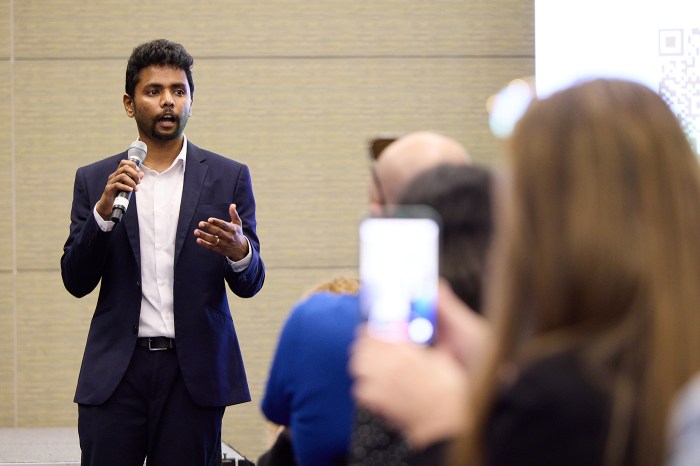

Joshua Joseph failed. Again and again.
Just out of college in Chennai, India, he dreamed of becoming a civil servant as a way to have an impact on society. So he decided to pursue a prestigious job to run a municipality or a province, because he loved organizing people and systems and rules.
What Joseph faced, however, was three years of rejections, vying for one of around 1,000 open jobs across the country as he squared off against about 1 million other applicants competing in national tests each year, he said.
“I was out-of-work, it was very discouraging,” Joseph, 29, now of Austin, Texas, recalled. “There was fatigue. That was three years out of my career. But I learned, even if you fail, don’t let the frustration stop you. It teaches you to try something else.”
That decision led him to Northeastern University in Boston and ultimately to a job as a Tesla robotics engineer who now develops fleets of autonomous robots for use in Tesla’s four major factories across North America.
Yingzi Lin, a professor and the chair of the College of Engineering, said that Joseph is “becoming quite famous,” as an up and coming voice in the autonomous machine industry.
He speaks at conferences, serves on national robotics boards, writes articles on the future of robotics for trade publications, and he was recently named to the 2026 “Watch List” by the American Society of Mechanical Engineers. The ASME list features 25 early-career engineers who help advance new technologies.
Editor’s Picks



Joseph said he wasn’t at liberty to publicly discuss intricate details of what he does at Tesla, but he works at the company’s Austin-based “Gigafactory, Texas,” near Austin, which is the manufacturing hub where Tesla’s Cybertruck and Model Y vehicles – a midsize electric SUV – are built.
Some of the autonomous mobile robots or AMRs Joseph has helped develop look like yard-long, flat-topped wagons – some with bins – that drive themselves round and about the factory.
They can carry 1 ton of weight and carry a freight of car parts from one end of the factory to another. A self-driving fleet of them traverses the huge Texas factory, which is one of the largest in the world, with 10 million square feet of factory floor on 2,500 acres along the Colorado River.
“It’s like a Roomba moving around your house,” Joseph said, referring to the robot vacuum made by iRobot. “The ones my team builds are bigger and go around the factory with the capabilities to pick up parts from one end of the factory and deliver them to the other end.”
Joseph said his life changed when he came to America and Northeastern University in Boston, where he graduated in 2023 with a masters degree in mechanical engineering.
He especially liked the university’s Cyber-Physical Manufacturing Lab, which is run like a small scale, fully functional modern factory that integrates autonomous robots in an industrial setting.
Professor Lin said that at Northeastern, Joseph, “really asked the right questions and wasn’t afraid of what he didn’t know. He knew what he wanted to learn, not just what was necessary for class credits.”
Joseph said the university helped kick-start his career at Tesla because he was accepted as a co-op for the car manufacturing company while at Northeastern, where he had already attained deep knowledge of how things work in a modern factory.
“When I got to Tesla, I knew exactly what to do already,” Joseph said.
He knew he was headed to the big leagues when he joined Tesla almost three years ago, he said, because he would be working in Texas at the flagship factory of the company that sold 1.7 million vehicles in 2024 globally, according to a 2026 article in Investing.com, an online stock trading publication.
He fills up most of his spare time, when he’s not playing gospel music on his guitar, speaking at engineering conferences and working with robotics associations where he sits on committees, such the International Society of Automation, where he and others help set standards for autonomous machines in factories.
He frequently writes articles for trade publications and has speaking engagements at engineering conferences about “the factories of the future,” where machines do the heavy lifting for humans.
Joseph also gives back, by mentoring Northeastern engineering students, including Shriman Raghav Srinivasan, 25, who graduated from Northeastern this year with a masters degree in robotics engineering. Srinivasan recently joined Joseph’s team at Tesla.
“He is open to helping anyone,” said Srinivasan, who connected with Joseph via social media and asked him for advice on his ongoing studies and how to turn it into a career.
“I reached out to him, introduced myself and said ‘I am a Huskie, too,’” he recalled.
Joseph said that helping people and leading teams, along with designing and building machines, fills a similar role in his life that he had wished for in running a city or province in India.
“Robotics is definitely the engineering space that I find similar to governance,” he said.


