Northeastern undergrads given a crash course on Seattle’s vibrant robotics scene
Northeastern Seattle’s robotics curriculum equips students with the skills to focus their careers toward the in-demand robotics industry.
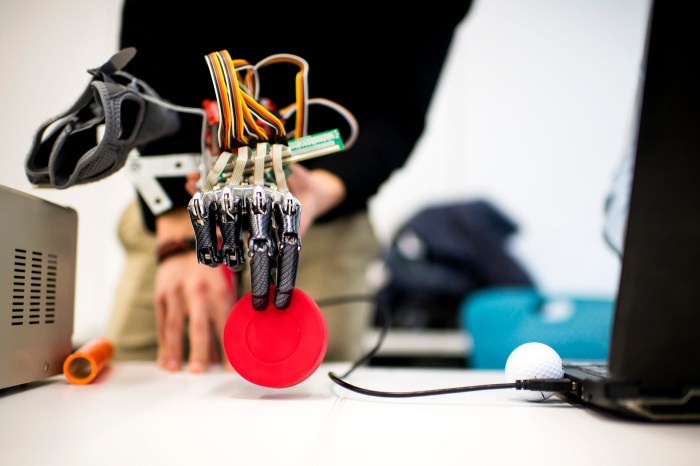

Seattle is known for more than its coffee, Douglas firs and proximity to the towering Mount Rainier. The city is also a notable leader in the modern robotics industry.
Companies like Boeing and Amazon, which are headquartered in Seattle, employ hundreds of thousands of robotic arms and autonomous systems. And a bubbling melting pot of small- and medium-sized companies use robots to enhance industries ranging from sustainability to national defense.
Northeastern University’s downtown Seattle campus, located next door to Amazon’s HQ, feeds this growing robotics ecosystem by educating the next generation of engineers and entrepreneurs through a Master of Science in Robotics program. An inaugural seven-week course also drew undergraduate students to the Pacific Northwest hub this summer, offering a variety of experiential learning opportunities and a taste of what Seattle can provide to those with ambitions in the space.
According to the U.S. Bureau of Labor Statistics, employment of mechanical engineers is projected to grow 9% from 2024 to 2034, much faster than the average for all other occupations. Jobs for computer hardware engineers and electrical engineers are similarly expected to grow 7% by 2034, both job categories that are essential to the automation and robotics space. And the demand for people versed in robotics is also projected to grow: The World Economic Forum reported in 2025 that it expects 58% of employers to reshape their businesses with robotics and automation by 2030.
“Computer science has always been this field where you need to keep on being agile and upskilling yourself, and I think of robotics as one of those next frontiers,” said Tamara Bonaci, a Northeastern computer science professor who has worked in Seattle’s robotics research scene since 2009. “In that sense, it feels like a robotics program in Seattle is the [right thing at the] right place at the right time.”

Northeastern’s Seattle-based robotics curriculum, and its extension into summer undergraduate programming, seeks to equip students with backgrounds in mechanical, electrical or computer engineering with the proper skillset to focus their careers toward robotics. It also allows students to personalize their studies with courses on smart robotic systems, AI, machine learning, control systems and more.
Like the Seattle’s master’s program cohort, the nine students who attended the Summer In Seattle program brought with them a wide range of robotics experience, interests and personal goals for the condensed course.
Editor’s Picks


Among them was Benji Alwis, an incoming third-year student studying computer science and entrepreneurship who, before coming to Seattle, whose interest in robots had already led him to research them for nearly five years.
Alwis was particularly interested in how robots maneuver their way around unfamiliar spaces. Though humans can navigate a new city or grocery store using partial directions, context clues or their own intuition, many robots rely on perfect instructions to move about a space, Alwis said. To make robots more intuitive inside a warehouse, his research challenged them to overcome obstacles, suboptimal pathways and imperfect instructions on their way to the correct destination, he said.
“Normally in robotics, we use a ‘perfect view.’ I was trying to do something with ‘sub-perfect view,’” he said. His goal was to find ways for robots to go from one place to another without hitting a point at which they could no longer handle the mathematics behind the route and crashed, he said.
Serendipitously, Alwis found overlapping interest with a Seattle company while attending one of the summer program’s industry excursions to the AI House, an incubator for technology start-ups under the Allen Institute for AI. The company is performing similar research to Alwis’ ‘sub-perfect view’ experiments, he said.
“They told me a bit more about the developments that they had, and they wanted to see more about my research,” Alwis said.
Incoming fourth-year student Sandra Srinivasan said she found inspiration during her excursion to First Mode at Cummins, a company designing hybrid systems for mining trucks that reuse braking energy – the kinetic energy generated by the moving vehicle when brakes are applied that can be converted back into electricity – to reduce emissions.
“We could see what they were testing, the engines and the motors specifically, and got to have one-on-one conversations with the team,” said Srinivasan, who has completed two robotics-related co-ops. Seeing the company’s use of automated systems across its manufacturing facility aligned with her interest in the mechanical side of robotics, she added.
Bonaci delivered structured lessons to students on Northeastern’s Seattle campus between outings, she said, covering everything from robots’ movement and trajectory generation – the process of computing velocity, acceleration and positioning to move a robot along a path – to software architecture and design. To create their own robots, students ran simulations in the programming language Python, played with robot operating systems and electrical components, and used the campus’s 3D printers and newly stocked manufacturing facility.
Northeastern Global News, in your inbox.
Sign up for NGN’s daily newsletter for news, discovery and analysis from around the world.
Jack Greenwald, a computer science undergraduate minoring in biomedical engineering, said he found the breadth of classroom and lab instruction to be especially valuable. Though he came to Seattle with most of his experience in software and had little background working with robots, he left with a newfound grasp on linear algebra and other topics he said will translate to his field. Seattle is also a place Greenwald said he would like to live and work in someday.
“If you’re someone who likes to go explore a city, go to events, talk to professors, explore more of the big tech side of the industry, Seattle is one of those best places to go,” Aywis said. “You come out of it with a lot being learnt and a lot that you want to take forward – almost like an inspirational boost before you go into your next year.”