Faster, cheaper, smaller: That’s the secret to this researcher’s computer chips
Northeastern University professor Amhed Busaina has been named a NextFlex Fellow for his innovations in computer chip printing and design.
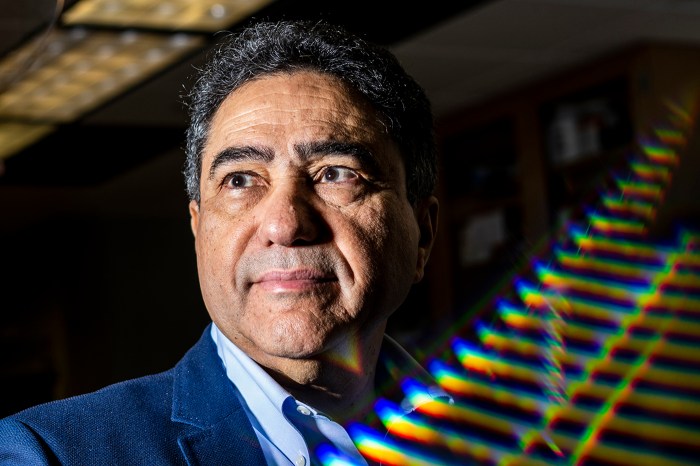

When Northeastern Professor Ahmed Busnaina joined Northeastern University in 2000, he knew one of the central challenges he wanted to tackle was the rising costs of computer chips.
“I started looking at more economical ways to fabricate chips because a facility in the mid ‘90s would cost $1 billion,” he said. “Now they cost $20 to 40 billion, and as a result, companies that actually used to make chips don’t make chips anymore.”
To develop a solution, Busnaina, a distinguished professor of mechanical and industrial engineering, turned to additive manufacturing, the process of building systems “layer by layer.” It stands in contrast to more traditional methods that involve taking large blocks of materials and etching away their excess.
With support from the National Science Foundation, Busnaina established The Nanoscale Science and Engineering Center (NSEC) for High-rate Nanomanufacturing in 2004 on Northeastern’s Boston campus. The center develops tools and techniques for nanoscale materials used to make electronics.
There he developed and patented several innovations including his nanoscale offset printing platform, which is capable of “printing circuits and electronics down to 25 nanometers —- roughly 10,000 times thinner than a human hair,” explained Yingzi Lin, chair of Northeastern University’s Department of Mechanical and Industrial Engineering.
Not only does this technology speed up the process of fabricating nanoscale electronic components, it’s also cheaper a method, undercutting traditional semiconductor manufacturing facilities that costs billions of dollars to build and manage, Lin explained
That is just one example of the innovations in nanoscale manufacturing that Busnaina has made in his decades-long career, Lin highlighted.
Busnaina has also pioneered techniques to print small electronics components that she said are 1000 times faster than traditional inkjet printers and 3D printers.
For his contributions to the industry, Busnaina has been named a 2026 NextFlex Fellow by NextFlex, which markets itself as America’s Hybrid Electronics Manufacturing Institute. Established in 2017, it is an honor given to those advancing “hybrid electronics manufacturing,” which combines traditional manufacturing with newer, more cutting-edge methods like 3D printing and other additive manufacturing technologies.
Editor’s Picks





NextFlex itself was formed as part of a joint effort between the U.S. Department of Defense and the FlexTech Alliance, “a consortium of companies, academic institutions, non-profits, and state, local, and federal governments” working to advance manufacturing, according to the organization’s Linkedin.
In its announcement recognizing Busnaina with the honor, the organization made specific mention of his work as the director of Northeastern University’s Advanced Manufacturing Clusters for Smart Sensors and Materials, where he is working on scaling and expanding the equipment needed for his nanoelectronic technologies, and his startup Nano OPS, where he is working on commercializing such technologies it.
“Ahmed is unequivocally the most deserving candidate for this award,” Lin said. “His exceptional technical contributions, sustained research impact, and long-standing, distinguished service have made profound and lasting contributions to the advancement of the field.”
Winning the award and recognition for his work in advancing additive manufacturing was “a very nice honor,” Busnaina said. He said researchers like himself aren’t just speaking about transforming the electronics supply chain, they are “doing the research to fulfill that vision.”


