What if the Supreme Court rules to end birthright citizenship?
The Supreme Court is expected to hand down its decision this week on the hotly contested executive order issued by President Donald Trump.
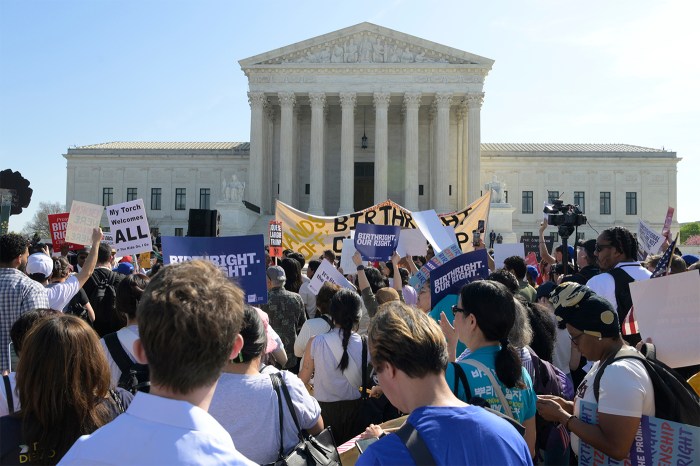

Hundreds of thousands of children would be left without a country if the Supreme Court rules that President Trump’s executive order restricting birthright citizenship in the U.S can stand, according to Northeastern legal experts.
“No country on Earth would have a responsibility to accept them,” said Martha Davis, distinguished professor of law at Northeastern University, adding that such people wouldn’t have a right to live in the U.S. or likely anywhere else in the world.
About one in nine babies born in the U.S. each year, or 320,000 of the 3.6 million children, are born to parents who are among the estimated 11 million people who are undocumented immigrants or those without permanent legal residency, according to the Pew Research Center.
The Supreme Court is expected to hand down its decision this week on the hotly contested executive order issued by President Donald Trump on the first day of his second term in office in January 2025.
At least some justices are likely dissenting, given that the court is waiting until its last day in session, said Davis, who teaches constitutional law.

Trump signed an executive order that would upend the right established in 1868 with the 14th Amendment of the U.S. Constitution – a guarantee that virtually everyone born in the United States is conferred citizenship. Exceptions under the Constitution include children born to foreign diplomats serving in the country. It has since been contested in federal courts by the American Civil Liberties Union and other legal groups.
Under Trump’s order, “Protecting the Meaning and Value of American Citizenship,” citizenship would be limited to children with at least one parent who is a citizen or a permanent legal resident.
Trump, on the site Truth Social, posted in February that the 14th Amendment has been largely misconstrued to apply to the children of undocumented immigrants. He stated that the amendment was made to “take care of the babies of slaves,” during the U.S. Reconstruction era to make sure that after the Civil War, former slaves and their children were considered full citizens. His executive order is meant to correct that.
Children born to undocumented individuals would have no right to work, to attend school, or to establish a domicile if the Supreme Court rules in favor of Trump’s executive order.
“It’s a terrible problem,” she said. “They’d have no right to be anywhere.”
Davis said she couldn’t predict how the Supreme Court would decide.
Northeastern Global News, in your inbox.
Sign up for NGN’s daily newsletter for news, discovery and analysis from around the world.