Is the White House’s UFC Freedom 250 event in jeopardy?
The event, billed as “UFC Freedom 250,” is under threat as plaintiffs challenge the legality of approval of the private sporting event. But some experts say the lawsuit is too little, too late.
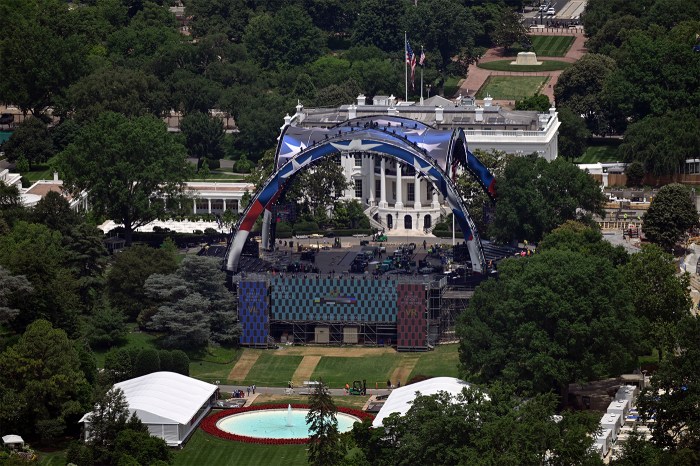

An enormous outdoor arena is being constructed on the South Lawn of the White House to host an Ultimate Fighting Championship as part of the celebrations marking the country’s 250th birthday, or semiquincentennial.
The June 14 event, billed as “UFC Freedom 250,” could be under threat as plaintiffs challenge the legality of the Trump administration’s approval of the private sporting event on federal premises, alleging, among other things, corruption.
UFC Freedom 250 is a mixed martial event with several high-profile bouts, including a lightweight title fight between Ilia Topuria and Justin Gaethje, as well as a heavyweight clash between Alex Pereira and Ciryl Gane.
Filed by the anti-corruption firm Public Integrity Project, the lawsuit names the National Park Service and the U.S. Department of the Interior as defendants and claims that the privately organized fight night violates federal rules.
Under park service rules, sporting events generally are prohibited at national landmarks such as White House grounds and at the Lincoln Memorial, and structures erected on the South Lawn typically undergo both congressional authorization and a “thorough environmental review,” before they can be approved, the lawsuit reads.
“To authorize UFC Freedom 250 in the face of these constraints, Trump’s administration appears to be relying on a [National Park Service] temporary rule enacted for the semiquincentennial,” the lawsuit reads.
Northeastern Global News, in your inbox.
Sign up for NGN’s daily newsletter for news, discovery and analysis from around the world.

That temporary rule, put into effect in June 2025, allows the service to bypass custom procedure in order to allow “special events planned, organized, and executed by executive departments and agencies or the Semiquincentennial Commission for the celebration of the 250th anniversary of American Independence” to occur on D.C.’s monumental grounds, the lawsuit reads.
With the event less than a week away, some experts say the legal challenge is too little, too late.
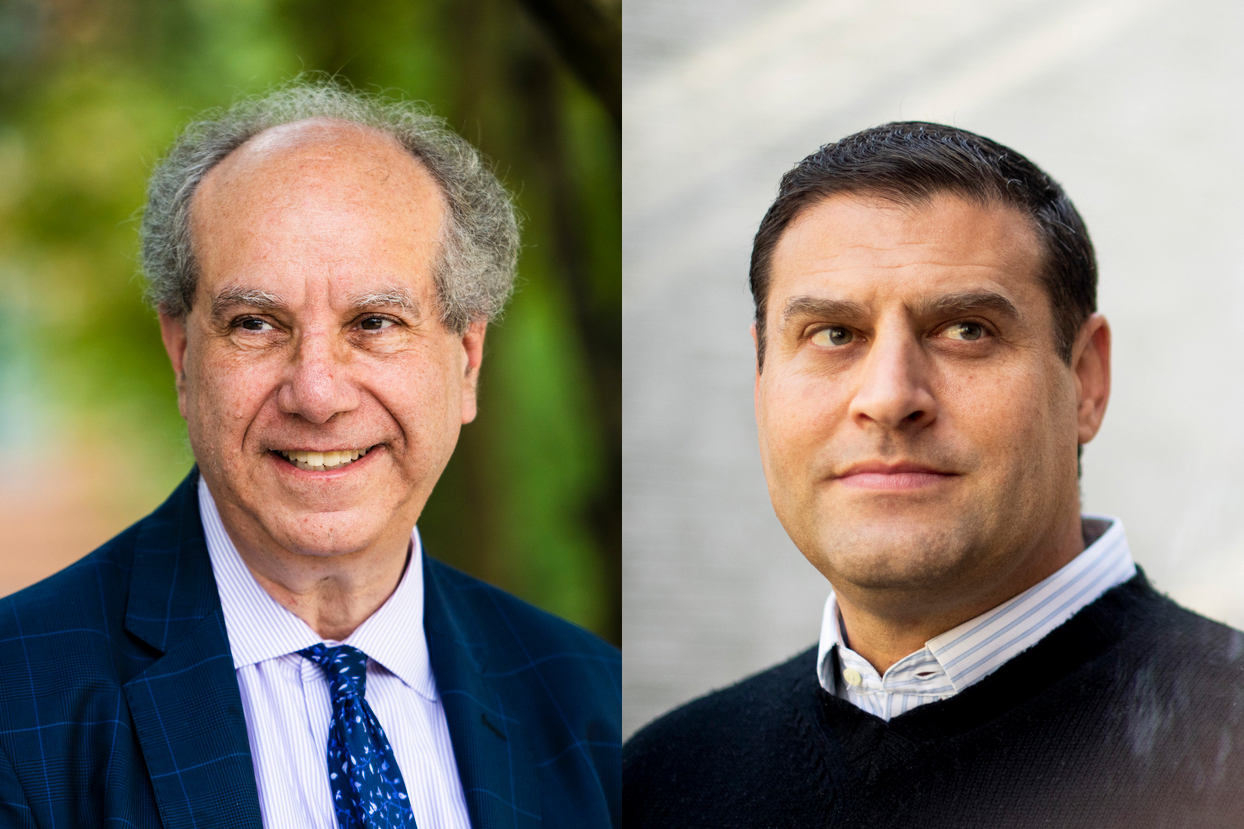
“My initial reaction is that challengers to Trump’s actions have had a fairly good litigation track record, but given the late date, a judge would have to block the event,” said Dan Urman, director of the law and public policy minor at Northeastern University.
Editor’s Picks


Urman thinks the event will go on as planned “even if a federal district court judge initially blocks it,” he said. That might in turn force the government to file an emergency appeal, which Urman thinks would succeed.
Jeremy Paul, a Northeastern University law professor, said despite the merits of the claim, the central issue is one of standing, or whether the plaintiffs can demonstrate a sufficient injury to bring the case.
“I see that as a huge problem with the lawsuit,” he said, adding that it “seems kind of open and shut.”
The case is brought on behalf of two people: Susan Douglas, a senior citizen activist and organizer, and Paul Romano, a Vietnam War veteran. The suit alleges that Douglas is suffering “aesthetic, physical, expressive and procedural harms,” and that Romano, similarly, is suffering “aesthetic, dignitary and procedural harms” as a result of what the plaintiffs describe as the unlawful approval of the UFC event and related construction.
The snafu is just the latest chapter in an ongoing debate about whether the president has enriched himself by blurring the line between his private business interests and his public office. The UFC and the Trump Organization are planning to sell merchandise connected to the event, including gold medallions priced at up to nearly $12,000.
In a Department of Justice filing Tuesday evening, administration attorneys argued that the plaintiffs lacked legal standing to challenge the event and had waited too long to seek emergency intervention. They argued that significant planning and logistical preparations for the event were already underway.
“It would be easy enough to simply avert their gazes for the weekend,” they wrote in Tuesday’s filing. “Instead, they seek to enlist the power of a federal court to impose their idiosyncratic preferences on the rest of the country and ruin an event designed to celebrate the United States of America.”
Other presidents have used the White House grounds for sports-related events. Jimmy Carter brought together ice-skaters for an exhibition on the lawn during his presidency, and George W. Bush organized a youth T-ball game there in 2001.