Graduate student speakers say Northeastern handed them the key
Three outstanding students tell fellow grads to ‘hold onto that feeling of belonging’ during the graduate commencement ceremony at Fenway Park.


Daniela Gonzalez arrived at Northeastern University with a doctorate in biological science and 10 years of lab work under her belt — more experience than most graduate students. Yet, she was “terrified” when she came to Boston to start her master’s in data science.
Gonzalez, a native of Tucumán, Argentina, would be learning a new scientific field in a new language — her doctoral degree work was all in Spanish. It was an intimidating prospect, she told her fellow graduates, but she realized quickly that her background was an asset.
“Northeastern didn’t ask me to become someone else,” she said. “It asked me to become more of who I already was. It did not replace my language, my training, my story, the place I came from, the people I love. It multiplied them.”
Gonzalez was one of three students to speak at Northeastern’s graduate commencement ceremony at Fenway Park on Wednesday. There were 3,400 graduate students receiving their degrees in front of an audience of proud friends and relatives.
While the morning of commencement was foggy with sporadic drizzle, it didn’t dampen the buzz for students, faculty and loved ones witnessing the celebration.
The graduate speakers shared their own Northeastern stories and left their classmates with words of wisdom about how their individual strengths, resilience and commitment to paying it forward will serve them beyond their time on campus.
In her address, Gonzalez recalled sitting in class one day, listening to a lecture about machine learning for biological data and realizing, through the help of her professor, that these computational tools could help read biological data from studies, something she’s wondering about since her days working as a biotechnologist.
“I remember thinking, ‘This is a door I never had the key to,’” said Gonzalez. “And, that day, Northeastern was not asking me to become someone else. It was leveling and raising the field. It was handing me the key.”
That, she said, was the moment she stopped being afraid. She asked her professor whether it’d be possible to model biological processes as graphs and teach a machine to read these results at a scale no human could. Her professor said yes.
Gonzalez went on to do this both at Northeastern’s Institute for Experiential AI and the pharmaceutical company Takeda, building different types of models that make it easier to translate computational data into decisions in drug discovery and research. Her work combines her background in biology and data science and led to her receiving honors, including being inducted into the Laurel and Scroll 100, a society honoring top graduate students.
She urged her fellow graduates to remember how their background is an asset.



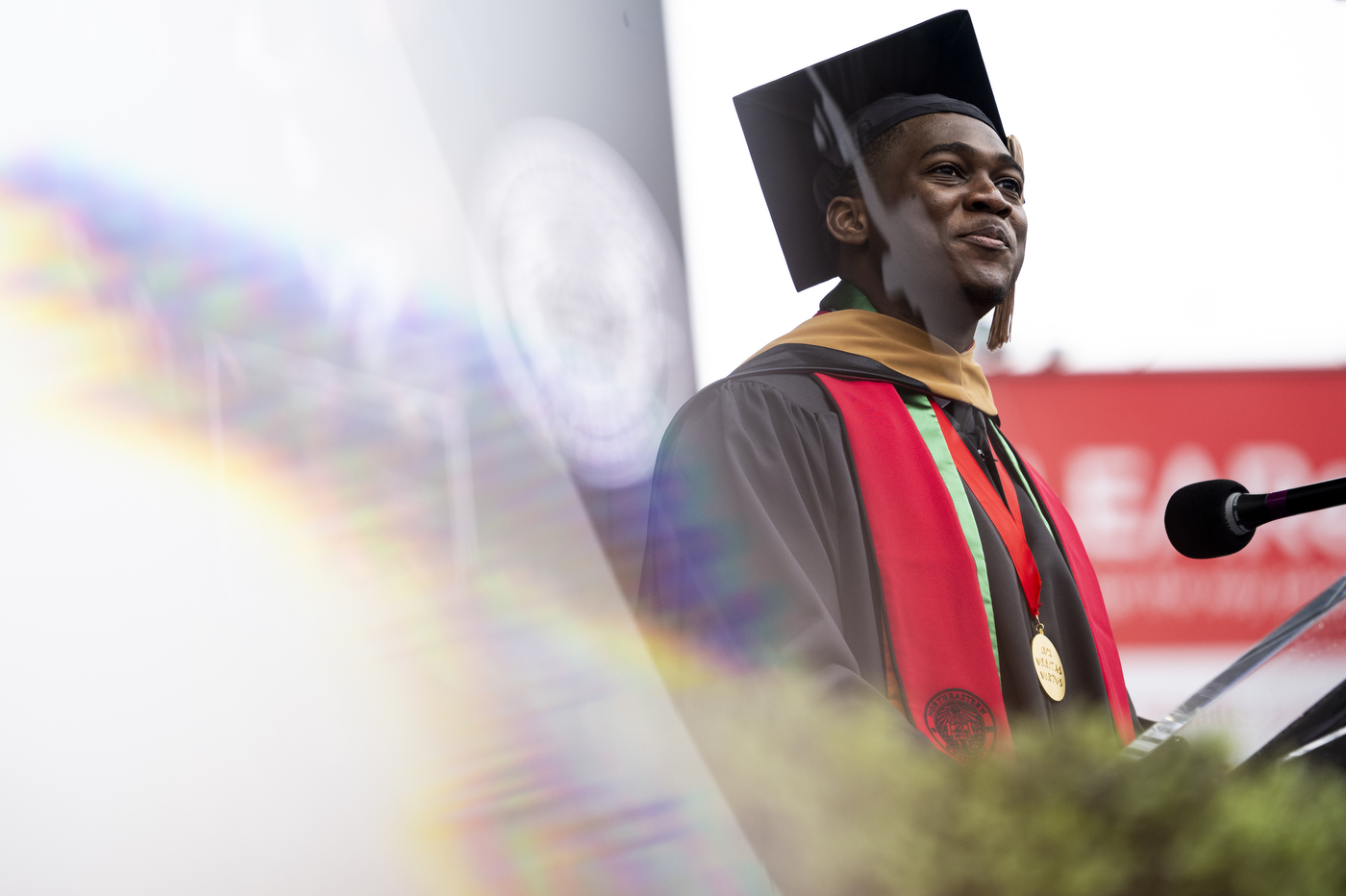
“Every person on this field today arrived here carrying something,” she said. “A culture. A hometown nobody at this university had ever heard of. A question no one else in the room was asking. A language you had to translate yourself into. … Northeastern didn’t ask us to leave those things at the door. It asked us to bring them in. … As we walk out of Fenway today, I hope we remember this: Whoever we were before we got here is not what we leave behind. It’s what we carry forward. … It’s what we build with.”
Abou-Bakar Mohamed Ouattara, a fellow graduate and speaker, similarly came to Northeastern with a unique story. Originally from Abidjan, Ivory Coast, he moved to Massachusetts in high school to attend boarding school, and later attended Northeastern University to pursue a bachelor’s degree in accounting and finance.
Given his experience before going to college, Ouattara thought he knew how to adapt.
“But Northeastern has a way of challenging you,” he said in his address. “Because here, change is not a one-time event. It is constant. And it is intentional.”
Editor’s Picks


After finishing his undergraduate degree, Ouattara received a job offer from an investment bank he said he was “very interested” in, but he decided to stay at Northeastern and pursue his master’s degree in accounting.
“I stayed because I knew Northeastern still had more to give, and honestly, I still had more to become,” he added.
Ouattara said grad school “humbled” him in new ways, but he survived through support from his friends and D’Amore-McKim School of Business faculty members, particularly professors Tim Rupert and Peggy O’Kelly.
He also had the chance to work as a peer mentor, guiding first-year students from D’Amore-McKim.
“It reminded me … growth is rarely something we go through alone,” he said. “Watching those students gain confidence, find their communities and ultimately succeed showed me that the true way of expressing gratefulness for the support we’ve all received is to pay it forward.”
Ouattara is going on to work in wealth management for EY (formerly known as Ernst and Young) while continuing to work on the nonprofit he founded, Heart Brothers, which raises funds to support the education of orphaned children in the Ivory Coast.
“Every child deserves a chance to stand where we are today,” he told fellow graduates, who erupted in applause.
“If there’s one thing this journey has taught me above all else, it is that success is not just about where we end up,” Ouattara added. “It is about who we become along the way and who we bring with us.”
Graduate speaker Menahi Shayan also came to Northeastern with an impressive resumé. By the time he came to Boston in 2024, he had cofounded a software service venture, served as a founding engineer for alert management platform Zenduty and spoke at international developer conferences around the globe.
His success, he told the audience, was due to resilience. When Shayan was 13, he came home from school to find out his family had to leave his home country of the United Arab Emirates. Within five days, he was relocating to India, his entire life packed in a single suitcase.
This process of starting over continued. At 18, Shayan built his first company, which failed, followed by a second entrepreneurial endeavor that was wiped out by the pandemic. He rebuilt this company, which turned into Zenduty, and which he later sold for millions of dollars.
“Change is inevitable, but the resilience to adapt is what keeps us on top,” said the master’s graduate who earned a degree in engineering management. “The strongest results are reaped not from doing the same thing until it works, but from the courage to differ each time, until something does.”
He rebuilt again when he came to the United States to pursue his master’s degree at Northeastern. But he said it was resilience and courage that allowed him to excel in this new experience. He joined NURover (Northeastern’s Mars Rover team), NUTV and completed a co-op at T-Mobile working on artificial intelligence.
In between, there were all-nighters at Snell Library, navigating a fickle subway system and other everyday challenges that all students manage to overcome — together.
“We were each other’s heroes throughout,” he continued. “At every moment, we chose to keep going when the easier path was to stop. It’s our shared dragons that give us our sense of belonging. Between the Beanpot’s roar of twenty thousand Huskies, we’ve all felt it: I belong here.”
Shayan’s parting words of advice to graduates: “Hold onto that feeling. It’s yours. No one, no one can take it.”


