Viktor Orbán’s defeat ‘a defining moment’ in Europe. What comes next?
Orbán acknowledged Sunday evening that he was too far behind to stage a comeback against Tisza party challenger Péter Magyar, who will take over as Hungary’s prime minister.


Sunday’s defeat of Viktor Orbán, a populist far-right leader and Hungary’s longest-serving prime minister, signals a monumental shift in Europe’s political landscape that could bolster the European Union’s unity and steel its resolve in the face of Russian influence in the region, Northeastern University experts say.
Results Sunday showed a decisive lead for the opposition Tisza party and its candidate Péter Magyar. Turnout surpassed 77%, the highest since the end of communism in 1989, according to Hungary’s National Election Office, underscoring the election’s unusually high stakes, analysts said.
Orbán acknowledged Sunday evening that he was too far behind to stage a comeback, stating that the election results are “painful for us, but clear.” Magyar said in a social media post that Orbán personally called him to congratulate him on the victory.
“The responsibility and possibility of governing was not given to us,” Orbán said in a televised address to supporters. “I have congratulated the winner.”
A former government insider turned critic of Orbán, Magyar emerged in 2024 as a key challenger in this year’s electoral contest. The 45-year-old centered his campaign on rooting out entrenched corruption and dismantling the systems of control and enrichment built under Orbán.
In his celebratory address, the prime minister-elect described his win as being “not a victory of one party over another, but a victory for all Hungarians — those who voted for Tisza and those who did not.”
Northeastern Global News, in your inbox.
Sign up for NGN’s daily newsletter for news, discovery and analysis from around the world.

Magyar expressed his wish for a country where citizens can count on their government for good healthcare and education, where “nobody is labeled for thinking differently than the majority.” He spoke in favor of equality and in support of everyone regardless of who they love or what they believe. He also called for ministers of Orbán’s government to step down and promised a strong justice system.
“Those who betrayed the country will be held accountable,” Magyar said.

Orban’s defeat marks the end of 16 years in power for a leader who has cultivated strong ties with U.S. President Donald Trump and Russian President Vladimir Putin, while antagonizing EU partners with his challenges to the bloc’s shared principles and foreign policy. It comes at a time when populist right-wing parties have in recent years been gaining influence across Europe, from victories in Italy and the Netherlands, to mounting pressure on mainstream parties in France and Germany.
Josephine Harmon, an assistant professor of political science at Northeastern University in London, attributed Orbán’s loss to a variety of factors, including long-standing allegations that he consolidated power through corruption with the help of a network of business and political allies. His method of operation prompted some Hungary-watchers to dub the period of his rule a kleptocracy, or a form of government in which those in power exploit public resources for personal enrichment.
Harmon also pointed to rising discontent among Gen Z voters, many of whom were dissatisfied with the country’s political direction.
Editor’s Picks


“We’ve seen Gen Z protests across the region and indeed the world,” Harmon told Northeastern Global News. “To them, the nationalist right who claimed to challenge the European establishment have become the establishment. I think that is a big part of what’s going on here.”
Since taking power in 2010, Orbán has overseen a government described by political analysts as “state capture,” a system whereby political allies and family members benefited from public contracts and EU funds while key institutions — such as the media — were brought under government control, according to Civil Rights Defenders, a Swedish nonprofit that monitors human rights and democracy worldwide.
His electoral coalition — including the Fidesz party, or the Hungarian Civic Alliance, which serves as his platform — is largely comprised of right-wing populists and Christian nationalists.
Sunday’s result could also reverberate far beyond Hungary’s borders, particularly in Europe’s response to the war in Ukraine, experts said. For years, Orbán stood out among EU leaders for his opposition to military aid for Ukraine in its struggles against Russian aggression, and his willingness to maintain political ties with Putin, complicating Europe’s efforts to present a unified front.
“His being out of power may augur a shift towards greater consensus in the EU in support of Ukraine,” Harmon said.
Still, it remains to be seen whether Hungary will succeed in casting off the spectre of strongman-style rule that has defined it for years.
“Hungary has been the most typical case of this idea of ‘competitive authoritarianism,’” said Colin Brown, an associate teaching professor of political science at Northeastern. The notion refers to a system in which democratic institutions formally exist, but are systematically exploited in order to keep incumbents in power.
Brown suggested that Orbán’s loss could be less to do with ideological preferences and more with a general mood of “anti-incumbency,” where voters across Europe and elsewhere seem to tire of those in power, regardless of who they are. Anti-incumbency is in part a result of what Brown described as “a loss of trust in institutions” writ large, a sentiment that touches on virtually every aspect of society, from politics to education, and even the media and public health institutions.
“That often benefits populists, but not always,” he said, adding that in Orbán’s case, he has suffered from it.
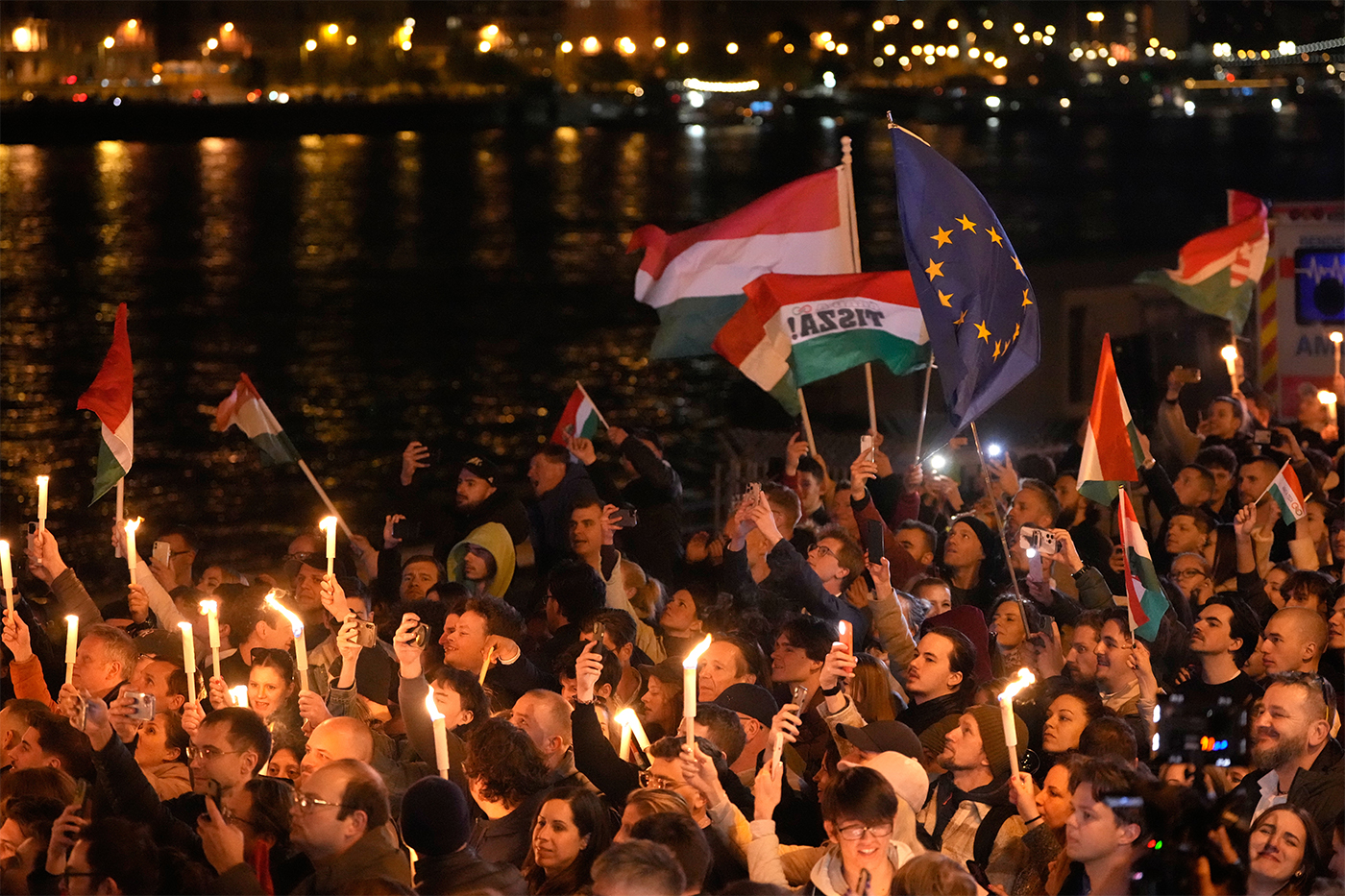
In addition, experts say Orbán’s longtime effort to cast the European Union as an external threat may have lost some of its political potency at a moment of shared concern over the threat that Russia poses to mainland Europe.
While skepticism toward Brussels remains a feature of Hungarian politics, public attitudes toward the EU have grown more mixed, particularly among younger voters and those with ties to other member states, according to some Hungary experts.
“There are people who want European integration,” Brown said. “Many Hungarians have moved to other EU countries, and they’re often the most opposed to the regime. So using the EU as a boogeyman doesn’t work if people start to like it more.”
On paper, prime minister-elect Magyar, described as center-right, may not represent a distinct or decisive ideological break from Orbán, but has pledged sweeping changes to Hungary’s political system, including anti-corruption reforms, restoring judicial independence and reducing political control over the media.
Pablo Calderon Martinez, an associate professor of politics and international relations, described Sunday’s election as a “personality test” between two candidates who are ideologically closer to each other than farther apart.
In the final days of the campaign, U.S. Vice President JD Vance flew to Hungary in a bid to boost support for Orbán. The visit highlighted the growing alignment between Orbán’s government and a faction of U.S. conservative politics, while drawing scrutiny from some leaders, including Ukrainian President Volodymyr Zelensky, who called the visit “not helpful.”