From the Atomic Era to AI, JFK’s message at Northeastern resonates 70 years later
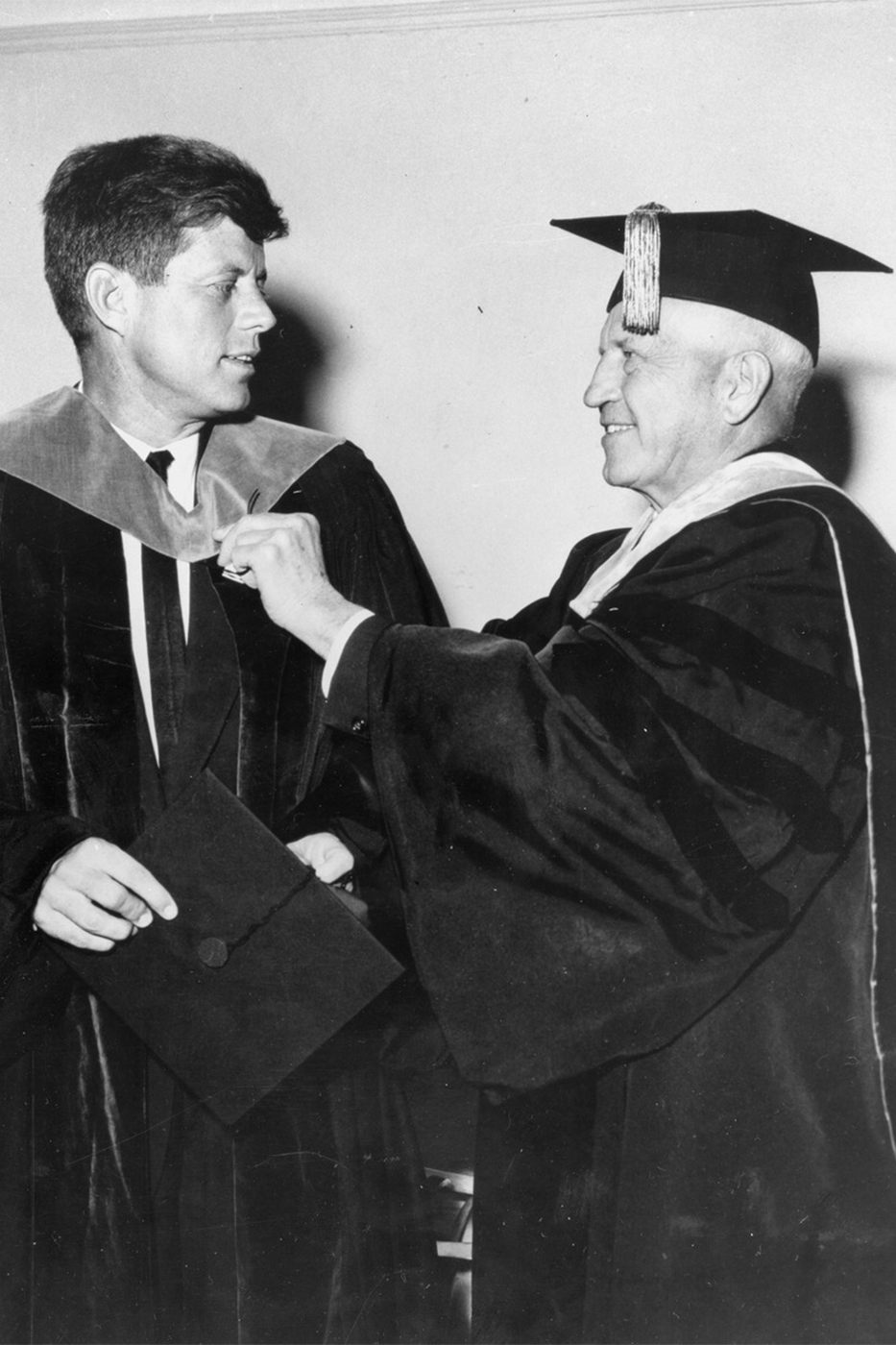
On June 17, 1956, then-U.S. Sen. and future President John F. Kennedy spoke at Northeastern University’s commencement, heralding the atomic age and a transformation of new industries and processes.


On June 17, 1956, then-U.S. Sen. and future President John F. Kennedy spoke at Northeastern University’s commencement, heralding the atomic age and its transformation of industry and society.
“We stand at the threshold of the atomic age,” Kennedy said to the graduating class of 1956 in Boston Garden.
Soon the world would see sweeping changes — from the expansion of nuclear energy and the acceleration of the space race, to the rise of automation that served as the engine of postwar economic growth.
Seventy years later, the age of artificial intelligence is at hand. The world is in the midst of another seismic technological shift, as AI begins to transform how people work, learn, create and solve problems.
“You are going to shape the future of this society, and you are also going to shape AI,” Northeastern President Joseph E. Aoun told the incoming first-year students at the start of the 2026 academic year, referring to the class as members of the “first AI generation.”
Kennedy was one in a long line of historic commencement speakers to grace the podium on graduation day with a parting message for the next generation. Kennedy would go on to serve as the 35th president of the United States in short order, winning the 1960 presidential election against then-Vice President Richard Nixon.
Kennedy’s “It’s Your America Now” speech at Northeastern preceded such events as the Cold War arms race, which would come to a head by the early 1960s with the Cuban Missile Crisis; the expansion of nuclear power through civilian energy programs and weapons development; and the dawn of the space age that would officially break new technological and scientific ground the following year with the Soviet Union’s launch Sputnik 1, the world’s first artificial satellite.
With so many global challenges on the horizon then, contemporary readers of Kennedy’s commencement address might find his advice to the 1956 class somewhat counterintuitive: he urged them to “stay home,” put down roots in Massachusetts and channel their talents to revive local industry. Doing so was meant, in part, to combat fears of New England’s economic decline amid a shift of manufacturing and industry to the South and West, Kennedy noted.
“He’s starting to put together that language that would inspire a generation to go out into the Peace Corps, to serve in the civil rights movement, to get involved in the space program,” said Ted Miller, a teaching professor of history at Northeastern University. “But he’s telling people not to reach for the stars, but rather to stay home and get Massachusetts moving again.”
While perhaps fitting for the day, the sentiment doesn’t fit with the university’s global focus and subsequent worldwide campus expansion. Now, Aoun frequently tells graduates to make the world their classroom.
Today, Northeastern has radically transformed itself into a hub of global innovation, research and real-world problem-solving. It has 13 campuses positioned all across the globe, with students on co-op in more than 100 countries, as part of its global network.
Much as it was still unclear “what the atom was capable of” by the middle of the 20th century, so too is there a mix of excitement and unease today about what artificial intelligence and emerging technologies will ultimately mean for society and the future, Miller said.
That trepidation is set against the backdrop of renewed geopolitical tensions and active conflicts, from an entrenched ground war in Europe and the rise of China, to an unfolding cycle of conflict and proxy skirmishes across the Middle East involving Israel, Iran, Lebanon and the United States — echoes from a Kennedy-era period of great power competition between the U.S. and the Soviet Union.
Editor’s Picks


But there are also notes of optimism paralleling that bygone era of accelerated technological progress, with the National Aeronautics and Space Administration’s recent success in sending a crewed space capsule to the moon and back; growing public-private collaboration in space; and plans to establish a sustained human presence on the moon, and eventually send astronauts to Mars.
These frontier-pushing challenges, and the opportunities for scientific and technological breakthroughs they create, help define the role of higher education institutions such as Northeastern University, Miller said.
The university’s growth is in part an effort to chart a way forward in a higher education landscape beset with challenges, from declining college enrollment and shifting workforce demands to the disruptive impact of artificial intelligence, Aoun said in a recent interview with Northeastern Global News.
The global network provides students and faculty with access to a range of international campuses, co-op placements and research partnerships that allow for “enhanced mobility for undergraduates; industry-aligned lifelong learning opportunities; and unparalleled opportunities for faculty to globalize their teaching and research,” Aoun said.
There are clear indications that Kennedy knew exactly what kind of audience he was speaking to in Northeastern graduates, Miller said. If there are any hallmarks of a Northeastern commencement speech, it’s the recognition that graduates are readily able to translate their education into real-world impact.
“Most Northeastern graduates, I believe, know what they are going to do — and when I look over the career achievements of past Northeastern graduates, or meet them in Washington, Boston, and all over the state, I am doubly proud to be even an honorary member of that distinguished group,” said Kennedy, who received an honorary Doctor of Laws during the ceremony.