Northeastern University marketing professor Koen Pauwels was the recipient of the 62nd annual Robert D. Klein University Lecturer Award
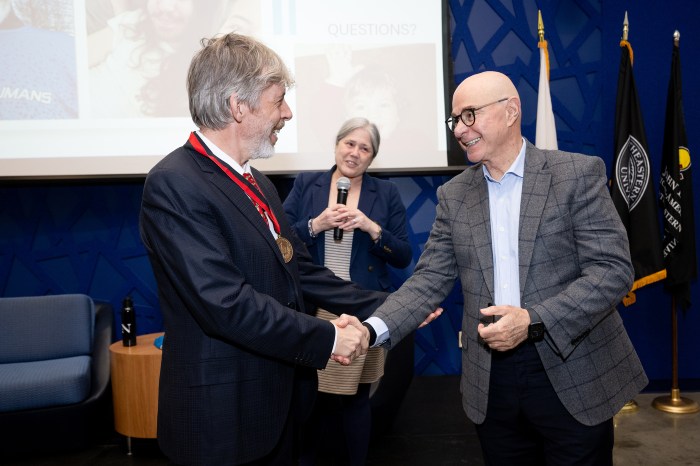
Koen Pauwels, distinguished professor of marketing, received a medal from President Joseph E. Aoun after delivering the Robert D. Klein Lecture. Photo by Alyssa Stone/Northeastern University
From completing mundane tasks to making recommendations, artificial intelligence has enabled machines to touch many aspects of our daily lives.
But Northeastern University marketing professor Koen Pauwels said that one thing AI can’t touch is your humanity, and in an increasingly technology-dominated world, your humanity is your most valuable asset.
“AI has gotten better, there is absolutely no doubt about it,” said Pauwels, associate dean of research and distinguished professor of marketing at Northeastern. But “as AI is getting better, it helps us focus on what is genuinely human and what we can contribute in the future.”
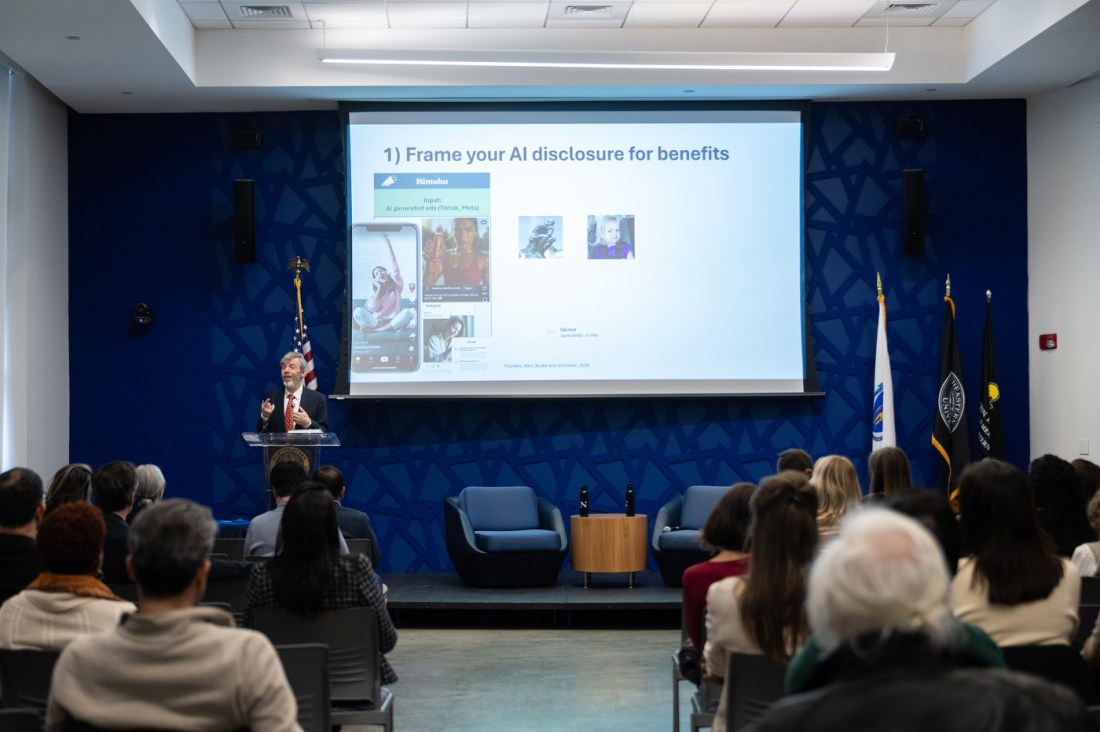
Pauwels was the recipient of the 62nd annual Robert D. Klein University Lecturer Award, an honor established in 1964 that highlights a faculty member who has contributed with distinction to their field of study. On Tuesday afternoon at the Cabral Center in the John D. O’Bryant African-American Institute on Northeastern’s Boston campus, Pauwels delivered his lecture, “The AI Authenticity Paradox: Why Machines are Making Us More Human,” on his research and scholarship on the use of AI in marketing.
“I’m grateful for the opportunity to celebrate cutting-edge, translational research with you today,” said Beth Winkelstein, provost and senior vice president for academic affairs at Northeastern, in introducing Pauwels. “It’s so wonderful to come together and to reflect on the important and timely topic of AI.”
Pauwels began the lecture, appropriately, with an advertisement that demonstrated the promise — and limitations — of AI.
In the ad, from the AI company Anthropic for its product Claude, a muscular young man representing a chatbot answers a scrawny man’s question, “How to develop a six-pack?” in quite technical and robotic language.
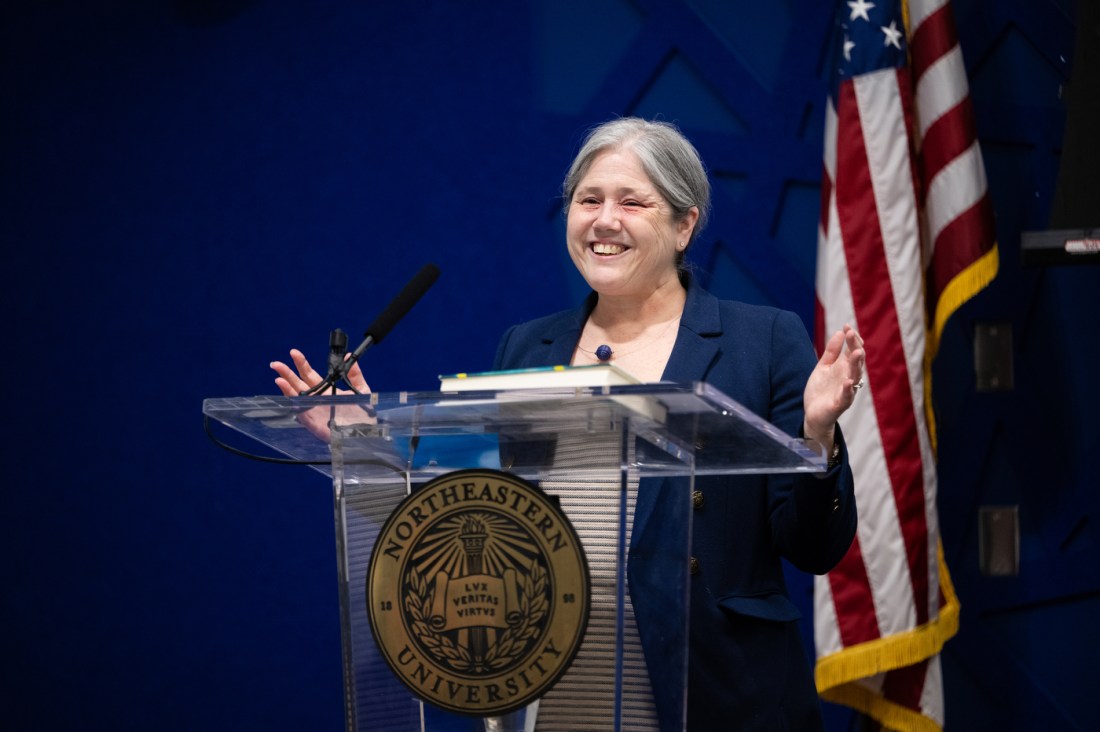
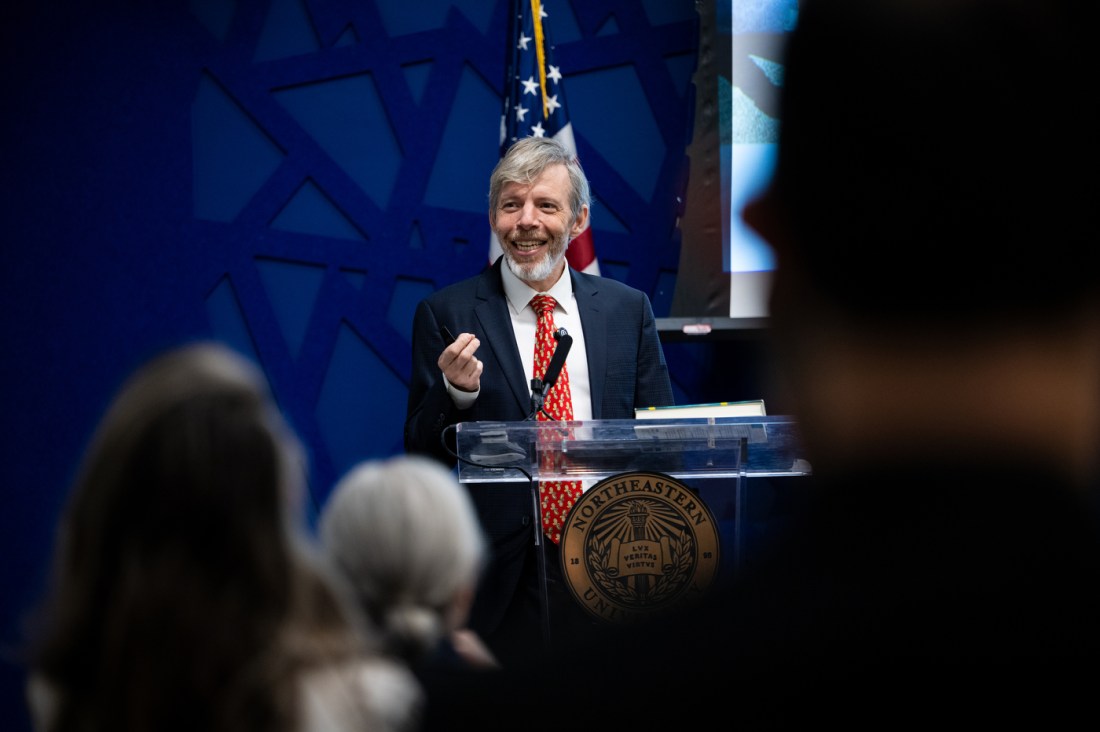
03/24/26 – BOSTON, MA. – Koen Pauwels, Associate Dean of Research and Distinguished Professor of Marketing at the D’Amore-McKim School of Business, delivers the 62nd Annual Robert D. Klein Lecture on The AI Authenticity Paradox: Why Machines Are Making Us More Human at the John D. O’Bryant Center on Tuesday, March 24, 2026. Following the lecture Pauwels receives a medal from Northeastern President Joseph E. Aoun and participates in a Q&A with Rashmi Dyal-Chand and members of the audience. Photo by Alyssa Stone/Northeastern University03/24/26 – BOSTON, MA. – Koen Pauwels, Associate Dean of Research and Distinguished Professor of Marketing at the D’Amore-McKim School of Business, delivers the 62nd Annual Robert D. Klein Lecture on The AI Authenticity Paradox: Why Machines Are Making Us More Human at the John D. O’Bryant Center on Tuesday, March 24, 2026. Following the lecture Pauwels receives a medal from Northeastern President Joseph E. Aoun and participates in a Q&A with Rashmi Dyal-Chand and members of the audience. Photo by Alyssa Stone/Northeastern University03/24/26 – BOSTON, MA. – Koen Pauwels, Associate Dean of Research and Distinguished Professor of Marketing at the D’Amore-McKim School of Business, delivers the 62nd Annual Robert D. Klein Lecture on The AI Authenticity Paradox: Why Machines Are Making Us More Human at the John D. O’Bryant Center on Tuesday, March 24, 2026. Following the lecture Pauwels receives a medal from Northeastern President Joseph E. Aoun and participates in a Q&A with Rashmi Dyal-Chand and members of the audience. Photo by Alyssa Stone/Northeastern University03/24/26 – BOSTON, MA. – Koen Pauwels, Associate Dean of Research and Distinguished Professor of Marketing at the D’Amore-McKim School of Business, delivers the 62nd Annual Robert D. Klein Lecture on The AI Authenticity Paradox: Why Machines Are Making Us More Human at the John D. O’Bryant Center on Tuesday, March 24, 2026. Following the lecture Pauwels receives a medal from Northeastern President Joseph E. Aoun and participates in a Q&A with Rashmi Dyal-Chand and members of the audience. Photo by Alyssa Stone/Northeastern University03/24/26 – BOSTON, MA. – Koen Pauwels, Associate Dean of Research and Distinguished Professor of Marketing at the D’Amore-McKim School of Business, delivers the 62nd Annual Robert D. Klein Lecture on The AI Authenticity Paradox: Why Machines Are Making Us More Human at the John D. O’Bryant Center on Tuesday, March 24, 2026. Following the lecture Pauwels receives a medal from Northeastern President Joseph E. Aoun and participates in a Q&A with Rashmi Dyal-Chand and members of the audience. Photo by Alyssa Stone/Northeastern UniversityThe Robert D. Klein University Lecture is given each year by a faculty member who has contributed with distinction to their field of study. Photos by Alyssa Stone/Northeastern University
The chatbot’s answer was “personalized, as was promised,” Pauwels said. “But it was also a bit creepy.”
Pauwels cited an incident in which the department store Target allegedly used AI to analyze customer purchases in order to send targeted (true to its name!) advertisements for pregnancy products … and outed a teen’s pregnancy.
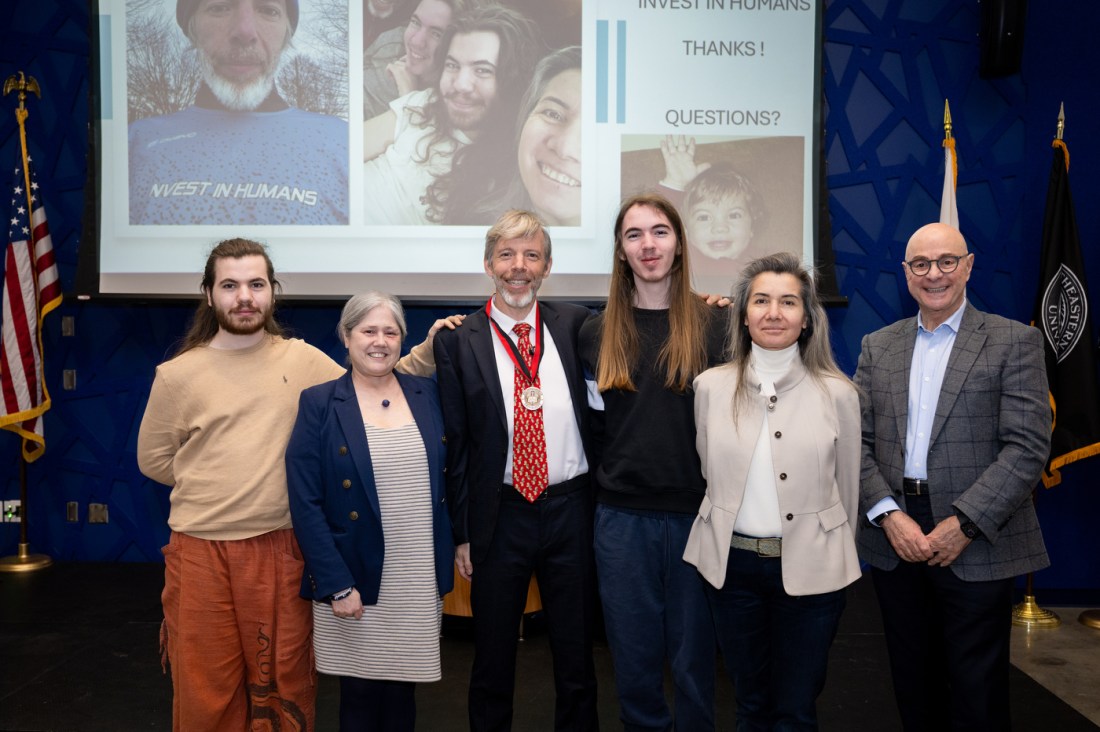
03/24/26 – BOSTON, MA. – Koen Pauwels, Associate Dean of Research and Distinguished Professor of Marketing at the D’Amore-McKim School of Business, delivers the 62nd Annual Robert D. Klein Lecture on The AI Authenticity Paradox: Why Machines Are Making Us More Human at the John D. O’Bryant Center on Tuesday, March 24, 2026. Following the lecture Pauwels receives a medal from Northeastern President Joseph E. Aoun and participates in a Q&A with Rashmi Dyal-Chand and members of the audience. Photo by Alyssa Stone/Northeastern University03/24/26 – BOSTON, MA. – Koen Pauwels, Associate Dean of Research and Distinguished Professor of Marketing at the D’Amore-McKim School of Business, delivers the 62nd Annual Robert D. Klein Lecture on The AI Authenticity Paradox: Why Machines Are Making Us More Human at the John D. O’Bryant Center on Tuesday, March 24, 2026. Following the lecture Pauwels receives a medal from Northeastern President Joseph E. Aoun and participates in a Q&A with Rashmi Dyal-Chand and members of the audience. Photo by Alyssa Stone/Northeastern UniversityPauwels was joined by university leaders and his family at the event. Photos by Alyssa Stone/Northeastern University
Meanwhile, at least in the United States, AI is graduating from the “hype stage” on the Gartner Hype Cycle where everyone tries to get in on the hottest new technology, to the “disillusionment stage” as we learn about AI’s limitations.
So, how do you counter these challenges? You double down, said Pauwels.
“Four studies, in two continents, and in every case, getting better at using AI actually helps you to sell, invest,” Pauwels said after summarizing studies analyzing AI research focused on consumers, marketing and worker behavior.
Ultimately, AI can provide us with information and answers, Pauwels said, but it can’t provide us with judgment, and judgment reflects your humanity and lived experience.
“AI is getting better, and that’s exactly why being genuinely you is becoming more, not less, valuable,” Pauwels said. “It’s up to you to choose to do with that what you want.”
Pauwels concluded the talk with his choice — citing his “personal slogan: invest in humans.”
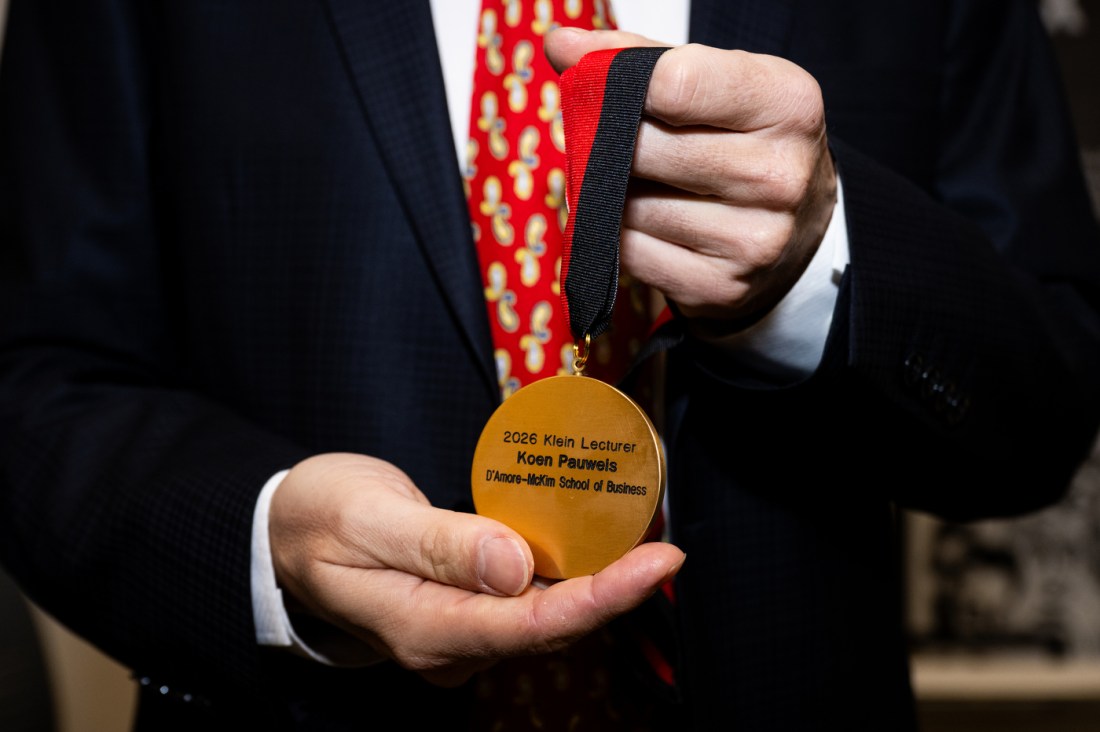
It’s a point that at least one person in the audience seems to have taken to heart. Certain things can’t be replaced by AI, Northeastern’s President Joseph E. Aoun emphasized when presenting the Klein award, a bronze-colored medallion engraved with the university’s seal, to Pauwels following the lecture.
“It’s not a virtual medal,” Aoun joked. “AI cannot give you that.”