What an abandoned monkey and his IKEA orangutan tell us about primates – of the sapiens species
Footage of Punch dragging around a stuffed orangutan for emotional support after he was abandoned by his mother went viral.
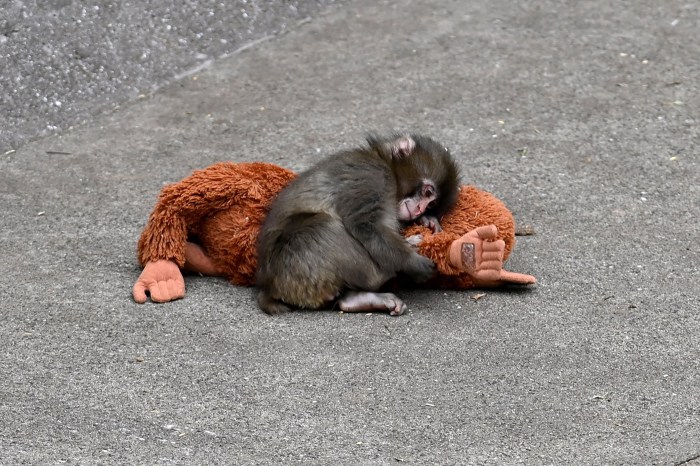

Punch the Monkey has gone viral, capturing the hearts of millions while dragging around a stuffed orangutan for emotional support after being rejected by his mother and troop.
Animal experts at Northeastern University said that the story is a look into primate behavior – but not just the behavior of monkeys.
“It tells us more about our species than Punch himself,” said Rébecca Kleinberger, assistant professor and director of Northeastern’s INTERACT Animal Lab, which uses technology to improve animals’ lives and described Punch’s orangutan as “classic enrichment” for a behavior in social species or managed care..
Kleinberger said the way humans are interpreting Punch’s predicament is very biased and based on snippets of videos, not necessarily a complete picture of what is happening to the monkey.
“Maybe the world needs those kinds of stories right now,” she said.
Mark Wells, assistant teaching professor of philosophy at Northeastern, concurred.
“It was a standard social media story of people getting way out of their depth into a thing they just do not understand, then having very strong hot takes on something they don’t understand, which is the care for animals – and highly complex animals – like Punch,” said Wells, who researches animal ethics. “The frenzy kind of caught me off guard in that sense.”
Footage of Punch recently went viral showing the 7-month-old macaque at the Ishikawa City Zoo in Japan dragging around a stuffed IKEA orangutan for emotional support after he was abandoned by his mother and rejected by the rest of his troop.
IKEA, for instance, could hardly keep Punch’s stuffed orangutan on the shelves, people flocked to the zoo, and the internet rallied behind the hashtag #HangInTherePunch.
But accusations that Punch is “being bullied” (which on Tuesday, the zoo had to publicly deny) or is being subject to “trauma,” (according to People for the Ethical Treatment of Animals) is a judgment best left to the baby monkey’s keepers, not the internet, experts said.
“The social dynamic in social species is very complex,” Kleinberger said. “People working every day with this species and this troop are the most knowledgeable about managing those types of situations.”


Both Kleinberger and Wells, however, noted that many species of animals regularly abandon their offspring and more offspring are regularly left orphaned.
“The reaction to it, I think, is radically disproportionate to how commonplace this sort of thing is,” Wells said.
It is also commonplace, both experts noted, for keepers to use “enrichment.”
Kleinberger said enrichment can include anything from actions – for example, scattering food to encourage foraging – to objects like stuffed toys to encourage certain behaviors, animal costumes to reduce the effects of humans raising animals, and more.
“What matters is for animals to have naturalistic behavior as a consequence of enrichment,” Kleinberger said. “In my lab, we always think about how the enrichment extends their world and gives them agency. They don’t have much control over their lives, so we give them systems that give them more control.”
Editor’s Picks


For example, Kleinberger has used tablets and smartphones to encourage parrots to make video calls and form friendships and developed sonic swings, adaptive puzzles and musical interfaces for zoo animals including bears, monkeys, foxes and parrots.
Regardless of how common Punch’s predicament may be, the little macaque has surely touched a nerve among Homo sapiens.
Kleinberger noted that the macaque’s actions are “reminiscent” of the way human children react to an object, and Wells noted anybody who’s been the new kid in school can probably sympathize with the young monkey.
Wells also said “charismatic” animals – “animals that are cute or animals that are spectacular or animals that just resonate with whatever our aesthetic sensibilities are,” as he described it – also get more attention and money than, say, a lamprey, which sucks the blood of its victims.
But anthropomorphizing, or assigning human values to Punch, would be a mistake.
“We try to say, ‘OK, well, if I were in Punch’s shoes, what would I like?’” Wells said. “But that’s a terrible way to go about it because you’re not a monkey.”
Moreover, “flash-in-the-pan” social media stardom does not mean that the internet’s attention to Punch will be sustained, Wells said.
“Long-term engagement is what these kinds of things really need because the care of an animal is in the span of years or decades, or I guess in tortoises, centuries,” Wells said.
Sustainability is also key to enrichment, Kleinberger added, and Punch’s needs will likely change.
“Enrichment should be thought of over the long term,” said Kleinberger. “As animals grow and their social environment changes, enrichment strategies also need to evolve.”


