Northeastern professors, students explore creative writing in the age of AI
The debate about artistic agency in the age of AI is playing out at Northeastern’s Oakland campus, where English professors are designing curricula to give creative writing students a taste of an AI-driven future.

There are those who worry that AI chatbots and text-generation tools, such as ChatGPT, may come to usurp the role of the artist through its imitations of creative human labor. Others espouse harnessing the technology in new and helpful ways, thinking about AI as yet another tool in the artist’s vast arsenal.
The debate about artistic agency in the age of AI is playing out in earnest at Northeastern University’s Oakland campus, where a pair of English professors are designing curricula to explore some of the thorny questions surrounding the new tech, while giving students interested in creative writing a taste of an AI-driven future.
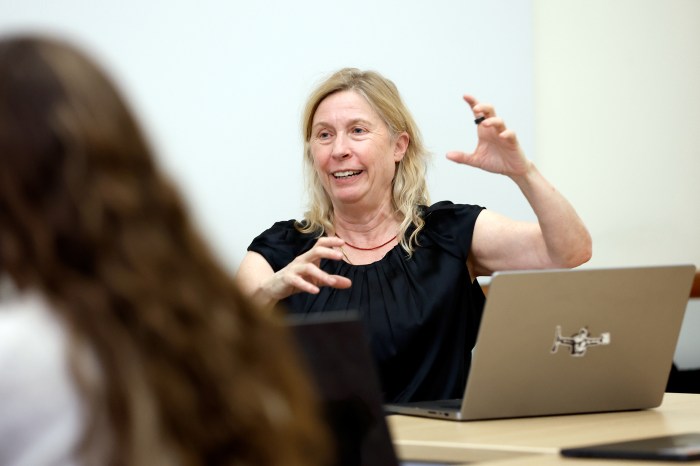
“The idea was to start thinking about what AI can do and what it can’t do,” said Juliana Spahr, a Northeastern University English professor who is teaching Writing Creatively in the Age of Artificial Intelligence this semester. “But there’s also a misunderstanding of what it can do because it’s such a great mimic.”
The class is ground zero for the exploration of generative AI’s capabilities and limitations, a laboratory intended to get students to exercise both their creative and critical faculties by examining the role of chatbots and prompt engineering in the creation of literary art.
As part of that effort, Saphr looks to explore not just the “computational” aspects of AI, or its ability to recognize patterns and produce variations on patterns, or its ability to act as a proofreader, but also its “expressive” aspects, to the extent that they exist.


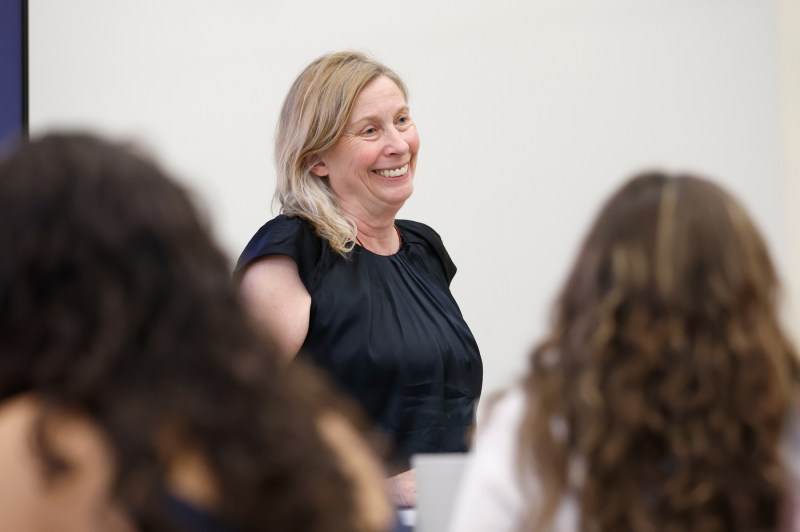
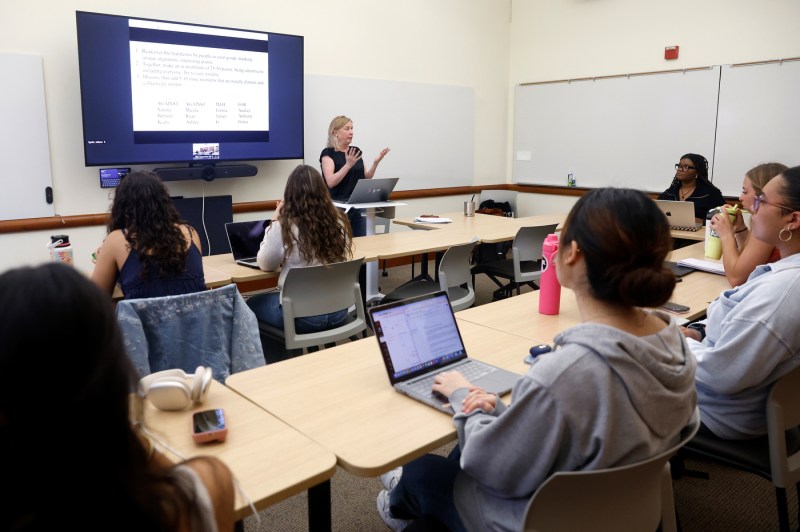
“This is where we are,” she said. “We can’t roll it back. So the question becomes: what do you do with it?”
Answering that requires delving further into the nature of art itself, Spahr said. Does making art too easy diminish its value, or is art necessarily born of difficulty? If meaning in art comes from the decisions an artist makes along the way, does AI strip those choices from the artist, therefore limiting the artist’s sense of agency? At the same time, what, if anything, can AI genuinely contribute to the act of making art?
These questions — and others — are the jumping-off point for the course.
“We know that it can produce endless variations on a sentence,” Spahr said. “It can sort of explain how a Raymond Carver short story is made, though it’s not great at that either. It’ll do a pale imitation of Carver, or Ray Bradbury, or Gertrude Stein. It can get to the surface of things.”
For Stephanie Young, an associate teaching professor of English, who is also the W. M. Keck Foundation Professor of Creative Writing, the stakes of the debate are less about whether AI can replace artists than about how it reshapes the way writers think about their own creative agency.
“I’m AI-optimistic, specifically about writing pedagogy as a useful, critical tool,” said Young, who previously designed and taught her own course about writing creatively in the AI age.
Young’s approach has been to ground the new tech in the avant-garde and experimental traditions. The Oulipo, a French literary movement from the 1960s, for example, built new forms of writing by deliberately restricting how language could be used, sometimes by eliminating entire letters or binding writers to rigid numerical systems. (Oulipo writers suggested that aesthetic freedom lies not in complete disinhibition, but in formal restrictions and constraints.)
Young asks students to interrogate where they feel authorship slipping, where they can identify the signature of their own voice, and how much labor creativity still demands — even when a machine is involved.
“The tools change, but the questions don’t,” Young said. “Constraint, randomness and collaboration have always been part of how writers make meaning. AI just makes those dynamics more visible.”
Editor’s Picks


Young and Spahr also examine copyright lawsuits, the question of consent, and how “voice” — that somewhat murky concept describing a writer’s unique sense of self on the page — is constructed. Of course, they’re both also interested in bias, the ways it’s been built into the tech, and how chatbot voices have been flattened to avoid harm, resulting in a strange, heterogeneous tone, they say.
“After teaching this class three times, you really start to recognize what AI ‘likes,’” Young said.
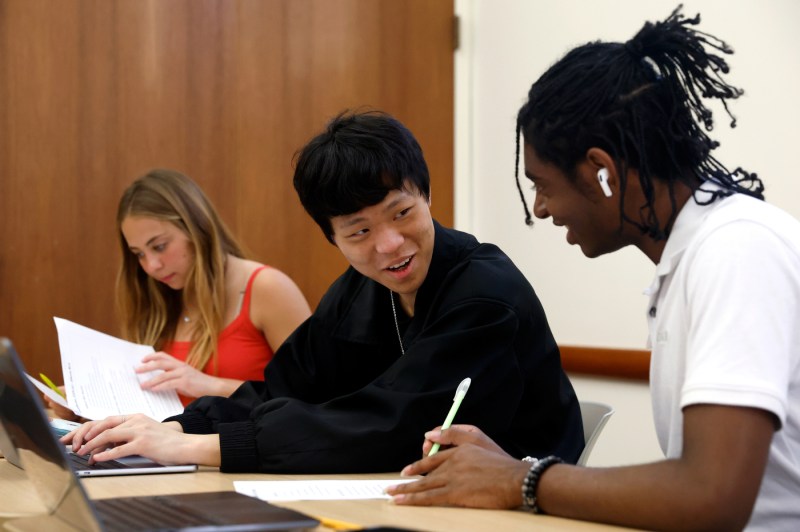
Ryan Huang, a freshman majoring in biology, signed up for Spahr’s class to rekindle his love of horror and science fiction writing, having grown up an admirer of the work of H. P. Lovecraft, known for the creation of the fiction universe of the Cthulhu Mythos.
As someone who studies biology, Huang said he is skeptical about the environmental impact of AI data centers, but thinks that there are use cases for artists of all disciplines.
He said where the tech succeeds is in providing “a more fleshed-out version of your own thinking.”
But he couched that by adding that chatbots shouldn’t be used to make the art itself.
“I like to think of AI more as a tool,” he said. “I think that, if used correctly, it has a lot of positive implications and benefits for society and for artists.”
Tiffany Lee, a second-year business administration major who took Young’s class in 2025, said the course completely changed his perspective on the use of AI.
“I believe that AI can be a problem, but I also think that is far from the truth, as it is such a powerful tool to efficiently write when used correctly,” Lee said.