She restored a 112-year-old Asian American film. Now it’s in the National Film Registry
After years of hiding in plain sight, a restored version of “The Oath of the Sword,” the oldest Asian American film, has been added to the National Film Registry thanks to a Northeastern professor.
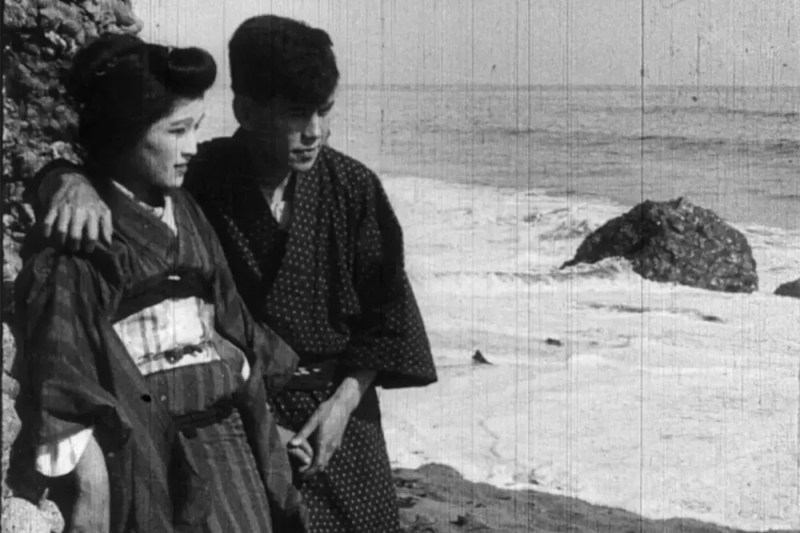

Among the Library of Congress’ recent additions to the National Film Registry, the library’s collection of films deemed worth preserving, are the likes of “Inception,” “The Karate Kid,” “The Grand Budapest Hotel” and “The Incredibles.” But tucked away in that list is a little-known silent film that carries with it a major legacy.
Produced in 1914, “The Oath of the Sword” is the oldest Asian American film on record. Its mere existence reveals a significant gap in cinematic history: The films made by Asian Americans in the silent film era are largely lost to time. And it would have remained hidden if not for Denise Khor.
Khor, a scholar of Asian American cinema, associate professor of Asian American studies and associate director of Asian American studies at Northeastern University, found the 30-minute silent film tucked away in the George Eastman Museum archives. Working with the George Eastman and Japanese American National Museum, Khor brought the film out of the archives and into the spotlight.
“The Oath of the Sword” received a world premiere at the Academy Museum of Motion Pictures in 2023, but its addition to the National Film Registry is another level of recognition, Khor said.
“Most of those films are the kinds of films that have these huge budgets and they have auteur directors at the helm,” Khor said. “To have it be part of the National Film Registry, which is something that acknowledges American film heritage, it just takes my breath away.”
Produced by the Japanese American Film Company, “The Oath of the Sword” tells the tragic story of a Japanese couple, Masao and Hisa. Masao leaves Japan to attend university in the U.S., leaving behind his wife, Hisa, to maintain their home. While Masao becomes a successful college athlete, Hisa struggles alone.
Masao later returns home, only to find that Hisa had a child with an American ship captain who washed ashore. This twist of fate leads to a fight that leaves the captain dead at Masao’s hands and Hisa, overcome with shame, takes her own life.

The film’s inclusion in the National Film Registry is more than just a recognition of the film’s artistic merits. According to the Library of Congress, it’s a recognition of a moment in history when Japanese immigrants were establishing themselves in America and Hollywood.
“Made at a time when Hollywood studios were not yet the dominant storytellers of the American film industry, ‘The Oath of the Sword’ highlights the significance of early independent film productions created by and for Asian American communities,” the Library of Congress wrote in its description of the film.
These kinds of independent ventures, like the Japanese American Film Company that produced this film, were short-lived. Still, they were part of a network of Asian American theaters, filmmakers and studios, Khor explained. Once Hollywood settled into the studio system, in which powerful companies owned distribution and production, smaller companies run by marginalized filmmakers struggled to find a place.
Many of these early films made by Japanese and Japanese Americans have been lost. There were many copies, or prints, made of major Hollywood films. But films like “The Oath of the Sword” made on a shoestring budget typically only had one or at most two prints.
Editor’s Picks




The founding curator of the George Eastman Museum, James Card, acquired the only existing print of the film in 1963.
“It’s quite a miracle, actually, that it survived considering in general how films were dispersed,” said Peter Bagrov, senior curator of the museum’s moving image department. “We have this one print that is more or less complete –– little pieces are missing –– and I’m not sure if there were any other prints.”
The museum created a safety print during an initial preservation effort in 1980, but the film then sat in its temperature-controlled vault for decades. Khor, who was on the hunt for early Japanese American films as part of her research, eventually tracked it down. She brought the Japanese American National Museum onboard and, with a grant from the National Film Preservation Foundation, helped restore the film to a version that is shockingly close to the original, Khor said.
It is not lost on Khor that the National Film Registry’s recognition of “The Oath of the Sword” comes at a time when Asian Americans have never been more visible in Hollywood. Netflix’s animated “Kpop Demon Hunters” is on its way to win an Academy Award. “Everything Everywhere All at Once,” a sci-fi movie based on inter-generational relationships between Chinese immigrants and their children, won the Oscar for Best Picture in 2023.
“It is just this really extraordinary moment,” Khor said. “As we look ahead … and we look at the present moment and what’s in store for the future, the past is hopefully something that can reanimate us.”


